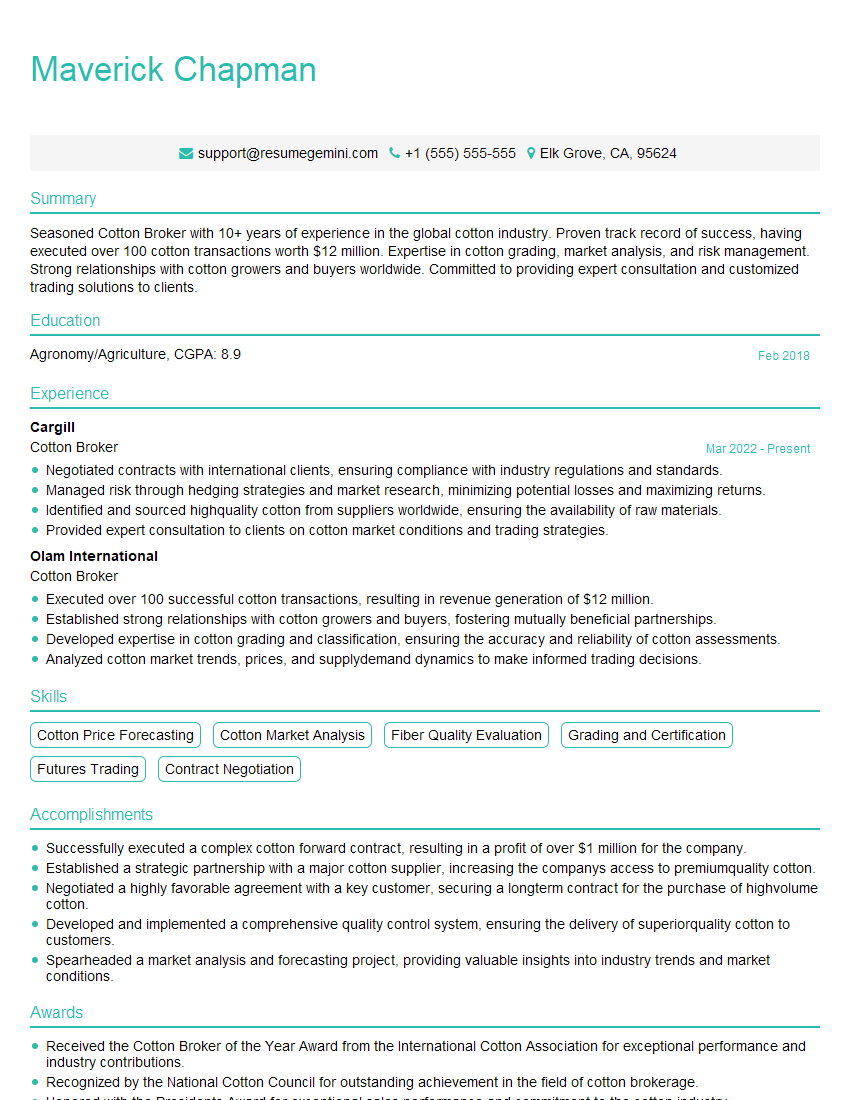
Are you gearing up for a career in Cotton Broker? Feeling nervous about the interview questions that might come your way? Don’t worry, you’re in the right place. In this blog post, we’ll dive deep into the most common interview questions for Cotton Broker and provide you with expert-backed answers. We’ll also explore the key responsibilities of this role so you can tailor your responses to showcase your perfect fit.
Acing the interview is crucial, but landing one requires a compelling resume that gets you noticed. Crafting a professional document that highlights your skills and experience is the first step toward interview success. ResumeGemini can help you build a standout resume that gets you called in for that dream job.






Essential Interview Questions For Cotton Broker
1. Describe the key components of a cotton bale and how they affect its value?
- Grade: Grade refers to the quality of cotton fibers, it affects the overall value of the bale.
- Staple length: Staple length refers to the average length of cotton fibers in a bale which impacts the spinning quality and value.
- Micronaire: Micronaire measures the fineness and maturity of cotton fibers, affecting the softness and strength of the yarn.
- Color: Color refers to the natural shade of the cotton, it impacts the quality and value of the bale.
- Moisture content: Moisture content refers to the amount of moisture in the bale which is essential for maintaining fiber quality.
- Weight: Weight refers to the total weight of the bale which is important for determining the quantity of cotton
- Packaging: Packaging involves the type of material used to wrap the bale which can influence its protection and value.
2. Explain the different types of cotton contracts and how they are used in the trading process?
Spot contracts
- Spot contracts are agreements to buy or sell cotton for immediate delivery.
- These contracts are typically used for small quantities of cotton and are settled within a few days.
Forward contracts
- Forward contracts are agreements to buy or sell cotton at a specified price at a future date.
- These contracts are used to lock in a price for a future delivery and are commonly used by mills and producers to manage price risk.
Futures contracts
- Futures contracts are standardized contracts to buy or sell cotton on a futures exchange.
- These contracts are traded on a regulated exchange and allow buyers and sellers to hedge against price volatility.
3. Discuss the key factors that influence the demand and supply of cotton in the global market?
- Economic conditions: Economic conditions impact the demand for cotton as it is used in various industries such as textile, apparel, and home furnishing.
- Weather conditions: Weather conditions in major cotton-producing regions can affect the supply and quality of cotton.
- Government policies: Government policies such as subsidies and import tariffs can influence the production and trade of cotton.
- Technological advancements: Advancements in cotton production and processing technologies can impact the efficiency and cost of cotton production.
- Consumer preferences: Changing consumer preferences for different types of cotton and cotton products can influence demand.
- Competition from other fibers: Competition from other natural and synthetic fibers can affect the demand for cotton.
- Global events: Global events such as political instability or pandemics can disrupt the cotton market and impact supply and demand.
4. Explain the process of classifying and grading cotton and its importance in the cotton industry?
- The process of classifying and grading cotton involves evaluating the physical characteristics of cotton fibers to determine their quality.
- It is important because it helps to standardize the cotton and ensure that buyers and sellers are trading on the same basis.
- Classification and grading are done based on factors such as fiber length, strength, color, and cleanliness.
- The classification and grading process helps to determine the value of cotton and ensures fair trading practices.
5. Describe the different methods used for pricing cotton and the factors that influence these prices?
- Spot prices: Spot prices reflect the current market value of cotton for immediate delivery.
- Forward prices: Forward prices are used to determine the price of cotton for future delivery.
- Futures prices: Futures prices are standardized prices for cotton contracts traded on futures exchanges.
- Factors influencing cotton prices include supply and demand, economic conditions, government policies, and global events.
6. Explain the role of technology in the cotton industry and how it has impacted your work as a cotton broker?
- Technology has revolutionized the cotton industry, improving efficiency and accuracy.
- Online trading platforms have made it easier for buyers and sellers to connect and trade.
- Software tools help brokers to manage their portfolios, track market trends, and analyze data.
- Technology has also improved the classification and grading process, ensuring more consistent and reliable results.
7. Describe your experience in managing the risk associated with cotton trading?
- Risk management is a critical aspect of cotton trading, I have taken various measures to manage risk.
- I use hedging strategies to mitigate price fluctuations.
- I diversify my portfolio by trading different types of cotton contracts and with various counterparties.
- I monitor market trends closely and stay informed about factors that can impact cotton prices.
- I have established strong relationships with reliable suppliers and buyers to minimize counterparty risk.
8. Explain your approach to building and maintaining relationships with clients in the cotton industry?
- Building and maintaining relationships is crucial in the cotton industry.
- I make an effort to understand my clients’ needs and provide tailored solutions.
- I am proactive in communicating with clients and keeping them informed about market developments.
- I am reliable and trustworthy, adhering to ethical practices and honoring commitments.
- I participate in industry events and engage in networking to expand my connections.
9. Share an example of a challenging situation you faced as a cotton broker and how you overcame it?
- Once, I faced a situation where a major supplier failed to deliver a large shipment of cotton on time, which could have resulted in significant losses for my client.
- I quickly assessed the situation and explored alternative sources to fulfill the order.
- Through my established network, I was able to secure the required quantity from another supplier at a reasonable price.
- By handling the situation promptly and efficiently, I minimized the impact on my client and maintained their trust.
10. How do you stay updated with the latest trends and developments in the cotton industry?
- I regularly monitor industry publications, reports, and news sources.
- I attend industry conferences and webinars to learn about the latest developments and network with professionals.
- I am actively involved in industry organizations and engage in discussions with experts.
- I conduct my own research and analysis to identify emerging trends and their potential impact on the market.
- By staying informed, I can provide valuable insights to my clients and make well-informed decisions.
Interviewers often ask about specific skills and experiences. With ResumeGemini‘s customizable templates, you can tailor your resume to showcase the skills most relevant to the position, making a powerful first impression. Also check out Resume Template specially tailored for Cotton Broker.
Career Expert Tips:
- Ace those interviews! Prepare effectively by reviewing the Top 50 Most Common Interview Questions on ResumeGemini.
- Navigate your job search with confidence! Explore a wide range of Career Tips on ResumeGemini. Learn about common challenges and recommendations to overcome them.
- Craft the perfect resume! Master the Art of Resume Writing with ResumeGemini’s guide. Showcase your unique qualifications and achievements effectively.
- Great Savings With New Year Deals and Discounts! In 2025, boost your job search and build your dream resume with ResumeGemini’s ATS optimized templates.
Researching the company and tailoring your answers is essential. Once you have a clear understanding of the Cotton Broker‘s requirements, you can use ResumeGemini to adjust your resume to perfectly match the job description.
Key Job Responsibilities
Cotton Brokers play a crucial role in the cotton industry, acting as intermediaries between cotton producers and end-users. Their key responsibilities include:
1. Contract negotiation
Negotiating and finalising sales contracts between cotton producers (farmers) and buyers (mills, traders, or other end-users), ensuring compliance with industry standards and regulations.
2. Market analysis and research
Staying abreast of industry trends, market conditions, and supply-demand dynamics to inform decision-making and provide valuable insights to clients.
3. Quality assessment and sampling
Assessing the quality of cotton through visual inspection, sampling, and using industry-standard testing methods. Establishing the grade, staple length, and other characteristics to determine its value.
4. Transportation and logistics
Coordinating the transportation and logistics of cotton from farms to buyers, including organising shipments, managing inventories, and ensuring timely delivery.
Interview Tips
To ace an interview for a Cotton Broker position, it’s important to prepare thoroughly. Here are some tips:
1. Research the industry and company
Understand the cotton industry dynamics, major players, and the company’s specific operations. Demonstrating your knowledge will impress the interviewer.
2. Highlight relevant experience and skills
Emphasize your experience in cotton trading, contract negotiation, quality assessment, or logistics. Showcase your ability to manage complex transactions and build strong relationships.
3. Prepare for technical questions
Expect questions related to cotton grading, classification, and market trends. Show your understanding of industry terminology and standards.
4. Practice your communication and negotiation skills
Cotton Brokers need to be effective communicators and negotiators. Prepare for questions where you’ll be asked to demonstrate your ability to negotiate contracts and build consensus.
5. Be confident and professional
Project confidence and a professional demeanor throughout the interview. Dress appropriately, arrive punctually, and maintain eye contact. A positive attitude and enthusiasm will make a lasting impression.
Next Step:
Armed with this knowledge, you’re now well-equipped to tackle the Cotton Broker interview with confidence. Remember, a well-crafted resume is your first impression. Take the time to tailor your resume to highlight your relevant skills and experiences. And don’t forget to practice your answers to common interview questions. With a little preparation, you’ll be on your way to landing your dream job. So what are you waiting for? Start building your resume and start applying! Build an amazing resume with ResumeGemini.