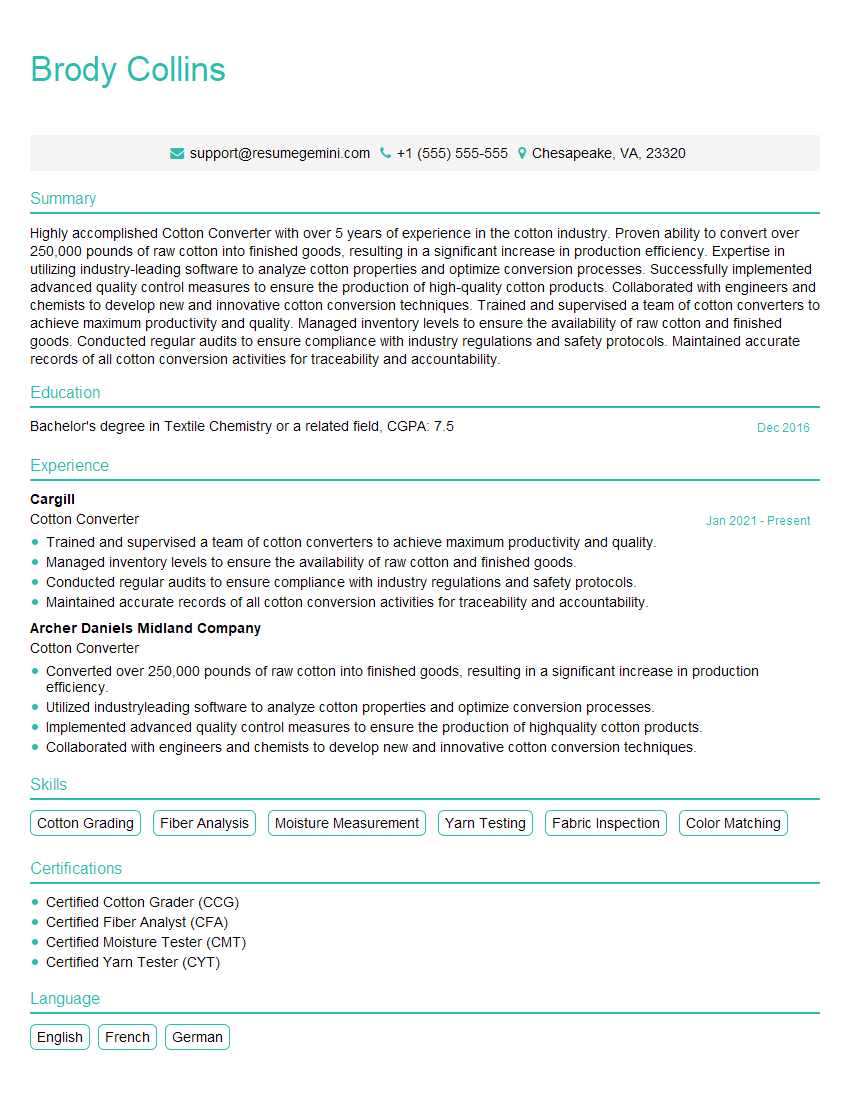
Are you gearing up for an interview for a Cotton Converter position? Whether you’re a seasoned professional or just stepping into the role, understanding what’s expected can make all the difference. In this blog, we dive deep into the essential interview questions for Cotton Converter and break down the key responsibilities of the role. By exploring these insights, you’ll gain a clearer picture of what employers are looking for and how you can stand out. Read on to equip yourself with the knowledge and confidence needed to ace your next interview and land your dream job!
Acing the interview is crucial, but landing one requires a compelling resume that gets you noticed. Crafting a professional document that highlights your skills and experience is the first step toward interview success. ResumeGemini can help you build a standout resume that gets you called in for that dream job.






Essential Interview Questions For Cotton Converter
1. What are the key challenges involved in converting cotton into high-quality yarn?
- Maintaining the fiber’s strength and elasticity during processing
- Removing impurities and foreign matter without damaging the fibers
- Controlling the twist and tension of the yarn to ensure proper spinning
- Balancing cost-effectiveness with yarn quality
- Meeting industry standards and customer specifications
2. Describe the different stages of the cotton conversion process.
Cotton Ginning
- Separating cotton fibers from seeds and other plant material
Cotton Carding
- Removing impurities and aligning the fibers
Cotton Combing
- Removing short fibers and further straightening the fibers
Cotton Drawing
- Thinning and aligning the fibers into a continuous strand
Cotton Spinning
- Twisting the fibers together to form yarn
3. What factors determine the quality of the final yarn?
- Quality of the raw cotton fibers
- Efficiency and accuracy of the conversion process
- Proper maintenance and calibration of equipment
- Skill and experience of the operators
- Compliance with industry standards and best practices
4. How do you ensure that the cotton conversion process is sustainable and environmentally friendly?
- Using energy-efficient equipment and processes
- Minimizing waste and emissions
- Recycling and reusing materials whenever possible
- Educating employees on sustainable practices
- Complying with environmental regulations
5. Describe your experience in troubleshooting and resolving issues in the cotton conversion process.
- Identified and fixed mechanical issues with spinning machines
- Adjusted process parameters to improve yarn quality
- Trained operators on proper maintenance techniques
- Collaborated with suppliers to resolve raw material issues
- Developed contingency plans to minimize downtime during production
6. How do you stay updated on the latest advancements in cotton conversion technology?
- Attending industry conferences and workshops
- Reading trade publications and research journals
- Consulting with experts in the field
- Visiting manufacturing facilities to observe new technologies
- Participating in online forums and discussion groups
7. What are your career goals and aspirations in the field of cotton conversion?
- To lead a team of cotton converters in a world-class manufacturing facility
- To develop innovative processes that improve yarn quality and efficiency
- To contribute to the sustainability of the cotton industry
- To become a recognized expert in the field
- To mentor and train future generations of cotton converters
8. What are your strengths and weaknesses as a cotton converter?
Strengths
- Strong technical knowledge of the cotton conversion process
- Excellent troubleshooting and problem-solving skills
- Proven ability to improve yarn quality and efficiency
- Excellent communication and interpersonal skills
- Passion for the cotton industry
Weaknesses
- Limited experience in large-scale manufacturing environments
- Need to further develop leadership skills
- Can be overly detail-oriented at times
9. How do you handle working in a fast-paced and demanding production environment?
- Prioritize tasks and manage my time effectively
- Stay calm under pressure and make quick decisions
- Delegate responsibilities to others when necessary
- Communicate clearly and regularly with colleagues
- Take breaks when needed to maintain focus and productivity
10. Why are you interested in working as a cotton converter for our company?
- Your company’s reputation for producing high-quality cotton yarn
- The opportunity to work with experienced professionals in the field
- The chance to contribute to the sustainability of the cotton industry
- Your company’s commitment to innovation and technology
- The potential for career growth and advancement
Interviewers often ask about specific skills and experiences. With ResumeGemini‘s customizable templates, you can tailor your resume to showcase the skills most relevant to the position, making a powerful first impression. Also check out Resume Template specially tailored for Cotton Converter.
Career Expert Tips:
- Ace those interviews! Prepare effectively by reviewing the Top 50 Most Common Interview Questions on ResumeGemini.
- Navigate your job search with confidence! Explore a wide range of Career Tips on ResumeGemini. Learn about common challenges and recommendations to overcome them.
- Craft the perfect resume! Master the Art of Resume Writing with ResumeGemini’s guide. Showcase your unique qualifications and achievements effectively.
- Great Savings With New Year Deals and Discounts! In 2025, boost your job search and build your dream resume with ResumeGemini’s ATS optimized templates.
Researching the company and tailoring your answers is essential. Once you have a clear understanding of the Cotton Converter‘s requirements, you can use ResumeGemini to adjust your resume to perfectly match the job description.
Key Job Responsibilities
Cotton Converters are responsible for converting raw cotton into finished cotton products, such as yarn, thread, and fabric. They oversee the entire cotton conversion process, from the initial purchase of raw cotton to the final packaging and shipping of finished products.
1. Raw Cotton Procurement
Cotton Converters are responsible for sourcing and purchasing high-quality raw cotton that meets the specific requirements of their customers. They must have a deep understanding of the different cotton grades and varieties available, as well as the factors that affect cotton quality, such as fiber length, strength, and color.
- Negotiate contracts with cotton suppliers
- Ensure that the cotton meets the quality standards of the company
- Manage inventory levels of raw cotton
2. Cotton Ginning and Baling
Cotton Converters are responsible for ginning and baling the raw cotton. Ginning is the process of removing the seeds from the cotton fibers, while baling is the process of compressing the cotton fibers into bales for easy storage and transportation.
- Operate cotton ginning and baling machinery
- Monitor the quality of the ginned and baled cotton
- Manage the storage and shipping of cotton bales
3. Cotton Spinning and Weaving
Cotton Converters are responsible for spinning the cotton fibers into yarn and weaving the yarn into fabric. Spinning is the process of twisting the cotton fibers together to create a strong, continuous thread, while weaving is the process of interlacing the threads to create a fabric.
- Operate cotton spinning and weaving machinery
- Monitor the quality of the yarn and fabric
- Manage the production schedule for spinning and weaving
4. Finishing and Packaging
Cotton Converters are responsible for finishing and packaging the cotton fabric. Finishing is the process of treating the fabric to improve its appearance, feel, and durability, while packaging is the process of preparing the fabric for sale and distribution.
- Operate fabric finishing and packaging machinery
- Monitor the quality of the finished and packaged fabric
- Manage the inventory levels of finished fabric
Interview Tips
Preparing for an interview can be daunting, but it doesn’t have to be. By following these tips, you can increase your chances of success.
1. Research the Company and the Position
Before you go on an interview, it’s important to do your research on the company and the position you’re applying for. This will help you understand the company’s culture, values, and goals, as well as the specific requirements of the position.
- Visit the company’s website
- Read the job description carefully
- Talk to people in your network who work for the company
2. Practice Your Answers to Common Interview Questions
There are a number of common interview questions that you’re likely to be asked, such as “Tell me about yourself” and “Why are you interested in this position?” It’s a good idea to practice your answers to these questions in advance so that you can deliver them confidently and concisely.
- Use the STAR method to answer interview questions
- Be prepared to talk about your skills and experience
- Be able to articulate why you’re the best candidate for the position
3. Dress Professionally and Arrive on Time
First impressions matter, so it’s important to dress professionally and arrive on time for your interview. This shows the interviewer that you’re serious about the position and that you respect their time.
- Choose clothing that is clean, pressed, and appropriate for the office environment
- Be punctual and arrive at the interview location at least 15 minutes early
- If you’re running late, call the interviewer to let them know
4. Be Yourself and Be Positive
It’s important to be yourself during an interview. The interviewer wants to get to know the real you, so don’t try to be someone you’re not. Be confident in your abilities and be positive about your future.
- Be honest and authentic
- Be enthusiastic and passionate about the position
- Show the interviewer that you’re a team player
Next Step:
Now that you’re armed with interview-winning answers and a deeper understanding of the Cotton Converter role, it’s time to take action! Does your resume accurately reflect your skills and experience for this position? If not, head over to ResumeGemini. Here, you’ll find all the tools and tips to craft a resume that gets noticed. Don’t let a weak resume hold you back from landing your dream job. Polish your resume, hit the “Build Your Resume” button, and watch your career take off! Remember, preparation is key, and ResumeGemini is your partner in interview success.