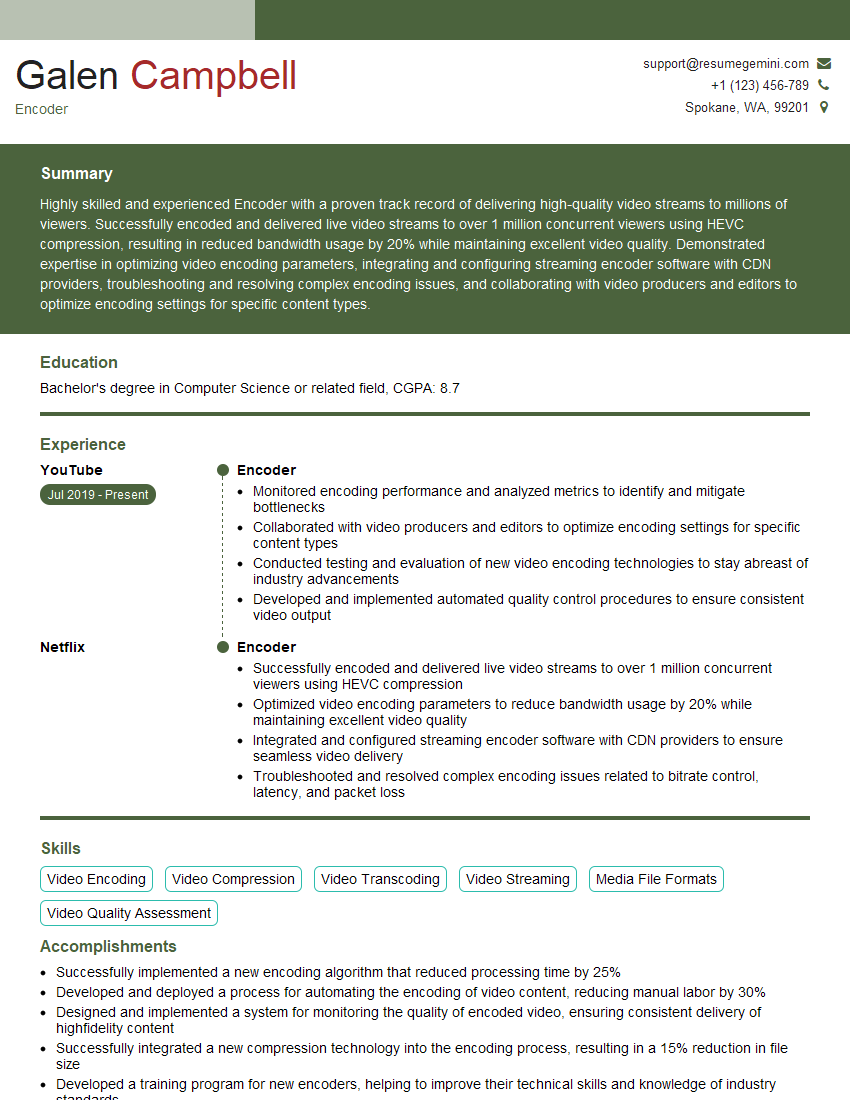
Are you gearing up for a career in Encoder? Feeling nervous about the interview questions that might come your way? Don’t worry, you’re in the right place. In this blog post, we’ll dive deep into the most common interview questions for Encoder and provide you with expert-backed answers. We’ll also explore the key responsibilities of this role so you can tailor your responses to showcase your perfect fit.
Acing the interview is crucial, but landing one requires a compelling resume that gets you noticed. Crafting a professional document that highlights your skills and experience is the first step toward interview success. ResumeGemini can help you build a standout resume that gets you called in for that dream job.






Essential Interview Questions For Encoder
1. What is the difference between a data encoder and a data entry operator?
Answer: Data encoders take raw data and convert it into a format that can be processed by a computer, while data entry operators input data into a computer system according to predefined rules and procedures.
2. Can you describe the process of data encoding?
Answer: Data encoding involves three key steps:
- Data collection
- Data conversion
- Data validation
3. What are the different types of data that can be encoded?
Answer: Data encoders can handle a wide range of data types, including:
- Textual data
- Numerical data
- Images
- Audio
- Video
4. What are some of the challenges you have faced as a data encoder?
Answer: I have faced challenges with:
- Inconsistent data formats
- Incomplete or missing data
- Data entry errors
- Meeting deadlines
5. How do you maintain data accuracy and quality during encoding?
Answer: I implement the following practices:
- Data validation and verification
- Use of automated tools
- Adherence to data encoding standards
- Regular review of encoded data
6. Can you explain the role of metadata in data encoding?
Answer: Metadata provides information about the encoded data, including its source, structure, and usage. It plays a crucial role in:
- Data discovery
- Data interpretation
- Data management
7. What are some best practices for efficient data encoding?
Answer: I follow best practices such as:
- Understanding data requirements
- Standardizing data formats
- Automating data encoding processes
- Documenting encoding procedures
8. Can you describe your experience with data encoding software?
Answer: I am proficient in using data encoding software, including:
- Microsoft Excel
- OpenRefine
- Talend Data Integration
9. How do you stay updated with the latest trends and advancements in data encoding?
Answer: I keep abreast of the latest trends through:
- Industry conferences
- Online resources
- Technical blogs
- Collaboration with peers
10. What is your approach to handling sensitive or confidential data?
Answer: I understand the importance of data security and adhere to strict confidentiality protocols:
- Encrypted data storage
- Controlled access to data
- Regular security assessments
- Compliance with industry regulations
Interviewers often ask about specific skills and experiences. With ResumeGemini‘s customizable templates, you can tailor your resume to showcase the skills most relevant to the position, making a powerful first impression. Also check out Resume Template specially tailored for Encoder.
Career Expert Tips:
- Ace those interviews! Prepare effectively by reviewing the Top 50 Most Common Interview Questions on ResumeGemini.
- Navigate your job search with confidence! Explore a wide range of Career Tips on ResumeGemini. Learn about common challenges and recommendations to overcome them.
- Craft the perfect resume! Master the Art of Resume Writing with ResumeGemini’s guide. Showcase your unique qualifications and achievements effectively.
- Great Savings With New Year Deals and Discounts! In 2025, boost your job search and build your dream resume with ResumeGemini’s ATS optimized templates.
Researching the company and tailoring your answers is essential. Once you have a clear understanding of the Encoder‘s requirements, you can use ResumeGemini to adjust your resume to perfectly match the job description.
Key Job Responsibilities
Encoders are responsible for converting data into a standardized format for efficient storage and retrieval. Their key job responsibilities include:
1. Data Entry
Encoders input raw data from various sources, such as handwritten documents, electronic files, and spoken recordings, into a digital format using specialized software.
- Ensuring data accuracy and consistency by adhering to established coding guidelines.
- Organizing and categorizing data into specific fields and databases for easy retrieval.
2. Data Encoding
Using established coding systems and classification schemes, encoders assign codes to data to represent its meaning and structure. This involves:
- Applying specific codes to different types of data, such as patient records, financial transactions, or legal documents.
- Ensuring that data is properly structured and formatted for efficient storage and retrieval.
3. Data Verification
Encoders verify the accuracy and completeness of encoded data by:
- Proofreading and checking the encoded data against the original source to ensure that it is free from errors.
- Resolving any discrepancies or missing information by consulting with subject matter experts or referring to established guidelines.
4. Data Quality Management
Encoders play a crucial role in maintaining the quality of data by:
- Establishing and implementing data validation processes to ensure that data is accurate, consistent, and complete.
- Adhering to data security and privacy regulations to protect sensitive information.
Interview Tips
To ace an encoder interview, candidates should:
1. Research the Industry and Company
Familiarize yourself with the healthcare, finance, or other relevant industry where encoders are employed. Research the specific company you’re applying to, its values, and the role’s responsibilities.
- Demonstrate your understanding of the industry and how your skills align with the company’s needs.
- Ask informed questions about the company’s data management practices and the role’s impact on the organization.
2. Highlight Your Attention to Detail and Accuracy
Encoders must be meticulous and accurate in their work. Showcase your strong attention to detail and ability to minimize errors.
- Provide examples of your experience in data entry, data verification, or similar roles where accuracy was critical.
- Discuss your understanding of data validation techniques and your commitment to maintaining data integrity.
3. Emphasize Your Knowledge of Coding Systems
Familiarity with coding systems is essential for encoders. Highlight your knowledge of specific coding systems used in the industry, such as ICD-10-CM, CPT, or LOINC.
- Demonstrate your proficiency in applying coding guidelines and ensuring data consistency.
- Discuss your experience in using coding software and your understanding of data structures.
4. Prepare for Technical Questions
Be prepared to answer technical questions related to data encoding. Practice explaining concepts such as data normalization, data validation, and data quality.
- Review common encoding tools and technologies used in the industry.
- Prepare examples of how you have used these tools and technologies to improve data quality and efficiency.
Next Step:
Armed with this knowledge, you’re now well-equipped to tackle the Encoder interview with confidence. Remember, preparation is key. So, start crafting your resume, highlighting your relevant skills and experiences. Don’t be afraid to tailor your application to each specific job posting. With the right approach and a bit of practice, you’ll be well on your way to landing your dream job. Build your resume now from scratch or optimize your existing resume with ResumeGemini. Wish you luck in your career journey!