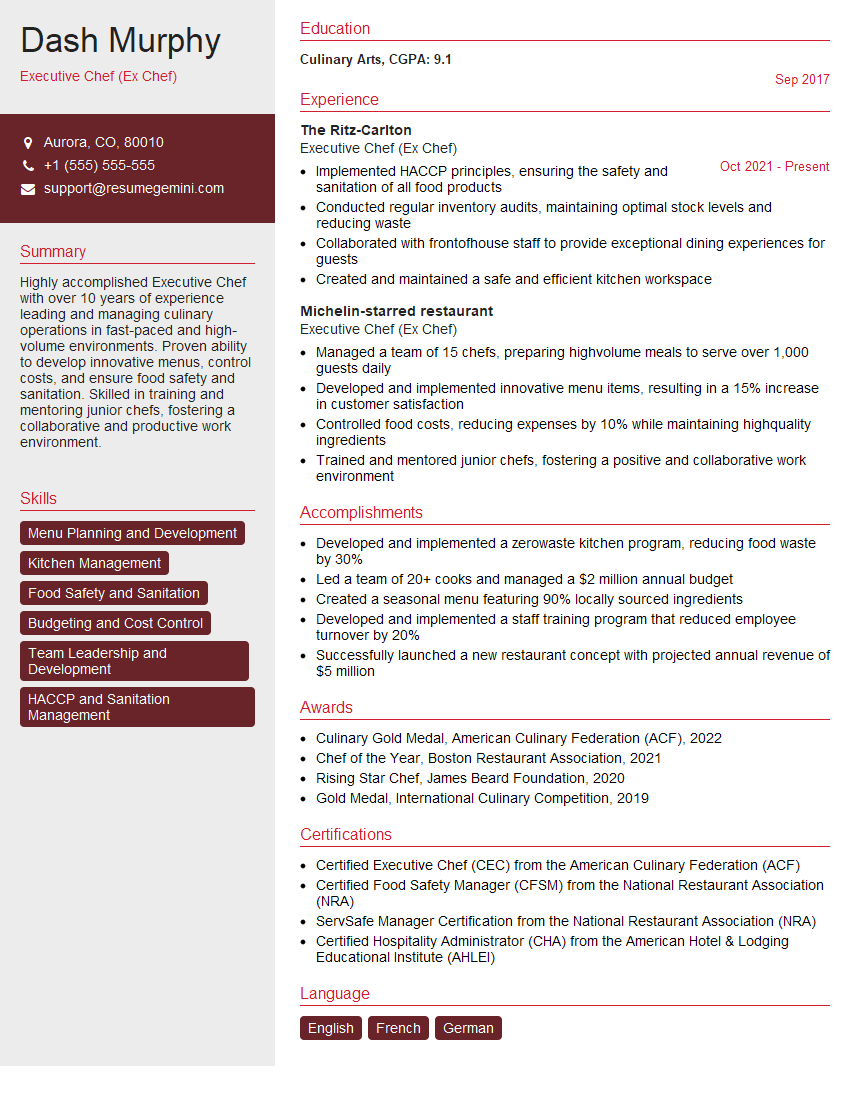
Are you gearing up for a career shift or aiming to ace your next interview? Look no further! We’ve curated a comprehensive guide to help you crack the interview for the coveted Executive Chef (Ex Chef) position. From understanding the key responsibilities to mastering the most commonly asked questions, this blog has you covered. So, buckle up and let’s embark on this journey together.
Acing the interview is crucial, but landing one requires a compelling resume that gets you noticed. Crafting a professional document that highlights your skills and experience is the first step toward interview success. ResumeGemini can help you build a standout resume that gets you called in for that dream job.






Essential Interview Questions For Executive Chef (Ex Chef)
1. What are the key responsibilities of an Executive Chef?
As an Executive Chef, my responsibilities encompass a broad spectrum of culinary operations:
- Leading and managing a team of chefs and kitchen staff
- Developing and executing innovative menus that adhere to industry trends and customer preferences
2. Describe your approach to menu planning and how you ensure menu innovation.
Menu Planning:
- Conduct market research to identify current culinary trends and customer demands
- Collaborate with the purchasing team to source high-quality ingredients at competitive prices
- Design menus that offer a balanced and diverse range of dishes, considering dietary restrictions and preferences
Menu Innovation:
- Stay updated on culinary innovations and techniques through industry seminars and workshops
- Experiment with new flavor combinations and cooking methods
- Incorporate seasonal and locally sourced ingredients to create unique and sustainable dishes
3. How do you manage food costs and ensure profitability?
Effective food cost management is crucial for profitability. I have implemented several strategies:
- Implement portion control measures to minimize food waste and optimize ingredient usage
- Negotiate favorable terms with suppliers to secure competitive prices
- Monitor food costs regularly and adjust menu prices as needed
4. How do you maintain food safety and quality standards in the kitchen?
Food safety and quality are paramount. I adhere to the following principles:
- Regularly train staff on food safety protocols, including proper food handling, storage, and preparation techniques
- Establish strict cleaning and sanitation standards for all kitchen equipment and work surfaces
- Implement a rigorous HACCP (Hazard Analysis and Critical Control Points) system to identify and mitigate potential food safety hazards
5. Describe your experience in managing a large kitchen team.
In my previous role as Executive Chef at [previous employer], I oversaw a team of over 20 chefs and kitchen staff. My responsibilities included:
- Setting clear expectations, providing guidance, and motivating the team to deliver exceptional results
- Managing staff schedules, ensuring adequate coverage for all shifts
- Conducting performance evaluations and providing ongoing feedback to support professional development
6. How do you handle conflicts and resolve issues within the kitchen team?
Conflict resolution is essential for maintaining a harmonious and productive work environment. My approach involves:
- Addressing conflicts promptly and professionally
- Actively listening to all parties involved to understand their perspectives
- Facilitating constructive discussions to find mutually acceptable solutions
7. Describe your experience in implementing new technologies in the kitchen.
I am proficient in utilizing various technologies to enhance kitchen operations:
- Inventory management software for tracking ingredients and reducing waste
- Temperature monitoring systems to ensure food safety and quality
- Online ordering platforms for seamless customer experience
8. How do you stay abreast of the latest culinary trends and innovations?
Continuing professional development is essential. I actively pursue opportunities to stay updated on industry trends:
- Attend culinary workshops, conferences, and exhibitions
- Read industry publications and subscribe to culinary journals
- Experiment with new ingredients and techniques in my own kitchen
9. Describe your approach to sustainability in the kitchen.
Sustainability is becoming increasingly important in the food industry. I implement the following practices:
- Sourcing ingredients from local and sustainable suppliers
- Reducing waste through careful portioning and composting programs
- Using energy-efficient kitchen appliances and lighting
10. How do you measure your success as an Executive Chef?
I measure my success based on the following key metrics:
- Customer satisfaction and positive reviews
- Food cost and profitability targets achieved
- Staff retention and development
- Compliance with food safety and quality standards
- Contribution to the overall reputation and success of the establishment
Interviewers often ask about specific skills and experiences. With ResumeGemini‘s customizable templates, you can tailor your resume to showcase the skills most relevant to the position, making a powerful first impression. Also check out Resume Template specially tailored for Executive Chef (Ex Chef).
Career Expert Tips:
- Ace those interviews! Prepare effectively by reviewing the Top 50 Most Common Interview Questions on ResumeGemini.
- Navigate your job search with confidence! Explore a wide range of Career Tips on ResumeGemini. Learn about common challenges and recommendations to overcome them.
- Craft the perfect resume! Master the Art of Resume Writing with ResumeGemini’s guide. Showcase your unique qualifications and achievements effectively.
- Great Savings With New Year Deals and Discounts! In 2025, boost your job search and build your dream resume with ResumeGemini’s ATS optimized templates.
Researching the company and tailoring your answers is essential. Once you have a clear understanding of the Executive Chef (Ex Chef)‘s requirements, you can use ResumeGemini to adjust your resume to perfectly match the job description.
Key Job Responsibilities for Executive Chef (Ex Chef)
The Executive Chef (Ex Chef) is responsible for the overall operation of the kitchen, including food preparation, menu planning, and staff management. They work closely with the restaurant manager to ensure that the kitchen runs smoothly and that the food meets the highest standards.
1. Food Preparation
The Ex Chef is responsible for overseeing all food preparation in the kitchen. This includes:
- Developing and implementing menus
- Ordering and receiving food supplies
- Preparing and cooking food to order
- Ensuring that all food is prepared safely and to the highest standards
2. Menu Planning
The Ex Chef is responsible for planning the restaurant’s menus. This includes:
- Creating seasonal menus
- Developing new dishes and recipes
- Costing out menus
- Ensuring that the menu is balanced and appealing to a wide range of customers
3. Staff Management
The Ex Chef is responsible for managing the kitchen staff. This includes:
- Hiring and training new staff
- Scheduling staff
- Motivating and leading the staff
- Ensuring that the staff is working safely and efficiently
In addition to these core responsibilities, the Ex Chef may also be responsible for:
4. Food Safety and Sanitation
The Ex Chef is responsible for ensuring that the kitchen is clean and sanitary at all times. This includes:
- Training staff on food safety procedures
- Implementing and enforcing food safety policies
- Inspecting the kitchen regularly to ensure that it is clean and sanitary
5. Kitchen Equipment
The Ex Chef is responsible for ensuring that the kitchen equipment is in good working order. This includes:
- Ordering and receiving new equipment
- Maintaining and repairing equipment
- Training staff on how to use equipment safely and efficiently
6. Budget Management
The Ex Chef is responsible for managing the kitchen budget. This includes:
- Tracking food and beverage costs
- Developing and implementing cost-saving measures
- Ensuring that the kitchen is operating within budget
Interview Tips for Executive Chef (Ex Chef) Positions
Interviewing for an Executive Chef position can be a challenging but rewarding experience. Here are a few tips to help you ace your interview:
1. Research the Restaurant
Before your interview, take some time to research the restaurant where you are applying. This will help you understand the restaurant’s concept, menu, and clientele. You can also find out more about the Executive Chef’s responsibilities and what the restaurant is looking for in a candidate.
2. Prepare Your Answers to Common Interview Questions
There are a few common interview questions that you are likely to be asked, such as:
- “Tell me about your experience as an Executive Chef.”
- “What are your strengths and weaknesses as an Executive Chef?”
- “What are your goals for this position?”
- “Why are you interested in working at this restaurant?”
Take some time to prepare your answers to these questions so that you can deliver them confidently and concisely.
Example Outline for answering “Tell me about your experience as an Executive Chef”:
- Start by giving a brief overview of your experience, including your years of experience, the types of restaurants you have worked in, and the positions you have held.
- Highlight your most relevant skills and experience for the position you are applying for.
- Provide specific examples of your accomplishments as an Executive Chef.
- End by emphasizing your passion for cooking and your commitment to providing excellent customer service.
3. Be Prepared to Talk About Your Menu Planning and Development Experience
Menu planning and development is a key responsibility of an Executive Chef. Be prepared to talk about your experience in this area, including how you develop menus, how you cost out dishes, and how you ensure that your menus are balanced and appealing to a wide range of customers.
4. Be Prepared to Talk About Your Management Experience
As an Executive Chef, you will be responsible for managing a team of kitchen staff. Be prepared to talk about your management experience, including how you motivate and lead your staff, how you resolve conflicts, and how you ensure that your staff is working safely and efficiently.
5. Be Prepared to Talk About Your Budget Management Experience
Budget management is another key responsibility of an Executive Chef. Be prepared to talk about your experience in this area, including how you track food and beverage costs, how you develop and implement cost-saving measures, and how you ensure that your kitchen is operating within budget.
6. Be Professional and Enthusiastic
First impressions matter, so it is important to be professional and enthusiastic during your interview. Dress appropriately, arrive on time, and be prepared to answer questions about your experience and qualifications. Show the interviewer that you are passionate about cooking and that you are confident in your ability to lead a kitchen team.
Next Step:
Now that you’re armed with the knowledge of Executive Chef (Ex Chef) interview questions and responsibilities, it’s time to take the next step. Build or refine your resume to highlight your skills and experiences that align with this role. Don’t be afraid to tailor your resume to each specific job application. Finally, start applying for Executive Chef (Ex Chef) positions with confidence. Remember, preparation is key, and with the right approach, you’ll be well on your way to landing your dream job. Build an amazing resume with ResumeGemini