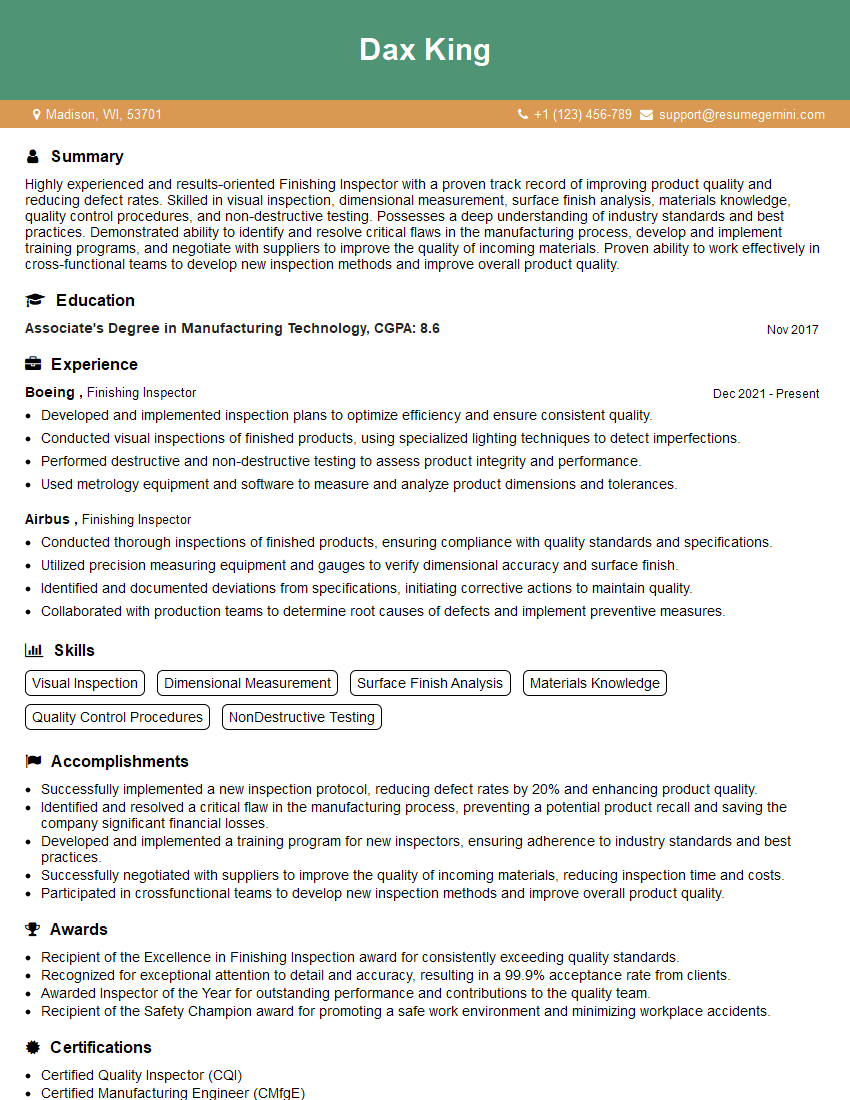
Are you gearing up for an interview for a Finishing Inspector position? Whether you’re a seasoned professional or just stepping into the role, understanding what’s expected can make all the difference. In this blog, we dive deep into the essential interview questions for Finishing Inspector and break down the key responsibilities of the role. By exploring these insights, you’ll gain a clearer picture of what employers are looking for and how you can stand out. Read on to equip yourself with the knowledge and confidence needed to ace your next interview and land your dream job!
Acing the interview is crucial, but landing one requires a compelling resume that gets you noticed. Crafting a professional document that highlights your skills and experience is the first step toward interview success. ResumeGemini can help you build a standout resume that gets you called in for that dream job.






Essential Interview Questions For Finishing Inspector
1. Describe the key responsibilities of a Finishing Inspector?
As a Finishing Inspector, my primary responsibilities include:
- Inspecting finished products to ensure they meet quality standards
- Identifying defects and non-conformities
- Documenting and reporting inspection results
- Providing feedback to production team
- Maintaining records and files
2. How do you ensure accuracy and reliability in your inspections?
Quality Management System
- Follow established quality management system
- Use standardized inspection checklists
Calibration and Verification
- Calibrate and verify inspection tools regularly
- Use certified reference materials
Training and Development
- Receive ongoing training on inspection methods and techniques
- Attend industry workshops and seminars
3. What are the common defects and non-conformities you look for in finished products?
Common defects and non-conformities include:
- Dimensional deviations
- Surface imperfections
- Material flaws
- Assembly errors
- Labeling and packaging discrepancies
4. How do you prioritize and handle critical defects?
- Identify and escalate critical defects immediately
- Isolate affected products to prevent further issues
- Notify relevant personnel (e.g., production manager, quality control manager)
- Collaborate with the team to determine root cause and implement corrective actions
5. Describe your approach to inspecting complex or high-value products.
- Review product specifications and drawings thoroughly
- Use specialized inspection equipment and techniques
- Consult with subject matter experts if necessary
- Document inspections with detailed reports and photographs
6. How do you communicate inspection results and work with production teams to resolve issues?
- Prepare clear and concise inspection reports
- Present findings to production team in a timely manner
- Collaborate with production team to identify root causes and develop solutions
- Monitor corrective actions to ensure effectiveness
7. Describe your experience with quality control software and systems.
I am proficient in using quality control software such as:
- InspectionXpert
- Q-DAS MES
- Visual Inspection Manager
I have experience in implementing and managing quality control systems, including:
- ISO 9001
- AS9100
- IATF 16949
8. How do you stay updated with industry best practices and advancements in finishing inspection?
- Attend industry conferences and exhibitions
- Read industry publications and technical articles
- Participate in online forums and discussion groups
- Obtain certifications and training
9. Describe a challenging inspection project you have worked on and how you resolved it.
In a recent project, I was tasked with inspecting a complex electronic assembly with multiple components and tight tolerances. To ensure accuracy, I used a combination of visual inspection, microscopy, and functional testing. I also consulted with the product designer and production team to gain a deep understanding of the specifications and potential failure modes. Through thorough investigation and analysis, I identified several non-conformities. I documented my findings, presented them to the team, and worked with them to develop corrective actions that improved the quality of the finished product.
10. What motivates you to excel as a Finishing Inspector?
- Passion for quality and precision
- Desire to contribute to customer satisfaction
- Continuous pursuit of improvement
- Teamwork and collaboration
- Contribution to the company’s success
Interviewers often ask about specific skills and experiences. With ResumeGemini‘s customizable templates, you can tailor your resume to showcase the skills most relevant to the position, making a powerful first impression. Also check out Resume Template specially tailored for Finishing Inspector.
Career Expert Tips:
- Ace those interviews! Prepare effectively by reviewing the Top 50 Most Common Interview Questions on ResumeGemini.
- Navigate your job search with confidence! Explore a wide range of Career Tips on ResumeGemini. Learn about common challenges and recommendations to overcome them.
- Craft the perfect resume! Master the Art of Resume Writing with ResumeGemini’s guide. Showcase your unique qualifications and achievements effectively.
- Great Savings With New Year Deals and Discounts! In 2025, boost your job search and build your dream resume with ResumeGemini’s ATS optimized templates.
Researching the company and tailoring your answers is essential. Once you have a clear understanding of the Finishing Inspector‘s requirements, you can use ResumeGemini to adjust your resume to perfectly match the job description.
Key Job Responsibilities
A Finishing Inspector is tasked with ensuring that manufactured goods meet quality standards and specifications. The key job responsibilities include:
1. Inspecting Finished Products
Examining completed products for defects, such as scratches, dents, or missing parts, using specialized tools and equipment.
- Verifying dimensions and tolerances.
- Identifying and documenting non-conforming products.
2. Conducting Quality Control Tests
Performing various tests, such as visual inspections, functional tests, and material analysis, to ensure product quality.
- Using measuring instruments and gauges to ensure accuracy.
- Evaluating products against established standards and specifications.
3. Maintaining Inspection Records
Accurately recording inspection results, including defect descriptions and corrective actions taken.
- Maintaining organized documentation for quality control purposes.
- Providing data for process improvement and troubleshooting.
4. Collaborating with Other Departments
Working closely with production and design teams to identify and resolve manufacturing issues.
- Providing feedback on product design and process improvements.
- Reporting defects and non-conformances to relevant departments.
Interview Tips
Preparing thoroughly for your Finishing Inspector interview can significantly increase your chances of success. Here are some tips to help you ace the interview:
1. Research the Company and Industry
Familiarize yourself with the company’s products, mission, and values. Research the industry to understand current trends and regulations.
- Visit the company website and social media pages.
- Read industry news and articles.
2. Practice Your Answers
Prepare answers to common interview questions, such as those related to your experience, skills, and motivations. Practice delivering your answers clearly and concisely.
- Use the STAR method (Situation, Task, Action, Result) to frame your responses.
- Tailor your answers to the specific job requirements.
3. Highlight Your Relevant Skills
Emphasize your expertise in inspection techniques, quality control procedures, and product knowledge. Showcase your ability to analyze data, identify defects, and solve problems.
- Provide specific examples of projects where you applied these skills successfully.
- Quantify your results whenever possible.
4. Be Prepared to Discuss Continuous Improvement
Finishing Inspectors are often responsible for identifying areas for improvement in manufacturing processes. Discuss your experience with implementing quality initiatives and your thoughts on continuous improvement.
- Share examples of how you have improved processes or reduced defects.
- Explain how you stay up-to-date with industry best practices.
5. Prepare Questions for the Interviewer
Asking thoughtful questions at the end of the interview shows your engagement and interest in the position. Prepare questions about the company’s quality control procedures, growth opportunities, and training programs.
- Avoid asking about benefits or salary at this stage.
- Thank the interviewer for their time and consideration.
Next Step:
Now that you’re armed with the knowledge of Finishing Inspector interview questions and responsibilities, it’s time to take the next step. Build or refine your resume to highlight your skills and experiences that align with this role. Don’t be afraid to tailor your resume to each specific job application. Finally, start applying for Finishing Inspector positions with confidence. Remember, preparation is key, and with the right approach, you’ll be well on your way to landing your dream job. Build an amazing resume with ResumeGemini