Feeling lost in a sea of interview questions? Landed that dream interview for Hot Die Press Operator but worried you might not have the answers? You’re not alone! This blog is your guide for interview success. We’ll break down the most common Hot Die Press Operator interview questions, providing insightful answers and tips to leave a lasting impression. Plus, we’ll delve into the key responsibilities of this exciting role, so you can walk into your interview feeling confident and prepared.
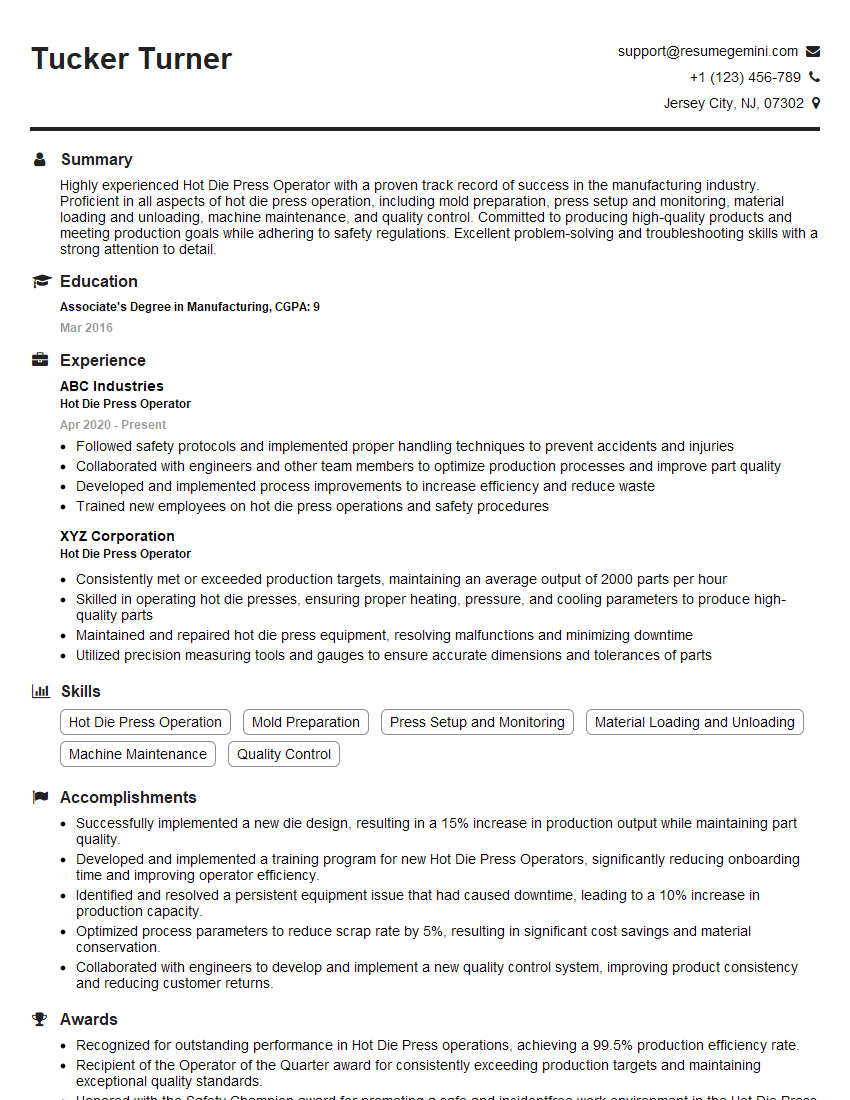
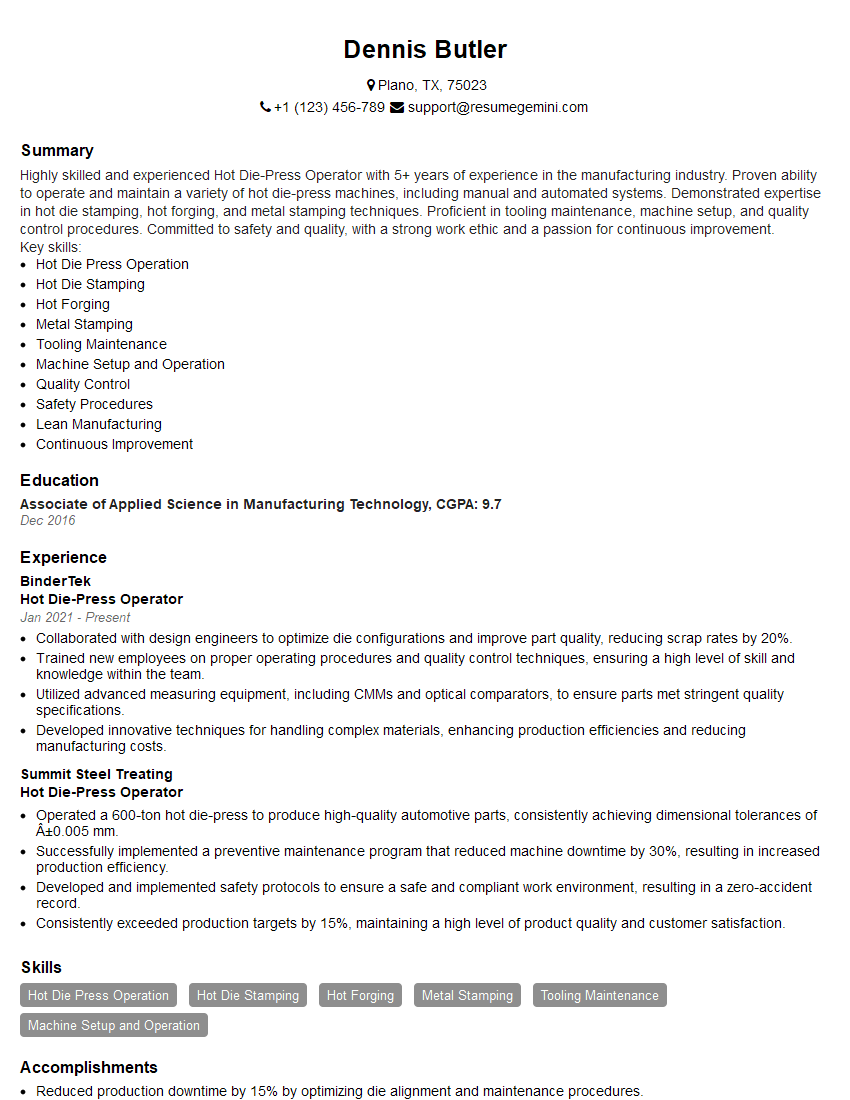
Acing the interview is crucial, but landing one requires a compelling resume that gets you noticed. Crafting a professional document that highlights your skills and experience is the first step toward interview success. ResumeGemini can help you build a standout resume that gets you called in for that dream job.






Essential Interview Questions For Hot Die Press Operator
1. Explain the process of hot die pressing?
Hot die pressing is a manufacturing process that uses heat and pressure to shape and form metal or other materials. It involves the following steps:
- The workpiece is placed in a heated die.
- A ram or piston presses down on the workpiece, applying pressure.
- The workpiece is heated to a predetermined temperature and maintained at that temperature for a specific amount of time.
- The pressure is released, and the workpiece is removed from the die.
2. What are the different types of hot die pressing machines?
Hydraulic presses
- Hydraulic presses use a hydraulic fluid to generate the pressure required to form the workpiece.
- They are typically used for low to medium volume production, and can be used to form a wide variety of materials.
Mechanical presses
- Mechanical presses use a mechanical linkage to generate the pressure required to form the workpiece.
- They are typically used for high volume production, and can be used to form a wide variety of materials.
3. What are the advantages and disadvantages of hot die pressing?
Advantages
- Hot die pressing produces parts with high strength and accuracy.
- It can be used to form a wide variety of materials, including metals, plastics, and rubber.
- It can be used to create complex shapes and features, which would be difficult or impossible to produce using other methods.
Disadvantages
- Hot die pressing can be expensive, especially for high volume production.
- It requires specialized tooling and equipment.
- The process can be time-consuming, especially for large parts or complex shapes.
4. What are some of the applications of hot die pressing?
- Automotive parts, such as engine blocks, transmission housings, and suspension components.
- Aerospace parts, such as aircraft structural components, engine parts, and landing gear.
- Medical devices, such as surgical instruments, implants, and prosthetics.
- Consumer products, such as appliances, electronics, and sporting goods.
5. What are some of the challenges of operating a hot die press?
- Maintaining the correct temperature and pressure during the forming process.
- Preventing the workpiece from sticking to the die.
- Ensuring that the finished part meets the required specifications.
- Troubleshooting problems that may occur during the process.
6. What are some of the safety hazards associated with operating a hot die press?
- Crushing injuries from the press.
- Burns from the hot dies.
- Eye injuries from flying debris.
- Hearing loss from the noise of the press.
7. What are some of the maintenance tasks that are required for a hot die press?
- Lubricating the moving parts.
- Inspecting the dies for wear and damage.
- Calibrating the press.
- Troubleshooting problems that may occur.
8. What are some of the quality control procedures that are used for hot die pressing?
- Inspecting the raw materials.
- Monitoring the process parameters.
- Inspecting the finished parts.
- Testing the parts to ensure that they meet the required specifications.
9. What are some of the latest trends in hot die pressing technology?
- The use of new materials, such as advanced ceramics and composites.
- The development of new forming methods, such as warm forming and incremental forming.
- The use of automation and robotics to improve efficiency and safety.
10. What are your strengths and weaknesses as a hot die press operator?
Strengths
- I have several years of experience operating hot die presses.
- I am highly proficient in all aspects of the process, from setup to operation to maintenance.
- I am a safety-conscious and detail-oriented individual.
Weaknesses
- I am not as experienced with some of the newer hot die pressing technologies, such as warm forming and incremental forming.
- I can sometimes be a bit too meticulous, which can lead to delays in production.
Interviewers often ask about specific skills and experiences. With ResumeGemini‘s customizable templates, you can tailor your resume to showcase the skills most relevant to the position, making a powerful first impression. Also check out Resume Template specially tailored for Hot Die Press Operator.
Career Expert Tips:
- Ace those interviews! Prepare effectively by reviewing the Top 50 Most Common Interview Questions on ResumeGemini.
- Navigate your job search with confidence! Explore a wide range of Career Tips on ResumeGemini. Learn about common challenges and recommendations to overcome them.
- Craft the perfect resume! Master the Art of Resume Writing with ResumeGemini’s guide. Showcase your unique qualifications and achievements effectively.
- Great Savings With New Year Deals and Discounts! In 2025, boost your job search and build your dream resume with ResumeGemini’s ATS optimized templates.
Researching the company and tailoring your answers is essential. Once you have a clear understanding of the Hot Die Press Operator‘s requirements, you can use ResumeGemini to adjust your resume to perfectly match the job description.
Key Job Responsibilities
Hot Die Press Operators are responsible for operating and maintaining hot die press machines used in the manufacturing of a variety of products. Their primary duties include:
1. Machine Operation
Operators are responsible for setting up and operating hot die press machines according to established procedures. This involves loading raw materials into the machine, positioning the die, and initiating the pressing process. They must monitor the machine’s performance, adjust settings as needed, and ensure that the final products meet quality standards.
2. Die Maintenance
Maintaining the hot die press machines is crucial for efficient operation. Operators are responsible for regular maintenance tasks, including cleaning, lubricating, and inspecting the machine. They must also identify and resolve any mechanical or electrical issues that arise, ensuring that the machine remains in good working condition.
3. Quality Control
Producing high-quality products is paramount. Operators are responsible for inspecting finished products to ensure they meet specifications. They must identify any defects or non-conformities and take corrective action as necessary. This involves checking for dimensional accuracy, surface finish, and other quality attributes.
4. Production Optimization
Maximizing production efficiency is essential. Operators strive to optimize production processes by identifying and implementing improvements. They may suggest modifications to machine settings, material handling techniques, or work schedules to increase output while maintaining quality standards.
Interview Tips
To ace the interview for a Hot Die Press Operator position, candidates should prepare thoroughly and present themselves professionally. Here are some key tips:
1. Research the Company and Position
Familiarize yourself with the company’s industry, products, and values. Research the specific role and its responsibilities to demonstrate your understanding of the job requirements. This will help you answer questions intelligently and show your interest in the position.
2. Highlight Relevant Experience and Skills
Emphasize your previous experience in operating and maintaining hot die press machines. Quantify your accomplishments by providing specific examples of how you contributed to production efficiency, quality control, or problem-solving. Highlight any technical skills or certifications related to hot die press operation.
3. Prepare for Technical Questions
Interviewers may ask technical questions to assess your knowledge of hot die press machines. Be prepared to discuss topics such as machine setup, die design, quality control procedures, and troubleshooting techniques. Demonstrating your technical expertise will increase your credibility and show your ability to perform the job effectively.
4. Practice Your Answers
Rehearse your responses to common interview questions, such as “Tell me about your experience operating hot die press machines” or “How would you handle a quality issue on the production line?” Practicing your answers will help you deliver them confidently and concisely during the interview.
5. Ask Informed Questions
Prepare thoughtful questions to ask the interviewer about the company, the position, or the industry. Asking relevant questions demonstrates your engagement and interest in the opportunity. It also gives you an opportunity to gather more information and make an informed decision about whether the job is a good fit for you.
Next Step:
Armed with this knowledge, you’re now well-equipped to tackle the Hot Die Press Operator interview with confidence. Remember, a well-crafted resume is your first impression. Take the time to tailor your resume to highlight your relevant skills and experiences. And don’t forget to practice your answers to common interview questions. With a little preparation, you’ll be on your way to landing your dream job. So what are you waiting for? Start building your resume and start applying! Build an amazing resume with ResumeGemini.