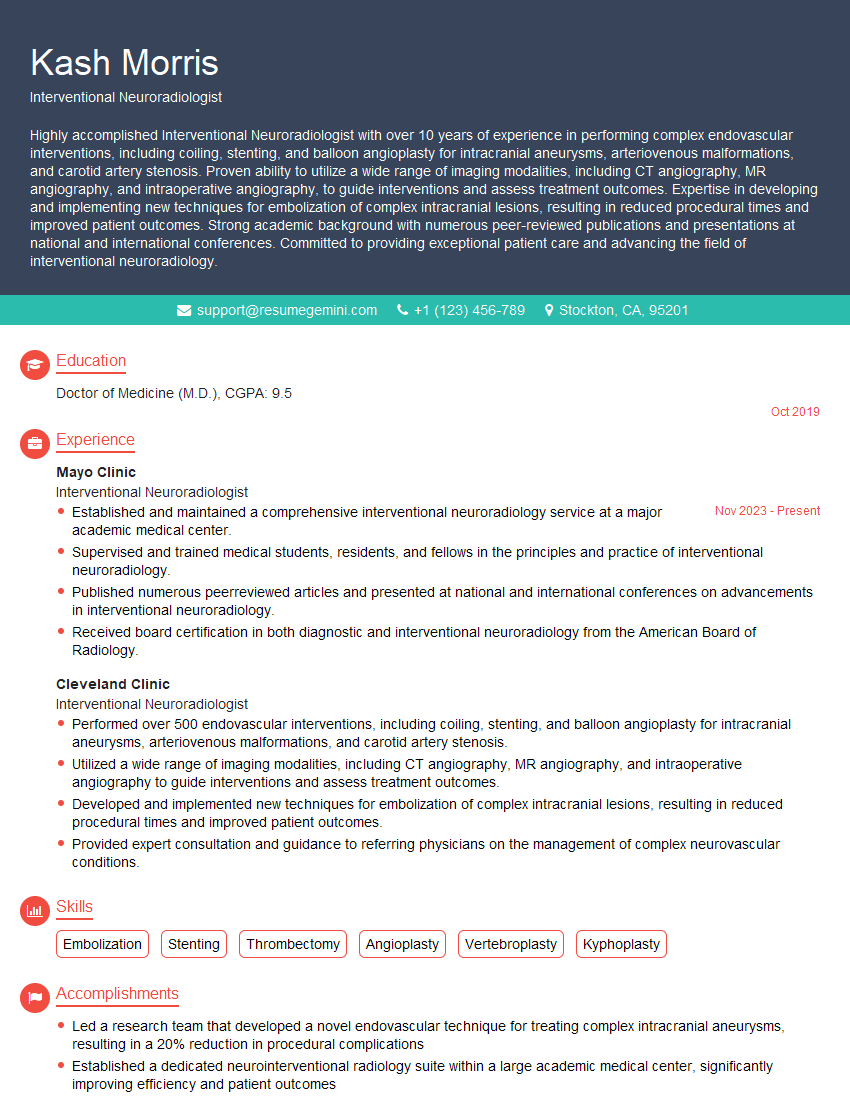
Are you gearing up for a career shift or aiming to ace your next interview? Look no further! We’ve curated a comprehensive guide to help you crack the interview for the coveted Interventional Neuroradiologist position. From understanding the key responsibilities to mastering the most commonly asked questions, this blog has you covered. So, buckle up and let’s embark on this journey together
Acing the interview is crucial, but landing one requires a compelling resume that gets you noticed. Crafting a professional document that highlights your skills and experience is the first step toward interview success. ResumeGemini can help you build a standout resume that gets you called in for that dream job.






Essential Interview Questions For Interventional Neuroradiologist
1. Describe the steps involved in performing a carotid artery stenting?
The steps involved in performing carotid artery stenting are as follows:
- Patient selection: The patient is assessed for suitability for carotid artery stenting based on their medical history, physical examination, and imaging studies.
- Pre-procedural planning: The anatomy of the carotid artery is studied using imaging studies such as CT angiography or magnetic resonance angiography to plan the procedure.
- Procedure: The procedure is performed under local anesthesia. A small incision is made in the groin area and a catheter is inserted into the femoral artery. The catheter is then navigated to the carotid artery and a stent is placed to open the narrowed artery.
- Post-procedural care: The patient is monitored closely after the procedure for any complications. The patient is typically discharged from the hospital the next day.
2. What are the potential complications of carotid artery stenting?
The potential complications of carotid artery stenting include:
- Stroke: This is the most serious complication and can occur if the stent blocks the carotid artery or if debris from the plaque breaks off and travels to the brain.
- Bleeding: This can occur at the site of the incision or from the carotid artery itself.
- Infection: This can occur at the site of the incision or in the carotid artery itself.
- Allergic reaction: This can occur to the contrast dye used during the procedure or to the stent itself.
3. What is the success rate of carotid artery stenting?
The success rate of carotid artery stenting is high. In most cases, the procedure is successful in opening the narrowed artery and preventing a stroke.
4. What are the advantages of carotid artery stenting over carotid endarterectomy?
Carotid artery stenting has several advantages over carotid endarterectomy, including:
- Less invasive: Carotid artery stenting is a less invasive procedure than carotid endarterectomy. It does not require a large incision in the neck.
- Faster recovery time: Patients who undergo carotid artery stenting typically have a faster recovery time than patients who undergo carotid endarterectomy.
- Lower risk of complications: Carotid artery stenting has a lower risk of complications than carotid endarterectomy, including the risk of stroke, bleeding, and infection.
5. What are the disadvantages of carotid artery stenting?
Carotid artery stenting also has some disadvantages, including:
- Higher cost: Carotid artery stenting is more expensive than carotid endarterectomy.
- Not suitable for all patients: Carotid artery stenting is not suitable for all patients, such as patients with severe carotid artery disease or patients who have had previous neck surgery.
6. What is the role of interventional neuroradiology in the management of stroke?
Interventional neuroradiology plays a vital role in the management of stroke. Interventional neuroradiologists can use a variety of techniques to treat stroke, including:
- Thrombectomy: This is a procedure to remove a blood clot from a blocked artery in the brain.
- Stenting: This is a procedure to place a stent in a narrowed artery in the brain.
- Angioplasty: This is a procedure to widen a narrowed artery in the brain.
7. What are the challenges of interventional neuroradiology?
Interventional neuroradiology is a challenging field. Some of the challenges include:
- The anatomy of the brain is complex: The brain is a complex organ and the arteries that supply it are small and delicate. This makes it difficult to perform interventional neuroradiology procedures.
- The procedures are high-risk: Interventional neuroradiology procedures are high-risk and can have serious complications, such as stroke and bleeding.
- The field is constantly evolving: Interventional neuroradiology is a rapidly evolving field and new techniques are constantly being developed. This makes it difficult to keep up with the latest advances.
8. What are the rewards of interventional neuroradiology?
Despite the challenges, interventional neuroradiology is a rewarding field. Some of the rewards include:
- The opportunity to help patients: Interventional neuroradiologists can help patients with a variety of neurological conditions, including stroke, brain tumors, and aneurysms.
- The challenge of the work: Interventional neuroradiology is a challenging field, but it is also very rewarding. Interventional neuroradiologists are constantly learning and growing.
- The opportunity to make a difference: Interventional neuroradiologists can make a real difference in the lives of their patients. They can help patients to recover from strokes, improve their quality of life, and even save their lives.
9. What are your strengths and weaknesses as an interventional neuroradiologist?
My strengths as an interventional neuroradiologist include:
- Excellent technical skills: I have excellent technical skills and I am able to perform complex interventional neuroradiology procedures with precision and accuracy.
- Strong clinical judgment: I have strong clinical judgment and I am able to make quick decisions in high-pressure situations.
- Compassionate and empathetic: I am compassionate and empathetic and I am able to build rapport with patients and their families.
My weaknesses as an interventional neuroradiologist include:
- I am sometimes too critical of myself: I am sometimes too critical of myself and I can be hard on myself when I make mistakes.
- I can be impatient at times: I can be impatient at times and I can get frustrated when things do not go according to plan.
10. Why are you interested in this position?
I am interested in this position because it is a great opportunity to use my skills and experience to help patients with neurological conditions. I am particularly interested in the opportunity to work with a team of experienced interventional neuroradiologists and to learn from them.
Interviewers often ask about specific skills and experiences. With ResumeGemini‘s customizable templates, you can tailor your resume to showcase the skills most relevant to the position, making a powerful first impression. Also check out Resume Template specially tailored for Interventional Neuroradiologist.
Career Expert Tips:
- Ace those interviews! Prepare effectively by reviewing the Top 50 Most Common Interview Questions on ResumeGemini.
- Navigate your job search with confidence! Explore a wide range of Career Tips on ResumeGemini. Learn about common challenges and recommendations to overcome them.
- Craft the perfect resume! Master the Art of Resume Writing with ResumeGemini’s guide. Showcase your unique qualifications and achievements effectively.
- Great Savings With New Year Deals and Discounts! In 2025, boost your job search and build your dream resume with ResumeGemini’s ATS optimized templates.
Researching the company and tailoring your answers is essential. Once you have a clear understanding of the Interventional Neuroradiologist‘s requirements, you can use ResumeGemini to adjust your resume to perfectly match the job description.
Key Job Responsibilities
Interventional neuroradiologists are highly specialized physicians who use imaging techniques to diagnose and treat conditions affecting the brain, spine, and central nervous system.
1. Diagnosis and Treatment of Neurological Conditions
Interventional neuroradiologists use a variety of imaging techniques, including magnetic resonance imaging (MRI), computed tomography (CT), and angiography, to diagnose and treat a wide range of neurological conditions, such as:
- Brain tumors
- Stroke
- Aneurysms
- Arteriovenous malformations (AVMs)
2. Endovascular Procedures
Interventional neuroradiologists perform a variety of endovascular procedures, which are minimally invasive procedures that use catheters to access the blood vessels in the brain and spine. These procedures include:
- Stenting
- Coiling
- Embolization
- Thrombectomy
3. Collaboration with other healthcare professionals
Interventional neuroradiologists often collaborate with other healthcare professionals, such as neurosurgeons, neurologists, and radiation oncologists, to provide the best possible care for their patients.
4. Research and development
Interventional neuroradiologists are often involved in research and development to improve the diagnosis and treatment of neurological conditions.
Interview Tips
Preparing for an interview for an interventional neuroradiology position can be daunting, but it is important to remember that the interviewers are looking for a candidate who is not only qualified but also a good fit for the team.
1. Research the organization and the position
Before your interview, take some time to research the organization and the specific position you are applying for. This will help you to understand the organization’s mission, values, and culture, as well as the specific requirements of the position.
2. Practice your answers to common interview questions
There are a number of common interview questions that you are likely to be asked, such as “Tell me about yourself” and “Why are you interested in this position?” It is helpful to practice your answers to these questions in advance so that you can deliver them confidently and concisely.
3. Be prepared to discuss your experience and qualifications
The interviewers will want to know about your experience and qualifications, so be prepared to discuss your education, training, and any relevant work experience. You should also be able to articulate your skills and abilities, and how they would benefit the organization.
4. Be prepared to ask questions
At the end of the interview, the interviewers will likely give you an opportunity to ask questions. This is a good time to ask about the organization’s culture, the specific responsibilities of the position, and the opportunities for professional development.
Next Step:
Armed with this knowledge, you’re now well-equipped to tackle the Interventional Neuroradiologist interview with confidence. Remember, a well-crafted resume is your first impression. Take the time to tailor your resume to highlight your relevant skills and experiences. And don’t forget to practice your answers to common interview questions. With a little preparation, you’ll be on your way to landing your dream job. So what are you waiting for? Start building your resume and start applying! Build an amazing resume with ResumeGemini.