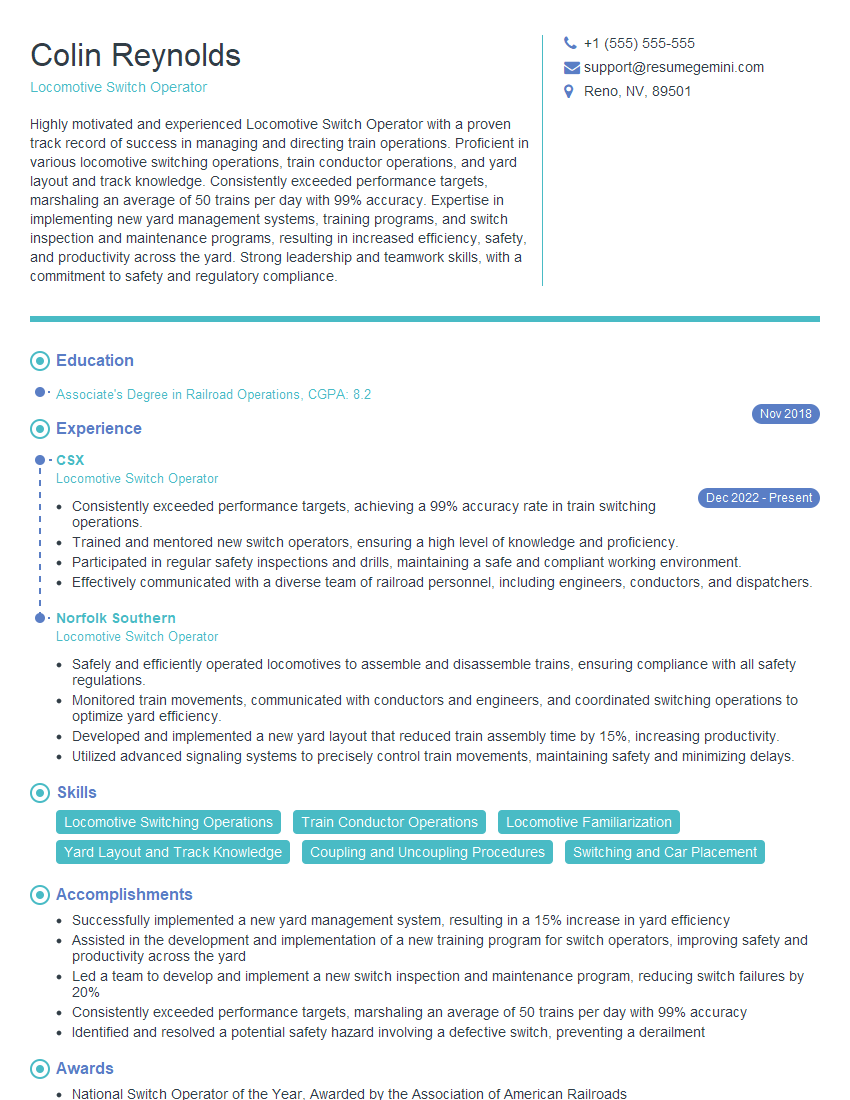
Are you gearing up for a career shift or aiming to ace your next interview? Look no further! We’ve curated a comprehensive guide to help you crack the interview for the coveted Locomotive Switch Operator position. From understanding the key responsibilities to mastering the most commonly asked questions, this blog has you covered. So, buckle up and let’s embark on this journey together
Acing the interview is crucial, but landing one requires a compelling resume that gets you noticed. Crafting a professional document that highlights your skills and experience is the first step toward interview success. ResumeGemini can help you build a standout resume that gets you called in for that dream job.






Essential Interview Questions For Locomotive Switch Operator
1. Explain the key responsibilities of a Locomotive Switch Operator?
As a Locomotive Switch Operator, my key responsibilities would include:
- Operating and maintaining railroad switches and signals to ensure safe movement of trains
- Communicating with train crews and other operators to coordinate train movements
- Monitoring train movements and track conditions to prevent accidents
2. Describe the different types of switches and signals used in railroad operations and how you operate them?
Interlocking Switches
- Power-operated switches that are controlled from a central location
- Ensure safe movement of trains through complex track layouts
Manual Switches
- Operated by hand using a switch stand
- Require physical presence at the switch location
Signals
- Visual or audible devices that convey information about train movements
- Types include: block signals, interlocking signals, switch indicators
3. How do you ensure the safety of train movements when operating switches and signals?
Safety is paramount in my role, and I follow strict procedures to ensure the safety of train movements:
- Adhering to established operating rules and regulations
- Communicating effectively with train crews and other operators
- Performing regular inspections of switches and signals
- Responding promptly to any emergencies or irregularities
4. What is the importance of maintaining accurate train movement records?
Maintaining accurate train movement records is essential for several reasons:
- Documenting the movement of trains for safety and regulatory purposes
- Tracking train arrivals and departures for efficient scheduling
- Identifying any delays or irregularities in train movements
5. How do you prioritize conflicting train movements and prevent collisions?
Prioritizing conflicting train movements and preventing collisions is a crucial aspect of my role:
- Understanding train schedules and track layouts
- Communicating with train crews to coordinate movements
- Utilizing interlocking systems to prevent conflicting routes
6. What are the common challenges faced by Locomotive Switch Operators, and how do you overcome them?
Common challenges faced by Locomotive Switch Operators include:
- Extreme weather conditions, such as fog or snow
- Equipment malfunctions or failures
- Human error or miscommunications
To overcome these challenges, I rely on:
- Diligent monitoring of track conditions and equipment
- Effective communication with train crews and other operators
- Following established safety procedures and protocols
7. How do you stay updated on industry regulations and best practices?
To stay updated on industry regulations and best practices, I engage in the following:
- Attending training sessions and workshops
- Reading industry publications and manuals
- Consulting with experienced operators and supervisors
8. Why are you interested in working as a Locomotive Switch Operator for our company?
I am eager to join your company as a Locomotive Switch Operator because:
- Your company’s reputation for safety and operational excellence
- The opportunity to contribute to the efficient and safe movement of trains
- The chance to work with experienced professionals in the railroad industry
9. How do you handle stressful situations while working as a Locomotive Switch Operator?
In stressful situations as a Locomotive Switch Operator, I employ the following strategies:
- Remaining calm and focused
- Prioritizing tasks and making quick decisions
- Communicating effectively with train crews and other operators
10. What are your career goals as a Locomotive Switch Operator?
My career goals as a Locomotive Switch Operator are:
- To continuously improve my skills and knowledge in railroad operations
- To contribute to the safety and efficiency of train movements
- To advance my career to positions with greater responsibility and leadership
Interviewers often ask about specific skills and experiences. With ResumeGemini‘s customizable templates, you can tailor your resume to showcase the skills most relevant to the position, making a powerful first impression. Also check out Resume Template specially tailored for Locomotive Switch Operator.
Career Expert Tips:
- Ace those interviews! Prepare effectively by reviewing the Top 50 Most Common Interview Questions on ResumeGemini.
- Navigate your job search with confidence! Explore a wide range of Career Tips on ResumeGemini. Learn about common challenges and recommendations to overcome them.
- Craft the perfect resume! Master the Art of Resume Writing with ResumeGemini’s guide. Showcase your unique qualifications and achievements effectively.
- Great Savings With New Year Deals and Discounts! In 2025, boost your job search and build your dream resume with ResumeGemini’s ATS optimized templates.
Researching the company and tailoring your answers is essential. Once you have a clear understanding of the Locomotive Switch Operator‘s requirements, you can use ResumeGemini to adjust your resume to perfectly match the job description.
Key Job Responsibilities
Locomotive Switch Operators are responsible for the safe and efficient movement of trains by operating switches and signals.
1. Operate Switches and Signals
Switch Operators use levers and buttons to control the movement of trains by changing the position of switches and signals. They must be able to quickly and accurately identify the correct switch or signal to operate.
- Control the movement of trains by operating switches and signals.
- Ensure the safe and efficient movement of trains.
2. Monitor Train Movements
Switch Operators must constantly monitor the movement of trains to ensure that they are following the correct route and are not in danger of colliding with other trains. They must be able to quickly identify any potential hazards and take corrective action.
- Monitor the movement of trains to ensure that they are following the correct route.
- Identify any potential hazards and take corrective action.
3. Communicate with Train Crews
Switch Operators must be able to communicate clearly and effectively with train crews to ensure that they understand the instructions that are being given. They must be able to use both verbal and non-verbal communication to convey information.
- Communicate clearly and effectively with train crews.
- Ensure that train crews understand the instructions that are being given.
4. Maintain Equipment
Switch Operators are responsible for maintaining the equipment that they use, including switches, signals, and communication devices. They must be able to identify any potential problems and take corrective action to prevent them from causing a train accident.
- Maintain the equipment that they use, including switches, signals, and communication devices.
- Identify any potential problems and take corrective action to prevent them from causing a train accident.
Interview Tips
Preparing for the interview may increase the likelihood of securing the position of a Locomotive Switch Operator. Here are some tips and hacks to help you ace your interview:
1. Research the Company and the Position
Before the interview, take some time to research the company. This will help you understand their culture, values, and what they are looking for in a Locomotive Switch Operator.
- Visit the company’s website.
- Read industry news and articles.
- Talk to people who work for the company.
2. Practice Your Answers to Common Interview Questions
Be prepared to answer questions about your experience, skills, and why you are interested in the position. Practice your answers to common interview questions.
- Tell me about yourself.
- Why are you interested in this position?
- What are your strengths and weaknesses?
- What is your experience with operating switches and signals?
3. Dress Professionally
First impressions matter, so it is important to dress professionally for your interview. This means wearing a suit or dress pants and a button-down shirt or blouse. You should also make sure your shoes are clean and polished.
- Wear a suit or dress pants and a button-down shirt or blouse.
- Make sure your shoes are clean and polished.
- Avoid wearing casual clothes, such as jeans or t-shirts.
4. Be Confident and Enthusiastic
Confidence is key in an interview. Believe in yourself and your abilities. This will help you make a good impression on the interviewer and show them that you are the right person for the job.
- Make eye contact with the interviewer.
- Speak clearly and confidently.
- Smile and be enthusiastic.
5. Ask Questions
At the end of the interview, be sure to ask the interviewer questions about the position and the company. This shows that you are interested in the job and that you are taking the interview seriously.
- What are the day-to-day responsibilities of the position?
- What are the company’s goals for the future?
- What is the company culture like?
Next Step:
Armed with this knowledge, you’re now well-equipped to tackle the Locomotive Switch Operator interview with confidence. Remember, preparation is key. So, start crafting your resume, highlighting your relevant skills and experiences. Don’t be afraid to tailor your application to each specific job posting. With the right approach and a bit of practice, you’ll be well on your way to landing your dream job. Build your resume now from scratch or optimize your existing resume with ResumeGemini. Wish you luck in your career journey!