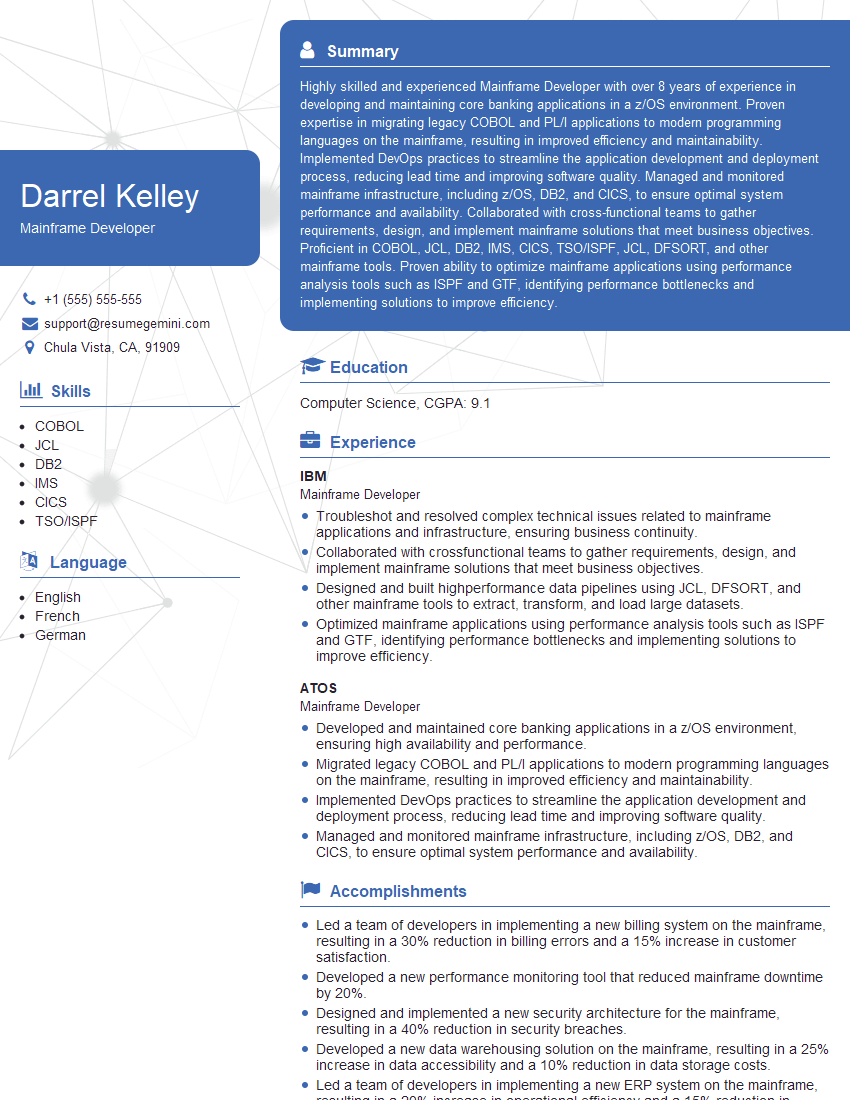
Are you gearing up for a career shift or aiming to ace your next interview? Look no further! We’ve curated a comprehensive guide to help you crack the interview for the coveted Mainframe Developer position. From understanding the key responsibilities to mastering the most commonly asked questions, this blog has you covered. So, buckle up and let’s embark on this journey together.
Acing the interview is crucial, but landing one requires a compelling resume that gets you noticed. Crafting a professional document that highlights your skills and experience is the first step toward interview success. ResumeGemini can help you build a standout resume that gets you called in for that dream job.






Essential Interview Questions For Mainframe Developer
1. What are the key differences between COBOL and Java?
- COBOL is a structured programming language, while Java is an object-oriented programming language.
- COBOL has a strong focus on data handling, while Java has a strong focus on object manipulation.
- COBOL uses a fixed-format syntax, while Java uses a free-format syntax.
- COBOL is a compiled language, while Java is an interpreted language.
- COBOL is primarily used for business applications, while Java is used for a wide variety of applications.
2. What is the JCL used for?
Submitting a job to the system
- Identifying the job to the system
- Specifying the resources that the job will need
- Directing the output of the job
Controlling the execution of the job
- Specifying the order in which the job steps will be executed
- Setting up conditional execution
- Restarting the job if it fails
3. What is the difference between a load module and an executable program?
A load module is a program that has been compiled and linked, but not yet loaded into memory. An executable program is a load module that has been loaded into memory and is ready to run.
4. What is the purpose of a debugger?
A debugger is a tool that allows you to step through a program line by line, examining the values of variables and the state of the program. This can be useful for identifying and fixing errors in your code.
5. What is the difference between a syntax error and a runtime error?
A syntax error is an error that occurs when the compiler cannot understand the code you have written. A runtime error is an error that occurs when the program is running.
6. What are the different types of data structures that are supported by COBOL?
- Elementary data types (e.g., integer, decimal, character)
- Arrays
- Tables
- Records
- Files
7. What is the difference between a sequential file and a random access file?
- Sequential files can only be accessed sequentially, from beginning to end. Random access files can be accessed in any order.
- Sequential files are typically used for large datasets that are processed in batch mode. Random access files are typically used for smaller datasets that are accessed frequently.
8. What are the different types of database management systems that can be used with COBOL?
- Hierarchical databases (e.g., IMS)
- Network databases (e.g., DB2)
- Relational databases (e.g., Oracle, SQL Server)
9. What are the different types of reports that can be generated using COBOL?
- Detail reports
- Summary reports
- Cross-tab reports
- Graphs and charts
10. What are the different types of testing that can be performed on COBOL programs?
- Unit testing
- Integration testing
- System testing
- Acceptance testing
Interviewers often ask about specific skills and experiences. With ResumeGemini‘s customizable templates, you can tailor your resume to showcase the skills most relevant to the position, making a powerful first impression. Also check out Resume Template specially tailored for Mainframe Developer.
Career Expert Tips:
- Ace those interviews! Prepare effectively by reviewing the Top 50 Most Common Interview Questions on ResumeGemini.
- Navigate your job search with confidence! Explore a wide range of Career Tips on ResumeGemini. Learn about common challenges and recommendations to overcome them.
- Craft the perfect resume! Master the Art of Resume Writing with ResumeGemini’s guide. Showcase your unique qualifications and achievements effectively.
- Great Savings With New Year Deals and Discounts! In 2025, boost your job search and build your dream resume with ResumeGemini’s ATS optimized templates.
Researching the company and tailoring your answers is essential. Once you have a clear understanding of the Mainframe Developer‘s requirements, you can use ResumeGemini to adjust your resume to perfectly match the job description.
Key Job Responsibilities
Mainframe Developers are responsible for the development, maintenance, and support of applications running on mainframe computers. They work with a variety of technologies, including COBOL, Assembler, and JCL, and may also be involved in database management and systems administration.
1. Software Development
Mainframe Developers are responsible for the design, development, and implementation of new software applications. They work with business analysts and users to understand the requirements of the application, and then use their technical skills to create a solution that meets those requirements.
- Gather and analyze requirements from business analysts and users
- Design and develop new software applications
- Implement and test new software applications
- Maintain and update existing software applications
2. Software Maintenance
Mainframe Developers are also responsible for the maintenance and support of existing software applications. They work to identify and fix bugs, and to make sure that the applications are running smoothly. They may also work on performance tuning and optimization, and on making sure that the applications are compliant with regulatory requirements.
- Identify and fix bugs in existing software applications
- Make sure that applications are running smoothly
- Work on performance tuning and optimization
- Make sure that applications are compliant with regulatory requirements
3. Systems Administration
Mainframe Developers may also be involved in systems administration tasks. They work to ensure that the mainframe computer is running smoothly and that all of the necessary software is installed and configured correctly. They may also work on security and disaster recovery planning.
- Make sure that the mainframe computer is running smoothly
- Install and configure all of the necessary software
- Work on security and disaster recovery planning
4. Teamwork and Communication
Mainframe Developers typically work as part of a team, and they must be able to communicate effectively with other team members, as well as with business analysts and users. They must also be able to work independently, and to manage their own time and resources effectively.
- Work effectively as part of a team
- Communicate effectively with other team members
- Communicate effectively with business analysts and users
- Work independently and manage own time and resources effectively
Interview Tips
Preparing for a Mainframe Developer interview can be a daunting task, but there are a few things you can do to increase your chances of success.
1. Research the Company and the Position
Before you go into an interview, it is important to do your research on the company and the position you are applying for. This will help you to understand the company’s culture and values, and to tailor your answers to the specific requirements of the job.
- Visit the company’s website and read about their history, mission, and values.
- Research the specific position you are applying for. What are the key responsibilities? What are the qualifications?
- If possible, try to connect with someone who works at the company on LinkedIn. They may be able to give you some insights into the company culture and the interview process.
2. Practice Your Answers to Common Interview Questions
There are a few common interview questions that you are likely to be asked, such as “Tell me about yourself” and “Why are you interested in this position?” It is important to practice your answers to these questions so that you can deliver them confidently and concisely.
- Make a list of common interview questions and practice your answers.
- Time yourself to make sure that your answers are concise and to the point.
- Ask a friend or family member to mock interview you.
3. Be Prepared to Talk About Your Technical Skills
As a Mainframe Developer, you will need to have a strong understanding of a variety of technical skills. Be prepared to talk about your experience with COBOL, Assembler, JCL, and other relevant technologies. You should also be prepared to discuss your experience with database management and systems administration.
- Review your resume and highlight your technical skills.
- Be prepared to answer questions about your experience with specific technologies.
- If you have any relevant certifications, make sure to mention them.
4. Be Yourself and Be Confident
Most importantly, be yourself and be confident in your abilities. The interviewer wants to get to know the real you, so don’t try to be someone you’re not. Be honest about your strengths and weaknesses, and be prepared to talk about your goals and aspirations.
- Be yourself and be confident in your abilities.
- Be honest about your strengths and weaknesses.
- Be prepared to talk about your goals and aspirations.
Next Step:
Now that you’re armed with interview-winning answers and a deeper understanding of the Mainframe Developer role, it’s time to take action! Does your resume accurately reflect your skills and experience for this position? If not, head over to ResumeGemini. Here, you’ll find all the tools and tips to craft a resume that gets noticed. Don’t let a weak resume hold you back from landing your dream job. Polish your resume, hit the “Build Your Resume” button, and watch your career take off! Remember, preparation is key, and ResumeGemini is your partner in interview success.