Top 10 Questions for Medical Biller/Coder Interview

Essential Interview Questions For Medical Biller/Coder

1. What are the steps involved in the medical billing process?

  • Patient registration and chart preparation
  • Coding and assigning procedure and diagnosis codes
  • Creating and submitting claims to insurance companies
  • Tracking claims and following up with payers
  • Posting payments and managing patient accounts

2. What are some common medical billing errors?

  • Coding errors
  • Data entry errors
  • Missing or incomplete documentation
  • Improper claim submission
  • Insufficient follow-up

3. How do you handle denied claims?

I first review the explanation of benefits (EOB) to determine the reason for the denial. Then, I contact the insurance company to discuss the denial and request a reconsideration. If necessary, I submit additional documentation to support the claim.

4. What is the difference between ICD-10 and CPT codes?

  • ICD-10 codes are used to identify diagnoses
  • CPT codes are used to identify procedures
  • ICD-10 codes are required for all medical claims
  • CPT codes are required for claims submitted to insurance companies

5. What is the importance of medical coding accuracy?

  • Accurate coding ensures that claims are processed correctly
  • Improper coding can lead to claim denials
  • Accurate coding helps to identify trends and patterns in patient care
  • Correct coding contributes to the collection of accurate data for research and quality improvement

6. What software programs are you proficient in?

  • EHR software (e.g., Epic, Cerner)
  • Medical billing software (e.g., Medisoft, Lytec)
  • Coding software (e.g., EncoderPro, CodeLink)

7. What are your continuing education plans?

I plan to stay up-to-date on the latest coding regulations and guidelines by attending conferences, webinars, and workshops. I also plan to pursue additional certifications, such as the Certified Professional Coder (CPC) certification.

8. How do you stay organized and manage your time efficiently?

  • I use a to-do list to prioritize my tasks
  • I set deadlines and stick to them
  • I delegate tasks when necessary
  • I take breaks throughout the day to stay focused and productive

9. What is your experience with coding complex medical procedures?

I have experience coding a variety of complex medical procedures, such as surgeries, diagnostic tests, and injections. I am familiar with the different coding guidelines and regulations for these procedures, and I am able to accurately assign the appropriate codes.

10. How do you ensure the confidentiality of patient information?

  • I follow all HIPAA regulations and guidelines
  • I only access patient information that is necessary for my work
  • I do not share patient information with anyone outside of the healthcare team

Interviewers often ask about specific skills and experiences. With ResumeGemini‘s customizable templates, you can tailor your resume to showcase the skills most relevant to the position, making a powerful first impression. Also check out Resume Template specially tailored for Medical Biller/Coder.

Career Expert Tips:

  • Ace those interviews! Prepare effectively by reviewing the Top 50 Most Common Interview Questions on ResumeGemini.
  • Navigate your job search with confidence! Explore a wide range of Career Tips on ResumeGemini. Learn about common challenges and recommendations to overcome them.
  • Craft the perfect resume! Master the Art of Resume Writing with ResumeGemini’s guide. Showcase your unique qualifications and achievements effectively.
  • Great Savings With New Year Deals and Discounts! In 2025, boost your job search and build your dream resume with ResumeGemini’s ATS optimized templates.

Researching the company and tailoring your answers is essential. Once you have a clear understanding of the Medical Biller/Coder‘s requirements, you can use ResumeGemini to adjust your resume to perfectly match the job description.

Key Job Responsibilities

A Medical Biller/Coder plays a pivotal role in the healthcare industry, ensuring accurate and timely billing and coding processes. Their key responsibilities encompass:

1. Billing and Coding

They prepare and submit medical bills to insurance companies and patients, ensuring proper coding according to medical classification systems (e.g., ICD-10, CPT).

  • Review patient charts and medical records to extract relevant information.
  • Assign appropriate codes based on diagnoses, procedures, and services rendered.

2. Claim Processing

Track and manage medical claims throughout the billing cycle, including submission, follow-up, and resolution of denials.

  • Monitor claim status to ensure timely payments.
  • Investigate and resolve billing discrepancies and denials.

3. Payment Management

Process and manage patient payments, including receipting, posting, and adjustments.

  • Track patient balances and collections.
  • Issue statements and collection letters as needed.

4. Quality Assurance

Maintain high standards of accuracy and compliance in billing and coding practices.

  • Conduct internal audits and reviews to ensure adherence to regulations and industry standards.
  • Stay up-to-date on regulatory changes and best practices.

5. Communication and Collaboration

Interact effectively with healthcare providers, insurance companies, and patients.

  • Provide billing and coding information to requestors.
  • Resolve customer inquiries and disputes.

Interview Preparation Tips

Preparing thoroughly for a Medical Biller/Coder interview is crucial. Here are some essential tips and hacks:

1. Research the Company and Position

Familiarize yourself with the healthcare organization, its mission, values, and specific requirements for the role.

  • Visit the company’s website and social media profiles.
  • Read industry publications and news articles.

2. Review Job Description Carefully

Pay attention to the key responsibilities and qualifications outlined in the job description. Highlight your skills and experience that align with these requirements.

  • Use keywords from the job description in your resume and cover letter.
  • Prepare specific examples that demonstrate your proficiency in each area.

3. Practice Case Studies and Coding Scenarios

Anticipate potential interview questions that involve analyzing medical records and coding scenarios. Practice these exercises to showcase your technical abilities.

  • Enroll in online coding courses or workshops.
  • Use coding practice websites and software.

4. Emphasize Soft Skills

While technical skills are essential, don’t overlook the importance of soft skills such as communication, customer service, and problem-solving.

  • Share examples of how you have effectively communicated with healthcare providers and patients.
  • Describe situations where you have resolved billing or coding issues.

5. Ask Informed Questions

Asking well-thought-out questions at the end of the interview shows your interest and engagement. Prepare questions related to the company, the position, or industry trends.

  • Ask about the organization’s approach to coding compliance.
  • Inquire about opportunities for professional development and advancement.
Note: These questions offer general guidance, it’s important to tailor your answers to your specific role, industry, job title, and work experience.

Next Step:

Armed with this knowledge, you’re now well-equipped to tackle the Medical Biller/Coder interview with confidence. Remember, preparation is key. So, start crafting your resume, highlighting your relevant skills and experiences. Don’t be afraid to tailor your application to each specific job posting. With the right approach and a bit of practice, you’ll be well on your way to landing your dream job. Build your resume now from scratch or optimize your existing resume with ResumeGemini. Wish you luck in your career journey!
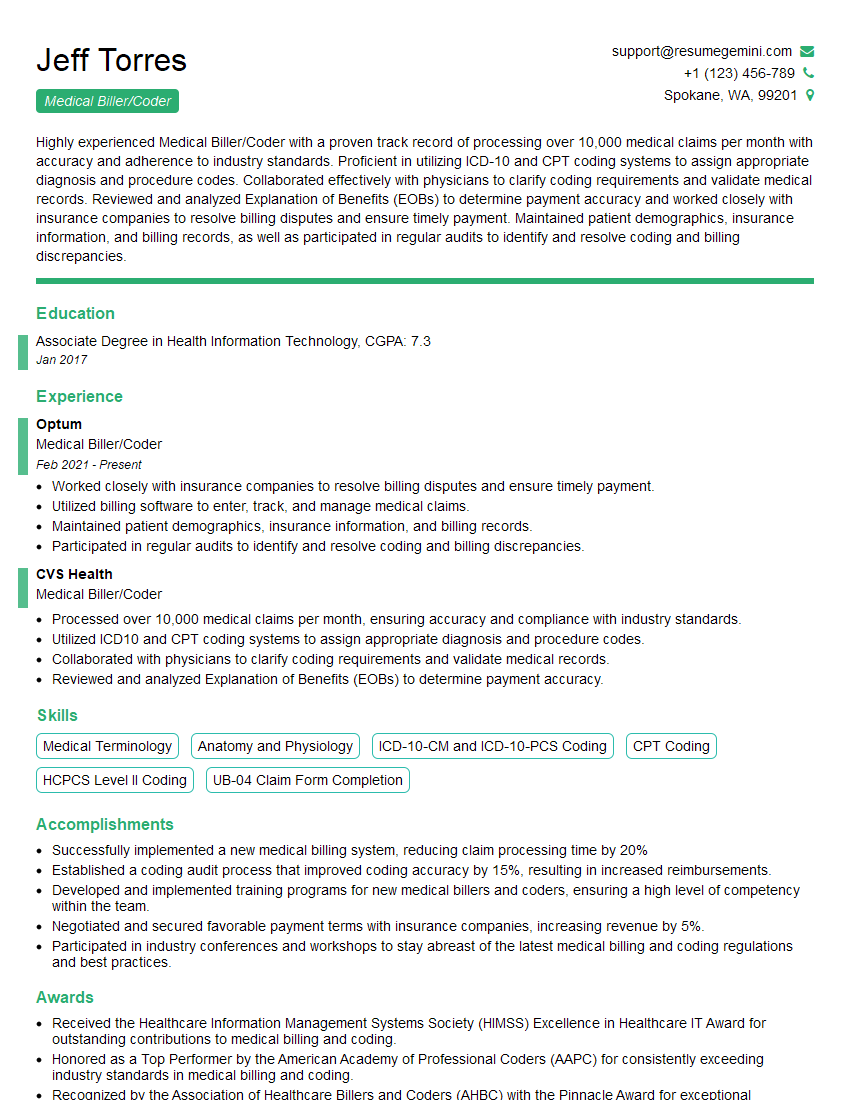
Medical Biller/Coder Resume Template by ResumeGemini
Disclaimer: The names and organizations mentioned in these resume samples are purely fictional and used for illustrative purposes only. Any resemblance to actual persons or entities is purely coincidental. These samples are not legally binding and do not represent any real individuals or businesses.

Top 10 Questions for Medical Biller Coder Interview

Essential Interview Questions For Medical Biller Coder

1. How would you ensure that medical records are processed accurately and efficiently for billing purposes?

  • Implement a robust quality assurance program to regularly review and assess the accuracy of billing processes.
  • Utilize technology such as electronic health records (EHRs) and billing software to streamline and automate data entry.
  • Provide ongoing training and support to billing staff to stay up-to-date on coding guidelines and industry best practices.

2. What are the key differences between ICD-10-CM and ICD-10-PCS coding systems?

ICD-10-CM

  • Used for coding diagnoses and symptoms.
  • Has a hierarchical structure with multiple levels of specificity.
  • Assigns codes based on the patient’s condition or disease.

ICD-10-PCS

  • Used for coding procedures and surgeries.
  • Has a non-hierarchical structure with a single code for each procedure.
  • Assigns codes based on the type of procedure performed.

3. Explain how you would handle a denied claim?

Review the claim to identify the reason for denial.

  • Contact the insurance company to discuss the issue and gather additional information.
  • Correct any errors in coding or billing information.
  • Provide supporting documentation to justify the claim.
  • Appeal the denial if necessary.

4. What is the importance of using modifiers in medical billing?

  • To provide additional information about a procedure or service.
  • To clarify the intent of the provider.
  • To prevent incorrect payment or denial of claims.
  • To ensure accurate coding and reimbursement.

5. How would you stay up-to-date on changes in medical billing regulations?

  • Attend industry conferences and workshops.
  • Read professional journals and publications.
  • Participate in online forums and discussion groups.
  • Obtain certifications and credentials in medical billing.

6. What is the difference between a primary and secondary payer?

  • Primary payer: The insurance company that is responsible for paying the majority of the claim.
  • Secondary payer: The insurance company that is responsible for paying the remaining balance after the primary payer has paid.

7. How would you handle a patient who is uninsured or underinsured?

  • Explain the financial assistance options available to the patient.
  • Offer a payment plan or flexible payment schedule.
  • Refer the patient to community resources or social service programs.

8. What is the importance of confidentiality in medical billing?

  • To protect patient privacy.
  • To comply with HIPAA regulations.
  • To maintain the trust and confidence of patients.
  • To avoid legal and financial penalties.

9. How would you communicate effectively with providers and other healthcare professionals?

  • Use clear and concise language.
  • Be respectful and professional.
  • Use multiple communication channels (e.g., phone, email, secure messaging).
  • Document all interactions and conversations.

10. What are your strengths and weaknesses as a Medical Biller Coder?

Strengths:
  • Strong knowledge of medical coding guidelines (ICD-10-CM, ICD-10-PCS, CPT).
  • Excellent attention to detail and accuracy.
  • Proficient in billing software and electronic health records (EHRs).
  • Exceptional communication and interpersonal skills.
Weaknesses:
  • Limited experience with certain specialized medical billing areas (e.g., workers’ compensation).
  • Still developing my knowledge of the latest regulatory changes in healthcare billing.

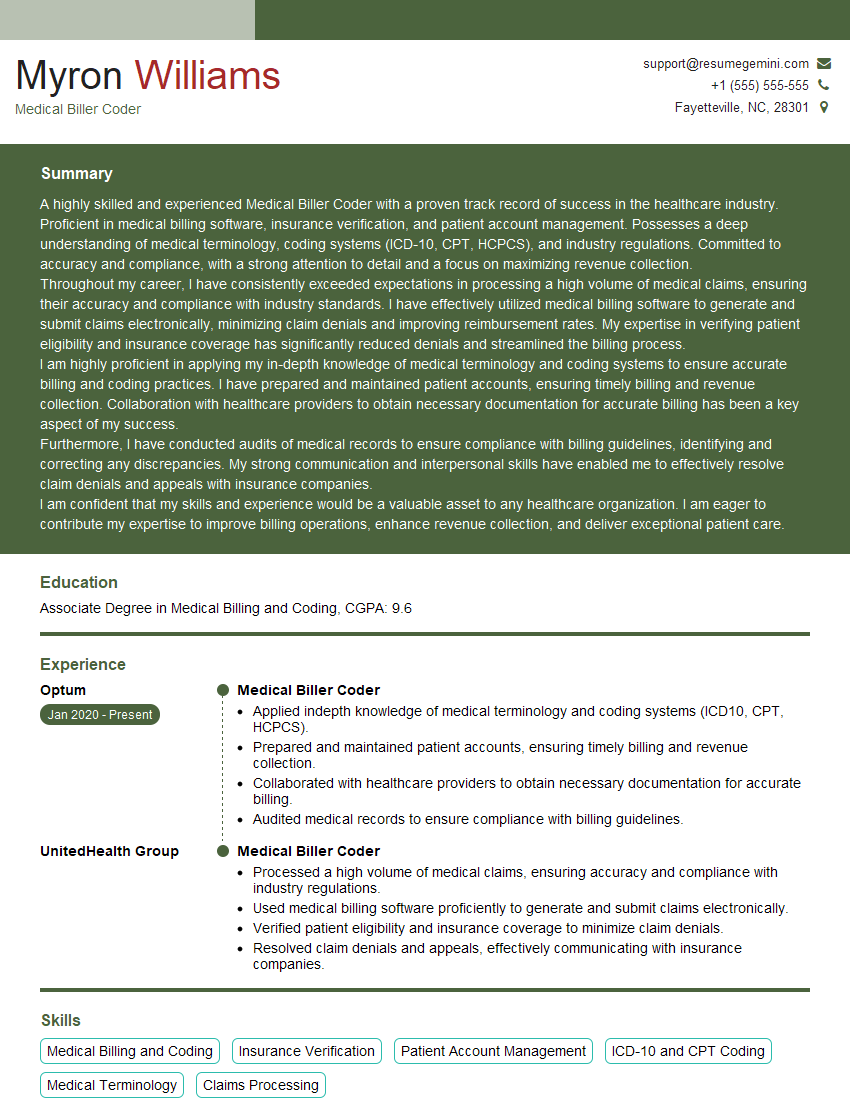
Interviewers often ask about specific skills and experiences. With ResumeGemini‘s customizable templates, you can tailor your resume to showcase the skills most relevant to the position, making a powerful first impression. Also check out Resume Template specially tailored for Medical Biller Coder.

Career Expert Tips:

  • Ace those interviews! Prepare effectively by reviewing the Top 50 Most Common Interview Questions on ResumeGemini.
  • Navigate your job search with confidence! Explore a wide range of Career Tips on ResumeGemini. Learn about common challenges and recommendations to overcome them.
  • Craft the perfect resume! Master the Art of Resume Writing with ResumeGemini’s guide. Showcase your unique qualifications and achievements effectively.
  • Great Savings With New Year Deals and Discounts! In 2025, boost your job search and build your dream resume with ResumeGemini’s ATS optimized templates.

Researching the company and tailoring your answers is essential. Once you have a clear understanding of the Medical Biller Coder‘s requirements, you can use ResumeGemini to adjust your resume to perfectly match the job description.

Key Job Responsibilities

Medical Biller Coders play a crucial role in the healthcare industry, ensuring accurate and timely medical billing and coding. Their key responsibilities include:

1. Medical Billing:

Preparing and submitting medical claims to insurance companies and patients.

  • Verifying patient eligibility and coverage details.
  • Collecting and organizing patient information for accurate billing.

2. Medical Coding:

Interpreting medical documentation and assigning appropriate codes to procedures, diagnoses, and services.

  • Utilizing medical coding systems such as ICD-10-CM and CPT.
  • Ensuring that codes align with healthcare regulations and industry standards.

3. Billing Management:

Managing the billing cycle and following up on outstanding payments.

  • Reconciling claims and resolving billing discrepancies.
  • Communicating with patients and insurance companies regarding billing matters.

4. Compliance and Regulatory Adherence:

Staying up-to-date with healthcare regulations and ensuring compliance with industry standards.

  • Protecting patient health information and adhering to HIPAA guidelines.
  • Maintaining accurate and ethical documentation for auditing purposes.

Interview Tips

Preparing thoroughly for a Medical Biller Coder interview is essential to showcase your skills and experience effectively:

1. Research the Company and Position:

Familiarize yourself with the healthcare organization and the specific role you’re applying for.

  • Visit the company’s website to learn about their mission, values, and services.
  • Review the job description carefully and identify the key requirements.

2. Highlight Relevant Experience and Skills:

Emphasize your experience in medical billing, coding, and healthcare administration.

  • Quantify your accomplishments whenever possible, using specific metrics to demonstrate your impact.
  • Practice describing your skills and expertise using industry-specific terminology.

3. Prepare for Technical Questions:

Review medical coding and billing systems, such as ICD-10-CM and CPT. Be prepared for questions about your proficiency in these areas.

  • Study coding manuals and reference materials to enhance your understanding.
  • Practice coding scenarios using sample medical records.

4. Demonstrate Communication and Interpersonal Skills:

Medical Biller Coders often interact with patients, healthcare providers, and insurance companies. Showcase your communication and interpersonal skills.

  • Prepare examples of how you handled challenging situations and resolved conflicts.
  • Emphasize your ability to work effectively in a team environment.

5. Ask Insightful Questions:

Prepare thoughtful questions to ask the interviewer about the company, the position, and the industry. This demonstrates your engagement and interest.

  • Inquire about the company’s billing processes and compliance standards.
  • Ask about opportunities for professional development and career growth.
Note: These questions offer general guidance, it’s important to tailor your answers to your specific role, industry, job title, and work experience.

Next Step:

Now that you’re armed with interview-winning answers and a deeper understanding of the Medical Biller Coder role, it’s time to take action! Does your resume accurately reflect your skills and experience for this position? If not, head over to ResumeGemini. Here, you’ll find all the tools and tips to craft a resume that gets noticed. Don’t let a weak resume hold you back from landing your dream job. Polish your resume, hit the “Build Your Resume” button, and watch your career take off! Remember, preparation is key, and ResumeGemini is your partner in interview success.

Medical Biller Coder Resume Template by ResumeGemini
Disclaimer: The names and organizations mentioned in these resume samples are purely fictional and used for illustrative purposes only. Any resemblance to actual persons or entities is purely coincidental. These samples are not legally binding and do not represent any real individuals or businesses.
Scroll to Top