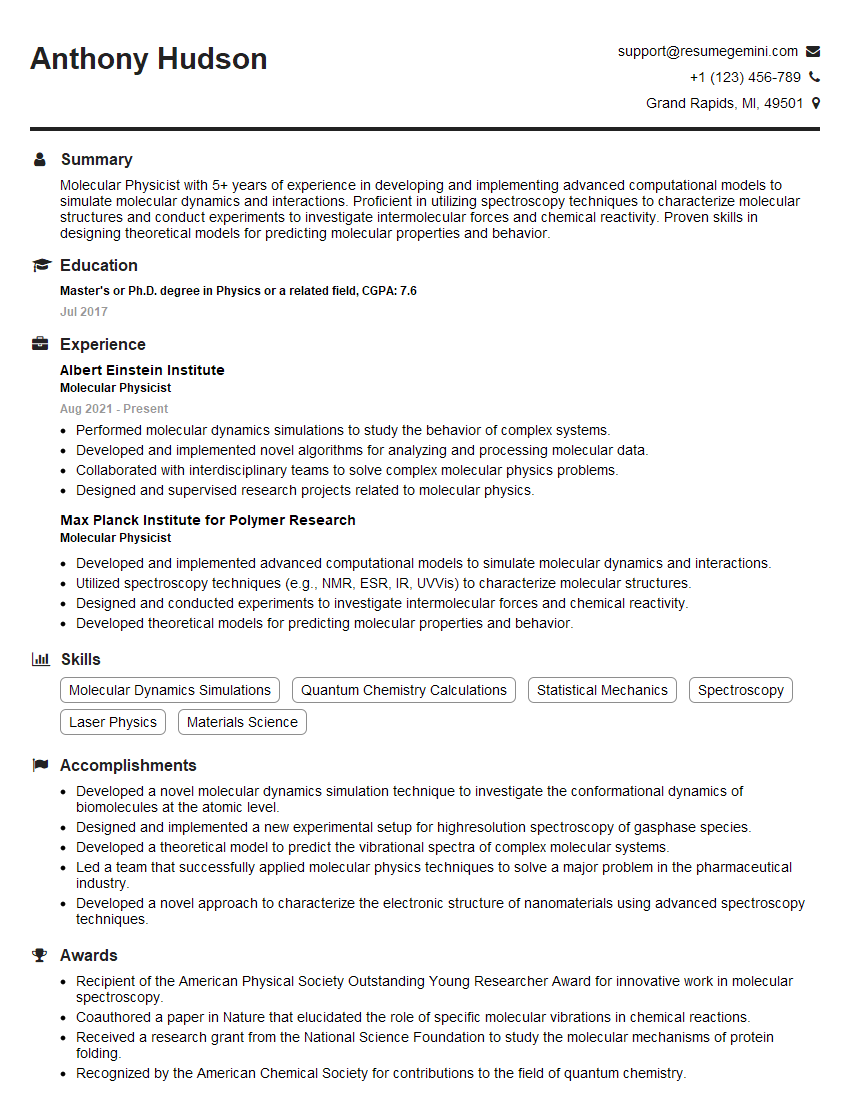
Feeling lost in a sea of interview questions? Landed that dream interview for Molecular Physicist but worried you might not have the answers? You’re not alone! This blog is your guide for interview success. We’ll break down the most common Molecular Physicist interview questions, providing insightful answers and tips to leave a lasting impression. Plus, we’ll delve into the key responsibilities of this exciting role, so you can walk into your interview feeling confident and prepared.
Acing the interview is crucial, but landing one requires a compelling resume that gets you noticed. Crafting a professional document that highlights your skills and experience is the first step toward interview success. ResumeGemini can help you build a standout resume that gets you called in for that dream job.






Essential Interview Questions For Molecular Physicist
1. What are the key principles of molecular quantum mechanics?
- The Schrödinger equation: This equation describes the wave function of a particle, which contains information about its position, momentum, and other properties.
- The Born interpretation: This interpretation states that the square of the wave function gives the probability of finding the particle at a particular location.
- The Pauli exclusion principle: This principle states that no two electrons can occupy the same quantum state.
2. What are the different types of molecular spectroscopy?
Absorption spectroscopy
- UV-Vis spectroscopy: This technique measures the absorption of light in the ultraviolet and visible regions of the spectrum.
- Infrared spectroscopy: This technique measures the absorption of light in the infrared region of the spectrum.
Emission spectroscopy
- Fluorescence spectroscopy: This technique measures the emission of light by a sample that has been excited by a light source.
- Phosphorescence spectroscopy: This technique measures the emission of light by a sample that has been excited by a light source and then continues to emit light after the light source has been turned off.
3. What are the different types of molecular interactions?
- Covalent bonds: These bonds are formed when two atoms share one or more pairs of electrons.
- Ionic bonds: These bonds are formed when one atom transfers one or more electrons to another atom.
- Hydrogen bonds: These bonds are formed between a hydrogen atom and an electronegative atom, such as oxygen or nitrogen.
- van der Waals forces: These forces are weak attractive forces that occur between molecules.
4. What are the different types of molecular structures?
- Linear molecules: These molecules have a linear shape.
- Bent molecules: These molecules have a bent shape.
- Trigonal planar molecules: These molecules have a trigonal planar shape.
- Tetrahedral molecules: These molecules have a tetrahedral shape.
5. What are the different types of molecular dynamics simulations?
- Classical molecular dynamics: This technique simulates the motion of molecules using classical mechanics.
- Ab initio molecular dynamics: This technique simulates the motion of molecules using quantum mechanics.
- Hybrid molecular dynamics: This technique combines classical and quantum mechanics to simulate the motion of molecules.
6. What are the different types of molecular modeling software?
- Gaussian: This software is used for quantum chemistry calculations.
- GAMESS: This software is used for quantum chemistry calculations.
- NWChem: This software is used for quantum chemistry calculations.
- VASP: This software is used for electronic structure calculations.
- LAMMPS: This software is used for molecular dynamics simulations.
7. What are the different types of molecular spectroscopy experiments?
- UV-Vis spectroscopy: This experiment measures the absorption of light in the ultraviolet and visible regions of the spectrum.
- Infrared spectroscopy: This experiment measures the absorption of light in the infrared region of the spectrum.
- Fluorescence spectroscopy: This experiment measures the emission of light by a sample that has been excited by a light source.
- Phosphorescence spectroscopy: This experiment measures the emission of light by a sample that has been excited by a light source and then continues to emit light after the light source has been turned off.
8. What are the different types of molecular modeling techniques?
- Molecular mechanics: This technique uses classical mechanics to model the motion of molecules.
- Molecular dynamics: This technique uses quantum mechanics to model the motion of molecules.
- Monte Carlo: This technique uses statistical methods to model the behavior of molecules.
9. What are the different types of molecular simulation techniques?
- Molecular dynamics: This technique simulates the motion of molecules using classical mechanics.
- Monte Carlo: This technique uses statistical methods to simulate the behavior of molecules.
- Brownian dynamics: This technique simulates the motion of molecules in a fluid using stochastic methods.
10. What are the different types of molecular visualization software?
- VMD: This software is used to visualize molecules.
- PyMOL: This software is used to visualize molecules.
- Chimera: This software is used to visualize molecules.
- Jmol: This software is used to visualize molecules.
Interviewers often ask about specific skills and experiences. With ResumeGemini‘s customizable templates, you can tailor your resume to showcase the skills most relevant to the position, making a powerful first impression. Also check out Resume Template specially tailored for Molecular Physicist.
Career Expert Tips:
- Ace those interviews! Prepare effectively by reviewing the Top 50 Most Common Interview Questions on ResumeGemini.
- Navigate your job search with confidence! Explore a wide range of Career Tips on ResumeGemini. Learn about common challenges and recommendations to overcome them.
- Craft the perfect resume! Master the Art of Resume Writing with ResumeGemini’s guide. Showcase your unique qualifications and achievements effectively.
- Great Savings With New Year Deals and Discounts! In 2025, boost your job search and build your dream resume with ResumeGemini’s ATS optimized templates.
Researching the company and tailoring your answers is essential. Once you have a clear understanding of the Molecular Physicist‘s requirements, you can use ResumeGemini to adjust your resume to perfectly match the job description.
Key Job Responsibilities
A Molecular Physicist is a scientist who studies the structure and properties of molecules at a fundamental level. Their work plays a crucial role in advancing our understanding of matter and driving technological innovations in various fields.
1. Fundamental Research and Theory Development
Investigate the structure, bonding, and dynamics of molecules using advanced computational and experimental techniques.
- Develop theoretical models and simulations to predict and explain molecular properties and behavior.
- Conduct experiments to validate models and gain insights into molecular phenomena.
2. Spectroscopic Analysis and Characterization
Analyze and interpret experimental data obtained from spectroscopic techniques (e.g., UV-Vis, IR, NMR, MS) to determine molecular structure, composition, and dynamics.
- Use spectroscopy to identify and characterize molecules in various samples.
- Develop new spectroscopic methods to enhance sensitivity and accuracy.
3. Computational Modeling and Simulations
Apply computational methods (e.g., quantum chemistry, molecular dynamics) to simulate and predict the behavior of molecules and molecular systems.
- Use computational models to design and optimize molecular structures for specific applications.
- Perform large-scale simulations to study the collective behavior of molecules in complex systems.
4. Collaboration and Innovation
Collaborate with researchers from diverse disciplines (e.g., chemistry, physics, biology, engineering) to tackle complex scientific problems.
- Participate in interdisciplinary research projects to develop innovative solutions.
- Present research findings at conferences and publish papers in peer-reviewed journals.
Interview Tips
To prepare effectively for a Molecular Physicist interview, consider the following tips:
1. Understand the Job Description and Company
Thoroughly review the job description to grasp the specific responsibilities and requirements.
- Research the company’s mission, values, and recent projects to demonstrate your alignment with their goals.
- Consider how your skills and experience align with the open position.
2. Highlight Your Technical Expertise
Emphasize your strong foundation in physics, particularly in molecular structure and properties.
- Showcase your experience in spectroscopic techniques, computational modeling, and quantum chemistry.
- Quantify your accomplishments with specific examples and results.
3. Showcase Your Problem-Solving Abilities
Describe your approach to solving complex scientific problems and your ability to apply theoretical knowledge to practical applications.
- Discuss projects where you developed innovative solutions or overcame challenges.
- Explain your thought process and the steps you took to reach a conclusion.
4. Prepare for Technical Questions
Expect questions that test your understanding of molecular physics concepts and theories.
- Review fundamental principles, such as quantum mechanics, spectroscopy, and statistical mechanics.
- Practice solving problems and explaining your reasoning clearly.
5. Demonstrate Your Communication and Collaboration Skills
Highlight your ability to communicate scientific concepts effectively and collaborate with others from different backgrounds.
- Share examples of presentations or publications that demonstrate your communication abilities.
- Discuss your experience working in interdisciplinary teams and contributing to shared goals.
Next Step:
Now that you’re armed with the knowledge of Molecular Physicist interview questions and responsibilities, it’s time to take the next step. Build or refine your resume to highlight your skills and experiences that align with this role. Don’t be afraid to tailor your resume to each specific job application. Finally, start applying for Molecular Physicist positions with confidence. Remember, preparation is key, and with the right approach, you’ll be well on your way to landing your dream job. Build an amazing resume with ResumeGemini