Are you gearing up for a career shift or aiming to ace your next interview? Look no further! We’ve curated a comprehensive guide to help you crack the interview for the coveted Motion Picture Film Examiner position. From understanding the key responsibilities to mastering the most commonly asked questions, this blog has you covered. So, buckle up and let’s embark on this journey together.
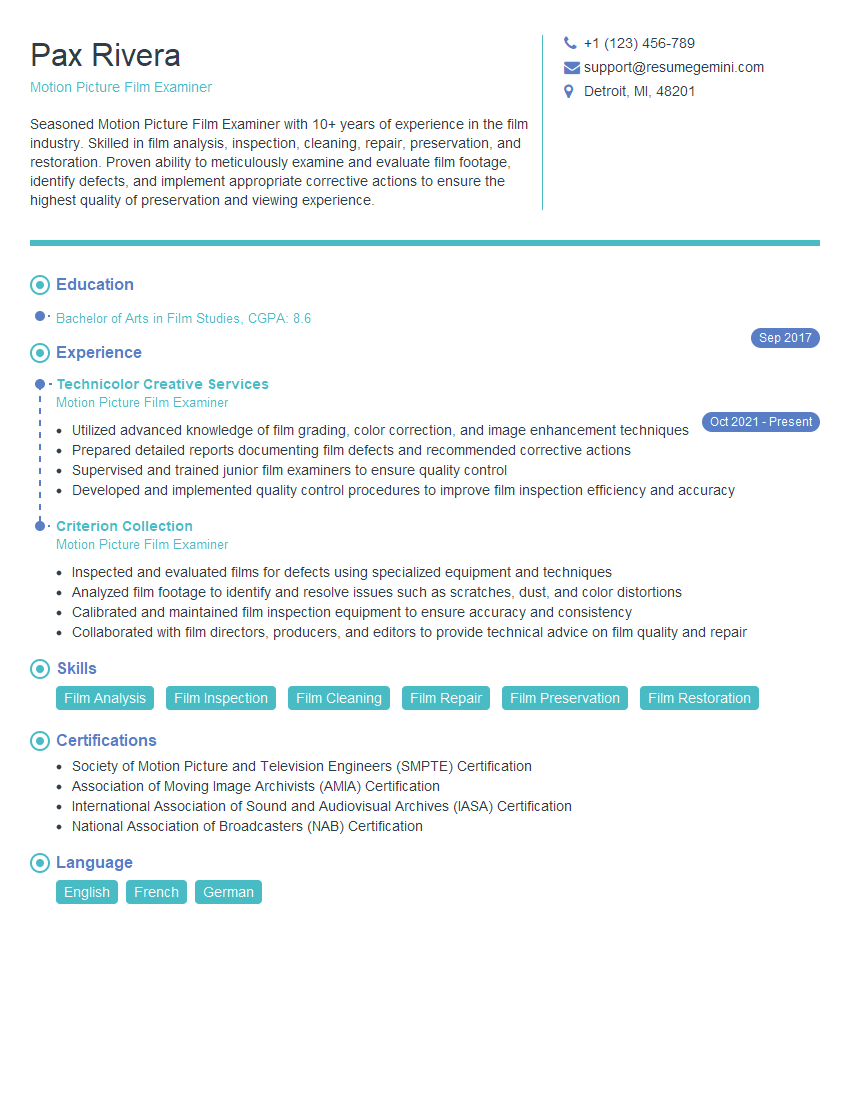
Acing the interview is crucial, but landing one requires a compelling resume that gets you noticed. Crafting a professional document that highlights your skills and experience is the first step toward interview success. ResumeGemini can help you build a standout resume that gets you called in for that dream job.






Essential Interview Questions For Motion Picture Film Examiner
1. Describe the process you follow to grade the quality of a motion picture film?
The process I follow to grade the quality of a motion picture film includes the following steps:
- Inspect the film for physical defects: I start by inspecting the film for any physical defects, such as scratches, tears, or splices. I also check the film’s overall condition and cleanliness.
- Set up the grading equipment: Once I have inspected the film, I set up the grading equipment. This includes calibrating the monitor and setting the grading software.
- Grade the film: I then begin grading the film. I use a variety of techniques to adjust the film’s color, contrast, and brightness. I also make sure that the film’s overall look is consistent throughout.
- Check the graded film: Once I have finished grading the film, I check the graded film to make sure that I am satisfied with the results. I also make any necessary adjustments.
- Export the graded film: Once I am satisfied with the graded film, I export it to a file format that can be used for distribution.
2. What are the different grading standards that you are familiar with?
American Society of Cinematographers (ASC) Reference Monitor Standard
- The ASC Reference Monitor Standard is a set of standards that have been developed by the American Society of Cinematographers (ASC) to ensure that films are graded consistently across different monitors.
- The ASC Reference Monitor Standard specifies the color temperature, gamma, and contrast ratio of the monitor that should be used for grading films.
International Telecommunication Union (ITU) Recommendation BT.709
- ITU Recommendation BT.709 is a set of standards that have been developed by the International Telecommunication Union (ITU) for the transmission and display of television signals.
- ITU Recommendation BT.709 specifies the color gamut, color temperature, and gamma of the display that should be used for grading television signals.
3. What are the different types of grading software that you are familiar with?
- DaVinci Resolve: DaVinci Resolve is a professional-grade grading software that is used by many major film and television studios.
- Adobe Premiere Pro: Adobe Premiere Pro is a popular video editing software that also includes grading tools.
- Final Cut Pro: Final Cut Pro is a video editing software that is popular with Mac users. It also includes grading tools.
- Avid Media Composer: Avid Media Composer is a video editing software that is used by many professional editors. It also includes grading tools.
4. What are the different film formats that you are familiar with?
- 35mm: 35mm film is a standard film format that has been used for many years.
- 16mm: 16mm film is a smaller film format that is often used for documentaries and independent films.
- Super 16mm: Super 16mm is a film format that is larger than 16mm but smaller than 35mm.
- 70mm: 70mm film is a large film format that is often used for IMAX films.
- Digital: Digital film formats, such as REDCODE RAW and ArriRAW, are becoming increasingly popular.
5. What are the different types of film stocks that you are familiar with?
- Kodak Vision3: Kodak Vision3 is a popular film stock that is used for a wide variety of films.
- Fuji Eternal: Fuji Eternal is a film stock that is known for its high contrast and saturation.
- Ilford HP5: Ilford HP5 is a black-and-white film stock that is known for its fine grain and high resolution.
6. What are the different types of cameras that you are familiar with?
- Film cameras: Film cameras use film to capture images.
- Digital cameras: Digital cameras use a sensor to capture images.
- DSLR cameras: DSLR cameras are digital cameras that use a interchangeable lens system.
- Mirrorless cameras: Mirrorless cameras are digital cameras that do not use a mirror to reflect light to the sensor.
7. What are the different types of lenses that you are familiar with?
- Prime lenses: Prime lenses have a fixed focal length.
- Zoom lenses: Zoom lenses have a variable focal length.
- Wide-angle lenses: Wide-angle lenses have a short focal length and are used to capture wide shots.
- Telephoto lenses: Telephoto lenses have a long focal length and are used to capture close-up shots.
8. What are the different types of lighting that you are familiar with?
- Natural light: Natural light is the light that comes from the sun.
- Artificial light: Artificial light is the light that comes from man-made sources, such as lamps and flashlights.
- Soft light: Soft light is diffused and creates a soft, even look.
- Hard light: Hard light is direct and creates a harsh, contrasty look.
9. What are the different types of sound that you are familiar with?
- Dialogue: Dialogue is the spoken words of the actors in a film.
- Sound effects: Sound effects are the sounds that are added to a film to create a more realistic or immersive experience.
- Music: Music is used in films to create a mood or atmosphere.
10. What are the different types of editing that you are familiar with?
- Linear editing: Linear editing is the traditional method of editing video. In linear editing, the editor cuts and pastes the footage in a linear fashion.
- Non-linear editing: Non-linear editing is a more modern method of editing video. In non-linear editing, the editor can cut and paste the footage in any order.
Interviewers often ask about specific skills and experiences. With ResumeGemini‘s customizable templates, you can tailor your resume to showcase the skills most relevant to the position, making a powerful first impression. Also check out Resume Template specially tailored for Motion Picture Film Examiner.
Career Expert Tips:
- Ace those interviews! Prepare effectively by reviewing the Top 50 Most Common Interview Questions on ResumeGemini.
- Navigate your job search with confidence! Explore a wide range of Career Tips on ResumeGemini. Learn about common challenges and recommendations to overcome them.
- Craft the perfect resume! Master the Art of Resume Writing with ResumeGemini’s guide. Showcase your unique qualifications and achievements effectively.
- Great Savings With New Year Deals and Discounts! In 2025, boost your job search and build your dream resume with ResumeGemini’s ATS optimized templates.
Researching the company and tailoring your answers is essential. Once you have a clear understanding of the Motion Picture Film Examiner‘s requirements, you can use ResumeGemini to adjust your resume to perfectly match the job description.
Key Job Responsibilities
Motion Picture Film Examiners are responsible for ensuring the quality and accuracy of motion picture film. They work in a variety of settings, including film studios, post-production houses, and archives. Their key responsibilities include:
1. Inspecting film for defects
Examining film for scratches, tears, and other defects using specialized equipment.
- Identifying and marking any defects found.
- Repairing or replacing damaged film.
2. Ensuring the accuracy of film content
Verifying that the film content is correct and complete.
- Checking the film for errors in continuity, sound, and timing.
- Making any necessary corrections to the film.
3. Maintaining film archives
Storing and preserving motion picture film in a controlled environment.
- Cataloging and labeling film cans.
- Monitoring the condition of film and taking steps to prevent damage.
4. Assisting with film restoration projects
Helping to restore damaged or deteriorated film.
- Cleaning and repairing film.
- Transferring film to digital formats.
Interview Tips
To ace an interview for a Motion Picture Film Examiner position, it’s important to be prepared. Here are some tips to help you succeed:
1. Research the company and the position
Take the time to learn about the company you’re applying to and the specific position you’re interested in. This will help you understand the company’s culture and values, and it will also help you answer questions about your qualifications and experience.
- Visit the company’s website to learn about their history, mission, and products or services.
- Read industry news and articles to stay up-to-date on the latest trends and developments.
2. Practice your answers to common interview questions
There are a few common interview questions that you’re likely to encounter, such as “Tell me about yourself” and “Why are you interested in this position?” It’s helpful to practice your answers to these questions in advance so that you can deliver them confidently and concisely.
- Use the STAR method (Situation, Task, Action, Result) to structure your answers.
- Focus on highlighting your skills and experience that are most relevant to the position.
3. Be prepared to talk about your experience with film
The interviewer will likely want to know about your experience with film. Be prepared to discuss your knowledge of film formats, equipment, and techniques.
- Highlight any specific projects or experiences that demonstrate your skills and abilities.
- If you have any formal training or education in film, be sure to mention that as well.
4. Dress professionally and arrive on time
First impressions matter, so it’s important to dress professionally and arrive on time for your interview. This shows the interviewer that you’re serious about the position and that you respect their time.
- Choose clothing that is clean, pressed, and appropriate for a business setting.
- Arrive at the interview location at least 10 minutes early to give yourself time to relax and prepare.
5. Prepare questions to ask the interviewer
Asking thoughtful questions at the end of the interview shows the interviewer that you’re engaged and interested in the position. It also gives you an opportunity to learn more about the company and the position.
- Ask about the company’s culture and values.
- Ask about the specific responsibilities of the position.
- Ask about the company’s plans for the future.
Next Step:
Armed with this knowledge, you’re now well-equipped to tackle the Motion Picture Film Examiner interview with confidence. Remember, a well-crafted resume is your first impression. Take the time to tailor your resume to highlight your relevant skills and experiences. And don’t forget to practice your answers to common interview questions. With a little preparation, you’ll be on your way to landing your dream job. So what are you waiting for? Start building your resume and start applying! Build an amazing resume with ResumeGemini.