Top 10 Questions for Offset Press Operator Interview

Essential Interview Questions For Offset Press Operator

1. How do you maintain colour consistency throughout the printing process?

  • Use spectrophotometer to measure colour values at various stages of the printing process.
  • Calibrate the press and ink system to ensure accurate colour reproduction.
  • Use colour management software to create colour profiles and monitor colour accuracy.
  • Make necessary adjustments to ink density, fountain solution, and press settings to achieve consistent colours.
  • Proof prints and compare them to the original artwork to ensure colour accuracy.

2. Explain the process of trapping and its significance in offset printing?

Trapping Process

  • Overlapping adjacent colours slightly to prevent gaps or white lines from appearing between them.
  • Ensures a smooth and seamless transition between colours.

Significance

  • Prevents colour misregistration and ensures crisp edges.
  • Compensates for paper expansion and contraction during printing.
  • Maintains colour integrity and prevents unwanted colour shifts.

3. How do you troubleshoot common offset printing problems such as ink smearing or ghosting?

  • Ink Smearing:
  • Check for excessive ink flow or improper ink viscosity.
  • Inspect rollers and blankets for wear or damage.
  • Adjust impression pressure to reduce ink transfer.
  • Ghosting:
  • Check for ink piling on the blanket or rollers.
  • Increase ink tack or reduce fountain solution to reduce ink transfer.
  • Inspect plates for scratches or damage.

4. Describe your experience in handling different types of paper stocks and inks?

  • Coated paper:
  • Experience in printing on coated paper, which requires precise ink and water balance.
  • Uncoated paper:
  • Familiar with the challenges of printing on uncoated paper, such as ink absorption and show-through.
  • Inks:
  • Experience in using various ink types, including conventional, UV, and specialty inks.
  • Knowledge of ink properties, such as viscosity, tack, and drying time.

5. How do you ensure print quality and accuracy in offset printing?

  • Pre-press preparation:
  • Reviewing artwork and verifying colour accuracy.
  • Creating plates with proper dot gain and registration.
  • Press operation:
  • Calibrating the press and ink system.
  • Maintaining proper ink and water balance.
  • Monitoring print quality throughout the run.
  • Post-press finishing:
  • Inspecting finished products for defects.
  • Ensuring proper cutting, folding, and binding.

6. What are the safety precautions you observe when operating offset printing equipment?

  • Wear appropriate safety gear, including gloves and eye protection.
  • Follow lockout/tagout procedures when cleaning or maintaining equipment.
  • Be aware of moving parts and pinch points.
  • Properly handle and store chemicals and inks.
  • Maintain a clean and well-ventilated work environment.
  • Report any safety concerns or incidents immediately.

7. How do you stay updated with the latest technologies and trends in offset printing?

  • Attend industry conferences and workshops.
  • Read trade publications and online resources.
  • Consult with equipment manufacturers and suppliers.
  • Participate in online forums and discussion groups.
  • Explore new techniques and materials to improve print quality and efficiency.

8. Explain the concepts of dot gain and dot loss in offset printing?

Dot Gain

  • The increase in dot size during the printing process due to ink spread.
  • Affects colour accuracy and image sharpness.
  • Dot Loss

  • The decrease in dot size during the printing process due to ink absorption or other factors.
  • Can lead to loss of detail and reduced colour saturation.
  • 9. How do you manage colour registration in offset printing?

    • Use registration marks on plates and paper.
    • Adjust press settings to ensure accurate alignment of colours.
    • Inspect proofs and make necessary corrections before printing large batches.
    • Monitor registration throughout the printing process.

    10. Describe your experience in working with a team in a printing environment?

    • Collaborated with pre-press and post-press departments to ensure smooth production flow.
    • Communicated effectively with team members to resolve issues and meet deadlines.
    • Assisted colleagues with training and troubleshooting.
    • Maintained a positive and supportive work environment.

    Interviewers often ask about specific skills and experiences. With ResumeGemini‘s customizable templates, you can tailor your resume to showcase the skills most relevant to the position, making a powerful first impression. Also check out Resume Template specially tailored for Offset Press Operator.

    Career Expert Tips:

    • Ace those interviews! Prepare effectively by reviewing the Top 50 Most Common Interview Questions on ResumeGemini.
    • Navigate your job search with confidence! Explore a wide range of Career Tips on ResumeGemini. Learn about common challenges and recommendations to overcome them.
    • Craft the perfect resume! Master the Art of Resume Writing with ResumeGemini’s guide. Showcase your unique qualifications and achievements effectively.
    • Great Savings With New Year Deals and Discounts! In 2025, boost your job search and build your dream resume with ResumeGemini’s ATS optimized templates.

    Researching the company and tailoring your answers is essential. Once you have a clear understanding of the Offset Press Operator‘s requirements, you can use ResumeGemini to adjust your resume to perfectly match the job description.

    Key Job Responsibilities

    Offset Press Operators are responsible for overseeing the printing process, ensuring that printed materials meet quality standards and deadlines.

    1. Preparing the Press

    Preparing the press includes tasks like:

    • Assembling printing plates
    • Adjusting ink and water levels
    • Setting up paper feeders

    2. Operating the Press

    Operating the press involves:

    • Monitoring paper flow
    • Making adjustments to ensure print quality
    • Troubleshooting any issues

    3. Maintaining the Press

    Maintaining the press requires:

    • Cleaning and lubricating the press
    • Replacing worn parts
    • Performing regular maintenance checks

    4. Post-Printing Tasks

    Post-printing tasks include:

    • Unloading printed materials
    • Inspecting finished products
    • Storing printed materials properly

    Interview Tips

    Preparing for an interview can help you make a great impression and increase your chances of getting the job.

    1. Research the Company and the Position

    Before the interview, take some time to research the company and the specific Offset Press Operator position you are applying for. This will help you understand the company’s culture, values, and the specific requirements of the role.

    • Visit the company’s website
    • Read industry news and articles
    • Connect with current or former employees on LinkedIn

    2. Practice Your Answers to Common Interview Questions

    There are a number of common interview questions that you are likely to be asked, such as “Tell me about yourself” and “Why are you interested in this position?”. It is helpful to practice your answers to these questions in advance so that you can deliver them confidently and concisely during the interview.

    • Use the STAR method to structure your answers
    • Be specific and provide examples
    • Tailor your answers to the specific job you are applying for

    3. Prepare Questions to Ask the Interviewer

    Asking thoughtful questions at the end of the interview shows that you are engaged and interested in the position. It also gives you an opportunity to learn more about the company and the role.

    • Ask about the company’s culture and values
    • Ask about the specific challenges and opportunities of the role
    • Ask about the company’s plans for growth and expansion

    4. Dress Professionally and Arrive on Time

    First impressions matter, so it is important to dress professionally and arrive on time for your interview. This shows that you are respectful of the interviewer’s time and that you are serious about the position.

    • Wear a suit or business casual attire
    • Be punctual and arrive early
    • Bring a portfolio of your work (if applicable)
    Note: These questions offer general guidance, it’s important to tailor your answers to your specific role, industry, job title, and work experience.

    Next Step:

    Now that you’re armed with a solid understanding of what it takes to succeed as a Offset Press Operator, it’s time to turn that knowledge into action. Take a moment to revisit your resume, ensuring it highlights your relevant skills and experiences. Tailor it to reflect the insights you’ve gained from this blog and make it shine with your unique qualifications. Don’t wait for opportunities to come to you—start applying for Offset Press Operator positions today and take the first step towards your next career milestone. Your dream job is within reach, and with a polished resume and targeted applications, you’ll be well on your way to achieving your career goals! Build your resume now with ResumeGemini.
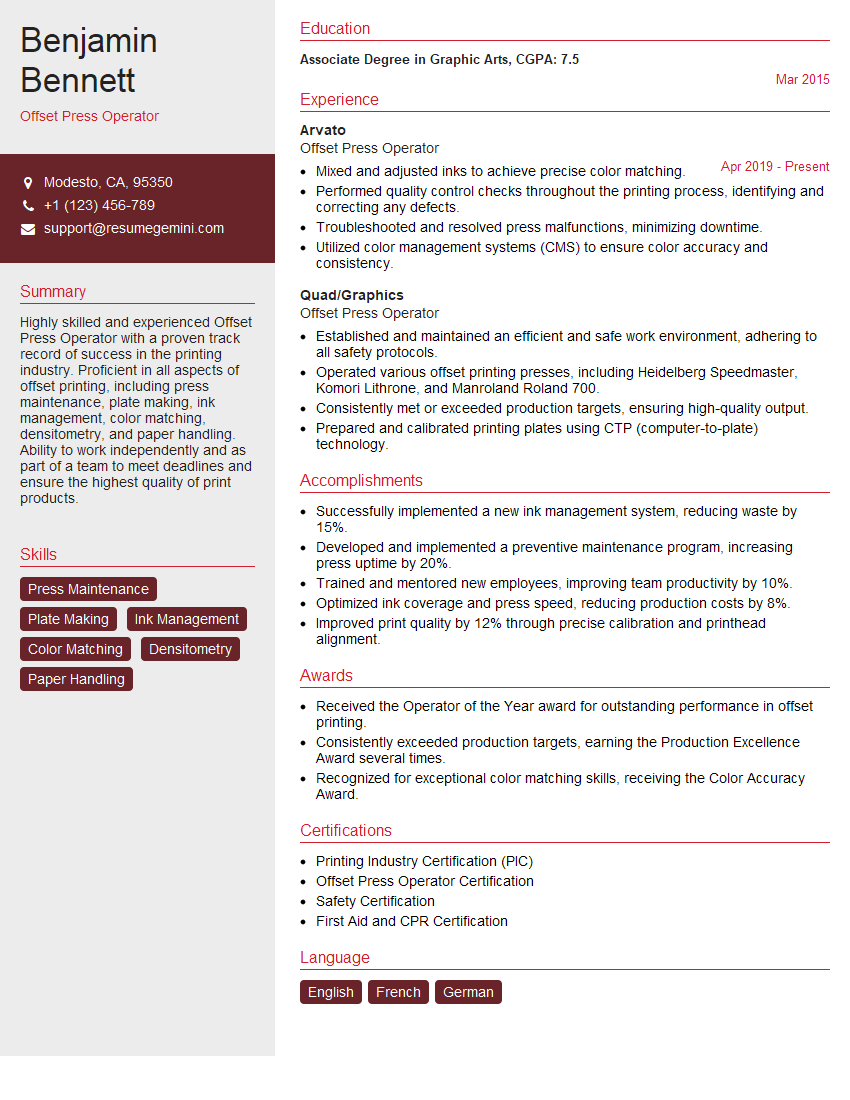
    Offset Press Operator Resume Template by ResumeGemini
    Disclaimer: The names and organizations mentioned in these resume samples are purely fictional and used for illustrative purposes only. Any resemblance to actual persons or entities is purely coincidental. These samples are not legally binding and do not represent any real individuals or businesses.

    Top 10 Questions for Offset-Press Operator Interview

    Essential Interview Questions For Offset-Press Operator

    1. Describe the steps involved in preparing an offset printing press for a print run.

    • Inspect plates for scratches, pinholes and tears.
    • Mount plates onto printing cylinders.
    • Adjust plate and blanket cylinders for correct impression and registration.
    • Load paper stock into feeder.
    • Set up ink feed system.
    • Calibrate color and ink density.
    • Run initial test prints, make adjustments as necessary.

    2. How do you ensure accurate color reproduction on an offset press?

    Color Calibration

    • Use color charts to create a reference point for color accuracy.
    • Calibrate press settings for ink density, dot gain, and registration.
    • Print color samples and compare them to the reference point, make adjustments as necessary.

    Ink Adjustment

    • Adjust ink feed rates, pH levels, and tackiness to achieve optimal color reproduction.
    • Use spectrophotometer to measure ink colors and make precise adjustments.
    • Monitor color consistency throughout the print run and make adjustments as needed.

    3. Explain the importance of maintaining correct tension on the paper web during printing.

    • Prevents paper jams, wrinkles, and tears.
    • Ensures consistent paper feed and accurate registration.
    • Minimizes ghosting and other print defects caused by paper movement.
    • Optimizes image quality and reduces waste.

    4. How do you troubleshoot common offset printing problems, such as ghosting, streaking, and slurring?

      Ghosting:
    • Check plate cylinders for scratches or pinholes.
    • Tighten tension on paper web.
    • Adjust ink feed for better trapping.
    • Streaking:
    • Inspect blanket cylinders for scratches or tears.
    • Replace worn rollers.
    • Check paper stock for moisture content or contaminants.
    • Slurring:
    • Adjust roller pressure for better ink transfer.
    • Clean ink rollers, fountain, and plate cylinders.
    • Check press speed and reduce if necessary.

    5. Describe the different types of printing plates used in offset printing and their advantages and disadvantages.

      Aluminum Plates:
    • Advantages: Good image quality, durable, economical.
    • Disadvantages: Not suitable for high-volume runs, can be scratched easily.
    • Photopolymer Plates:
    • Advantages: High-quality reproduction, flexible, suitable for long runs.
    • Disadvantages: More expensive, require special equipment for processing.
    • Thermal Plates:
    • Advantages: Fast to produce, good for short runs.
    • Disadvantages: Lower image quality, less durable.

    6. How do you ensure safety when working on an offset printing press?

    • Wear appropriate safety gear (e.g., gloves, ear protection, safety glasses).
    • Follow lock-out/tag-out procedures before performing maintenance or repairs.
    • Maintain a clean and organized work area.
    • Inspect equipment regularly and report any hazards.
    • Be aware of moving parts and potential pinch points.
    • Receive proper training and certification for operating the press.

    7. What are the common maintenance tasks required for an offset printing press?

    • Regular cleaning of rollers, blankets, and press components.
    • Inspecting and replacing worn parts (e.g., rollers, bearings).
    • Lubricating moving parts as per manufacturer’s recommendations.
    • Calibrating and adjusting press settings to maintain print quality.
    • Performing troubleshooting and repairs as needed.

    8. Describe the different paper stocks used in offset printing and their properties.

      Uncoated Paper:
    • Absorbent, provides a natural look and feel.
    • Coated Paper:
    • Smoother surface, improved image quality.
    • Glossy Paper:
    • High shine, enhances colors and contrast.
    • Matte Paper:
    • Non-reflective, reduces glare.
    • Recycled Paper:
    • Eco-friendly option, may have variations in color and texture.

    9. What are the key factors to consider when determining the ink coverage for an offset printing job?

    • Type of paper stock used.
    • Desired print quality.
    • Press speed and capabilities.
    • Ink characteristics (e.g., viscosity, drying time).
    • Environmental factors (e.g., temperature, humidity).

    10. Explain the concept of “registration” in offset printing and its importance.

    • Ensuring that multiple colors or elements of a printed image are aligned accurately.
    • Prevents misalignment, overlaps, and color shifts.
    • Achieved through precise adjustment of plate cylinders and other press components.
    • Critical for high-quality printing, particularly for multi-color designs and complex graphics.

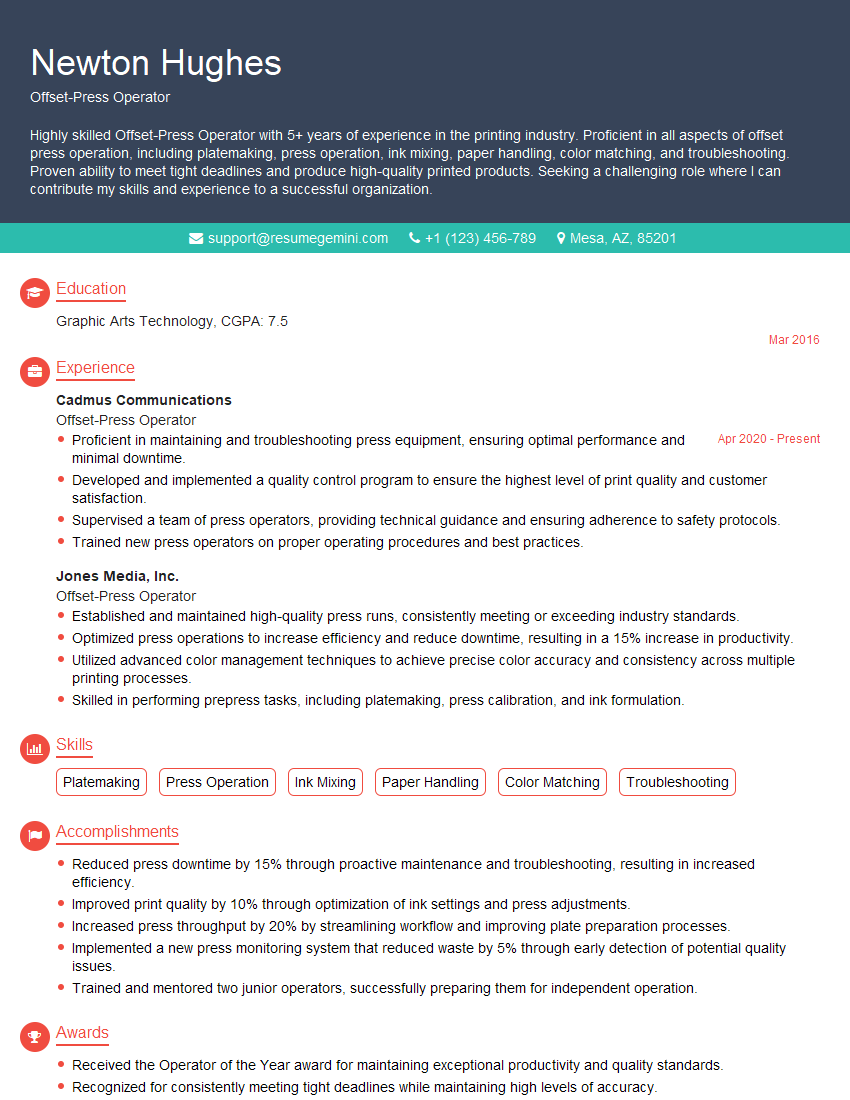
    Interviewers often ask about specific skills and experiences. With ResumeGemini‘s customizable templates, you can tailor your resume to showcase the skills most relevant to the position, making a powerful first impression. Also check out Resume Template specially tailored for Offset-Press Operator.

    Career Expert Tips:

    • Ace those interviews! Prepare effectively by reviewing the Top 50 Most Common Interview Questions on ResumeGemini.
    • Navigate your job search with confidence! Explore a wide range of Career Tips on ResumeGemini. Learn about common challenges and recommendations to overcome them.
    • Craft the perfect resume! Master the Art of Resume Writing with ResumeGemini’s guide. Showcase your unique qualifications and achievements effectively.
    • Great Savings With New Year Deals and Discounts! In 2025, boost your job search and build your dream resume with ResumeGemini’s ATS optimized templates.

    Researching the company and tailoring your answers is essential. Once you have a clear understanding of the Offset-Press Operator‘s requirements, you can use ResumeGemini to adjust your resume to perfectly match the job description.

    Key Job Responsibilities

    Offset-Press Operators are skilled professionals who play a crucial role in the printing industry. Their primary responsibilities involve operating and maintaining offset printing presses, ensuring high-quality print production.

    1. Press Operation

    Offset-Press Operators expertly set up, operate, and maintain offset printing presses. They adjust press settings, load paper rolls, and control ink flow to ensure optimal print quality.

    • Set up and adjust printing presses based on job specifications
    • Load paper rolls and monitor paper flow during printing runs
    • Monitor ink levels and adjust ink flow to achieve consistent color reproduction

    2. Plate Preparation

    Offset printing involves transferring images from metal plates to paper. Offset-Press Operators prepare and mount these plates to the press, ensuring accurate registration and precise ink transfer.

    • Inspect printing plates for defects and clean as necessary
    • Mount plates onto press cylinders using precise alignment techniques
    • Adjust plate pressure and cylinder settings to optimize print quality

    3. Quality Control

    Offset-Press Operators are responsible for monitoring print quality throughout the production process. They inspect printed sheets, adjust settings as needed, and troubleshoot any issues to achieve the desired results.

    • Inspect printed sheets for defects such as misregistration, ink smudging, or color variations
    • Adjust press settings and make corrections to ensure consistent print quality
    • Troubleshoot press problems and implement corrective actions

    4. Maintenance and Safety

    Offset-Press Operators perform routine maintenance on printing presses to ensure optimal performance and prevent breakdowns. They also adhere to safety protocols to maintain a safe and efficient work environment.

    • Lubricate and clean press components regularly
    • Inspect press parts for wear and tear, and replace or repair as needed
    • Follow safety procedures, including proper equipment handling and hazardous materials usage

    Interview Tips

    Preparing for an interview can significantly increase your chances of success. Here are some valuable tips to help you ace your interview for an Offset-Press Operator position:

    1. Research the Company and the Job

    Show the interviewer that you’ve taken the time to learn about the company’s history, values, and current projects. Understand the specific responsibilities of the Offset-Press Operator role and how your skills align with them.

    • Visit the company’s website and social media pages
    • Review the job description thoroughly and identify your relevant qualifications

    2. Practice Common Interview Questions

    Prepare answers to commonly asked interview questions, such as “Tell me about yourself,” “Why are you interested in this role?” and “What are your strengths and weaknesses?” Tailor your responses to the specific job requirements and highlight your relevant experience.

    • Research industry-specific questions and prepare concise and informative answers
    • Practice your answers aloud to improve your delivery and confidence

    3. Showcase Your Technical Skills

    Offset-Press Operators are expected to possess strong technical skills. During the interview, be prepared to discuss your knowledge of offset printing presses, plate preparation, and quality control procedures. Provide specific examples of your work and explain how you achieved optimal print results.

    • Highlight your experience with different types of printing presses and materials
    • Share examples of troubleshooting problems and implementing effective solutions

    4. Emphasize Your Attention to Detail

    Offset-Press Operators must have a keen eye for detail to ensure accurate print production. In your interview, emphasize your strong attention to detail and your ability to spot and correct errors. Provide examples of how you have consistently produced high-quality printed materials.

    • Describe your quality control processes and how you monitor print quality
    • Share instances where you identified and resolved printing defects
    Note: These questions offer general guidance, it’s important to tailor your answers to your specific role, industry, job title, and work experience.

    Next Step:

    Now that you’re armed with a solid understanding of what it takes to succeed as a Offset-Press Operator, it’s time to turn that knowledge into action. Take a moment to revisit your resume, ensuring it highlights your relevant skills and experiences. Tailor it to reflect the insights you’ve gained from this blog and make it shine with your unique qualifications. Don’t wait for opportunities to come to you—start applying for Offset-Press Operator positions today and take the first step towards your next career milestone. Your dream job is within reach, and with a polished resume and targeted applications, you’ll be well on your way to achieving your career goals! Build your resume now with ResumeGemini.

    Offset-Press Operator Resume Template by ResumeGemini
    Disclaimer: The names and organizations mentioned in these resume samples are purely fictional and used for illustrative purposes only. Any resemblance to actual persons or entities is purely coincidental. These samples are not legally binding and do not represent any real individuals or businesses.
    Scroll to Top