Ever felt underprepared for that crucial job interview? Or perhaps you’ve landed the interview but struggled to articulate your skills and experiences effectively? Fear not! We’ve got you covered. In this blog post, we’re diving deep into the Pharmaceutical Process Engineer interview questions that you’re most likely to encounter. But that’s not all. We’ll also provide expert insights into the key responsibilities of a Pharmaceutical Process Engineer so you can tailor your answers to impress potential employers.
Acing the interview is crucial, but landing one requires a compelling resume that gets you noticed. Crafting a professional document that highlights your skills and experience is the first step toward interview success. ResumeGemini can help you build a standout resume that gets you called in for that dream job.






Essential Interview Questions For Pharmaceutical Process Engineer
1. Describe the fundamental principles of fluid flow and heat transfer as applied to pharmaceutical manufacturing processes?
- Explain the principles of fluid flow, including laminar and turbulent flow, Reynolds number, and pressure drop calculations.
- Describe the modes of heat transfer, including conduction, convection, and radiation, and their applications in pharmaceutical manufacturing.
2. How would you design and optimize a pharmaceutical manufacturing process for a given product?
Process Design
- Describe the steps involved in process design, including product characterization, process selection, and equipment specification.
- Explain the importance of mass and energy balances, as well as process control and validation.
Process Optimization
- Discuss techniques for process optimization, such as statistical analysis, simulation, and scale-up studies.
- Identify potential bottlenecks and inefficiencies in a manufacturing process and suggest solutions to improve yield and efficiency.
3. What are the key elements of a GMP-compliant manufacturing facility for pharmaceutical products?
- Describe the principles of Good Manufacturing Practices (GMP) and their importance in pharmaceutical manufacturing.
- Explain the requirements for facility design, equipment validation, and quality control systems.
- Discuss the role of documentation, training, and process monitoring in GMP compliance.
4. How do you ensure the quality and safety of pharmaceutical products throughout the manufacturing process?
- Describe the quality control measures implemented at different stages of the manufacturing process.
- Explain the principles of analytical testing and process validation.
- Discuss the importance of risk assessment and mitigation strategies to ensure product safety.
5. What are the emerging trends and technologies in pharmaceutical manufacturing?
- Discuss the use of automation, robotics, and data analytics in pharmaceutical manufacturing.
- Explain the potential benefits and challenges of continuous manufacturing and biomanufacturing.
- Identify opportunities for innovation and process improvement in the pharmaceutical industry.
6. How do you troubleshoot and resolve technical issues that arise during pharmaceutical manufacturing?
- Describe a systematic approach to troubleshooting process problems, including data analysis, root cause identification, and corrective actions.
- Provide examples of common technical issues in pharmaceutical manufacturing and discuss potential solutions.
- Emphasize the importance of collaboration and communication with other engineers, technicians, and stakeholders.
7. Describe your experience in scale-up and technology transfer for pharmaceutical manufacturing processes.
- Explain the challenges and considerations involved in scale-up from pilot to commercial production.
- Discuss the role of simulation, modeling, and validation studies in technology transfer.
- Provide examples of successful scale-up projects and highlight the lessons learned.
8. What are the regulatory requirements for pharmaceutical manufacturing in your jurisdiction?
- Demonstrate knowledge of local and international regulatory requirements related to pharmaceutical manufacturing.
- Explain the importance of compliance with regulatory agencies, including the FDA, EMA, and ICH.
- Discuss the role of auditors and inspectors in ensuring compliance and quality standards.
9. How do you stay up-to-date with the latest advancements in pharmaceutical process engineering?
- Describe your professional development activities, such as attending conferences, reading technical journals, and pursuing continuing education.
- Explain how you leverage industry resources, such as professional organizations and vendors, to stay informed about emerging technologies and best practices.
- Discuss your contributions to the field through publications, presentations, or industry collaborations.
10. Why are you interested in this position and how do your skills and experience align with our company’s needs?
- Tailor your answer to the specific role and company you are applying for.
- Highlight your relevant skills, experience, and qualifications that match the job requirements.
- Express your interest in the company’s mission and values, and how your contributions can benefit the organization.
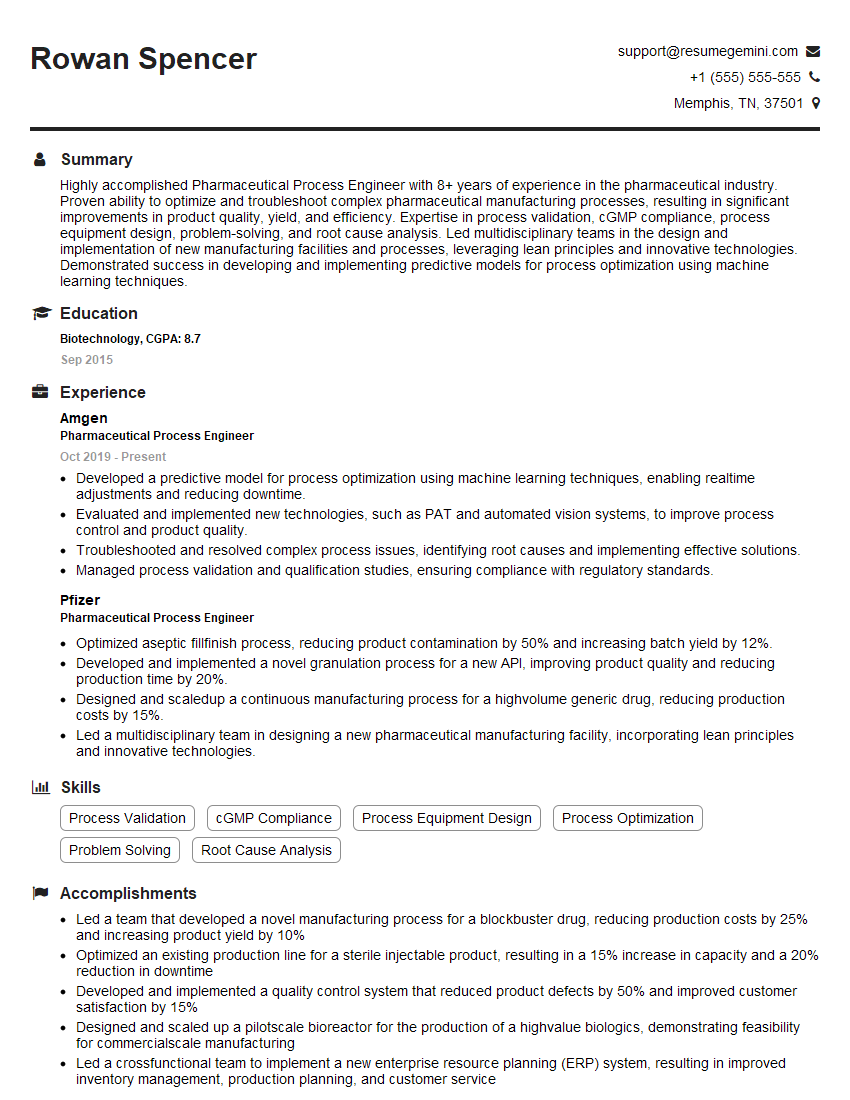
Interviewers often ask about specific skills and experiences. With ResumeGemini‘s customizable templates, you can tailor your resume to showcase the skills most relevant to the position, making a powerful first impression. Also check out Resume Template specially tailored for Pharmaceutical Process Engineer.
Career Expert Tips:
- Ace those interviews! Prepare effectively by reviewing the Top 50 Most Common Interview Questions on ResumeGemini.
- Navigate your job search with confidence! Explore a wide range of Career Tips on ResumeGemini. Learn about common challenges and recommendations to overcome them.
- Craft the perfect resume! Master the Art of Resume Writing with ResumeGemini’s guide. Showcase your unique qualifications and achievements effectively.
- Great Savings With New Year Deals and Discounts! In 2025, boost your job search and build your dream resume with ResumeGemini’s ATS optimized templates.
Researching the company and tailoring your answers is essential. Once you have a clear understanding of the Pharmaceutical Process Engineer‘s requirements, you can use ResumeGemini to adjust your resume to perfectly match the job description.
Key Job Responsibilities
Pharmaceutical Process Engineers are responsible for designing and improving the production processes used to manufacture pharmaceutical products. They work closely with other engineers, scientists, and technicians to ensure that the products meet all safety, quality, and regulatory standards. Their responsibilities include optimizing existing processes, developing new processes, troubleshooting issues, and managing equipment. They may also work on process validation, scale-up, and technology transfer.
1. Process Design and Improvement
Design and optimize pharmaceutical manufacturing processes to improve efficiency, yield, and quality.
- Identify and evaluate new technologies and equipment to improve processes.
- Conduct process simulation and modeling to optimize process parameters.
2. Process Development
Develop new manufacturing processes for new products or improve existing processes.
- Design and conduct experiments to optimize process parameters.
- Collaborate with research and development scientists to scale up new processes.
3. Troubleshooting
Identify and resolve issues that arise during production.
- Conduct root cause analysis to identify the source of problems.
- Develop and implement corrective actions to prevent issues from recurring.
4. Equipment Management
Manage and maintain equipment used in the manufacturing process.
- Develop and implement maintenance schedules.
- Troubleshoot and repair equipment issues.
5. Process Validation
Ensure that processes meet all regulatory requirements.
- Conduct process validation studies to demonstrate compliance with regulations.
- Maintain validation records and documentation.
6. Scale-Up and Technology Transfer
Scale up processes from development to commercial production.
- Transfer technology and processes from research and development to manufacturing.
- Train operators on new processes and equipment.
Interview Tips
Here are some tips to help you ace your interview for a Pharmaceutical Process Engineer position:
1. Research the Company and the Position
Before the interview, take the time to research the company and the specific position you are applying for. This will help you understand the company’s culture, values, and goals, as well as the specific responsibilities of the role. You can find this information on the company’s website, LinkedIn, and other online sources.
2. Practice Your Answers to Common Interview Questions
There are a number of common interview questions that you are likely to be asked, such as “Why are you interested in this position?” and “What are your strengths and weaknesses?”. It is helpful to practice your answers to these questions in advance so that you can deliver them confidently and concisely.
3. Highlight Your Relevant Skills and Experience
In your interview, be sure to highlight your relevant skills and experience, especially those that are mentioned in the job description. For example, if the job description mentions that the ideal candidate will have experience in process design and optimization, be sure to discuss your experience in these areas.
4. Ask Thoughtful Questions
At the end of the interview, the interviewer will typically ask if you have any questions. This is a great opportunity to show your interest in the position and the company. Ask thoughtful questions about the company’s culture, the position’s responsibilities, and the company’s future plans.
Next Step:
Armed with this knowledge, you’re now well-equipped to tackle the Pharmaceutical Process Engineer interview with confidence. Remember, preparation is key. So, start crafting your resume, highlighting your relevant skills and experiences. Don’t be afraid to tailor your application to each specific job posting. With the right approach and a bit of practice, you’ll be well on your way to landing your dream job. Build your resume now from scratch or optimize your existing resume with ResumeGemini. Wish you luck in your career journey!