Are you gearing up for a career in Pilates Instructor? Feeling nervous about the interview questions that might come your way? Don’t worry, you’re in the right place. In this blog post, we’ll dive deep into the most common interview questions for Pilates Instructor and provide you with expert-backed answers. We’ll also explore the key responsibilities of this role so you can tailor your responses to showcase your perfect fit.
Acing the interview is crucial, but landing one requires a compelling resume that gets you noticed. Crafting a professional document that highlights your skills and experience is the first step toward interview success. ResumeGemini can help you build a standout resume that gets you called in for that dream job.






Essential Interview Questions For Pilates Instructor
1. Describe the benefits of Pilates and how it differs from other forms of exercise?
- . Pilates focuses on improving core strength, flexibility, and balance by emphasizing proper alignment, breathing, and control.
- It is a low-impact exercise that is suitable for people of all ages and fitness levels.
- Pilates is often used to improve posture, reduce back pain, and enhance athletic performance.
2. How do you modify exercises for clients with different fitness levels and injuries?
Assessment
- Conduct a thorough assessment of the client’s fitness level, goals, and any injuries or limitations.
Modifications
- Provide modifications for exercises to accommodate different fitness levels and injuries.
- For example, exercises can be made easier by reducing the range of motion or using lighter weights.
- Exercises can be made more challenging by increasing the range of motion or using heavier weights.
3. How do you create a safe and effective Pilates program for clients?
- Take into account the client’s individual needs, goals, and limitations.
- Design a program that is challenging but achievable.
- Provide clear instructions and demonstrate exercises correctly.
- Monitor clients closely and provide feedback to ensure proper form and safety.
4. What are the key principles of Pilates and how do you apply them in your teaching?
- Concentration: Focus on the present moment and the quality of movement.
- Control: Move with precision and control throughout the entire range of motion.
- Centering: Engage the core muscles to stabilize and support the body.
- Flow: Move smoothly and fluidly from one exercise to the next.
- Breathing: Coordinate breathing with movement to enhance core activation and improve circulation.
5. How do you motivate clients to adhere to their Pilates program?
- Set realistic goals and celebrate progress.
- Provide a positive and supportive environment.
- Educate clients about the benefits of Pilates and how it can help them achieve their goals.
- Offer variety in exercises and make workouts enjoyable.
- Provide feedback and encouragement to keep clients engaged.
6. What are the common injuries associated with Pilates and how do you prevent them?
- Hamstring strains: Focus on proper alignment and avoid overextending the knees.
- Lower back pain: Strengthen the core muscles and maintain a neutral spine position.
- Shoulder impingement: Use proper form when performing exercises that involve overhead movements.
- Carpal tunnel syndrome: Avoid gripping equipment too tightly and take breaks to stretch the wrists.
7. How do you stay up-to-date on the latest Pilates techniques and research?
- Attend workshops and conferences.
- Read books and articles.
- Network with other Pilates instructors.
- Participate in continuing education courses.
8. What is your teaching style and how do you cater to different learning styles?
I believe in creating a supportive and encouraging learning environment where clients feel comfortable asking questions and learning at their own pace. I use a variety of teaching methods to cater to different learning styles, including:
- Verbal cues: I provide clear and concise verbal instructions to guide clients through the exercises.
- Visual cues: I demonstrate exercises clearly and use visual aids, such as charts and diagrams, to help clients understand the movements.
- Kinesthetic cues: I provide hands-on assistance to help clients feel the correct body alignment and movement patterns.
9. How do you assess client progress and make adjustments to their program?
- Regularly observe clients during sessions to assess their form and progress.
- Use objective measures, such as range of motion tests and balance assessments, to track progress.
- Consult with clients to discuss their goals and any changes they may be experiencing.
- Make adjustments to the program based on assessment results and client feedback to ensure continued progress and prevent plateaus.
10. What is your approach to working with clients who have special needs or injuries?
- Conduct a thorough assessment to understand the client’s specific needs and limitations.
- Modify exercises to accommodate the client’s abilities and ensure their safety.
- Work closely with the client’s healthcare team to develop a safe and effective Pilates program.
- Provide ongoing support and encouragement to help the client achieve their goals.
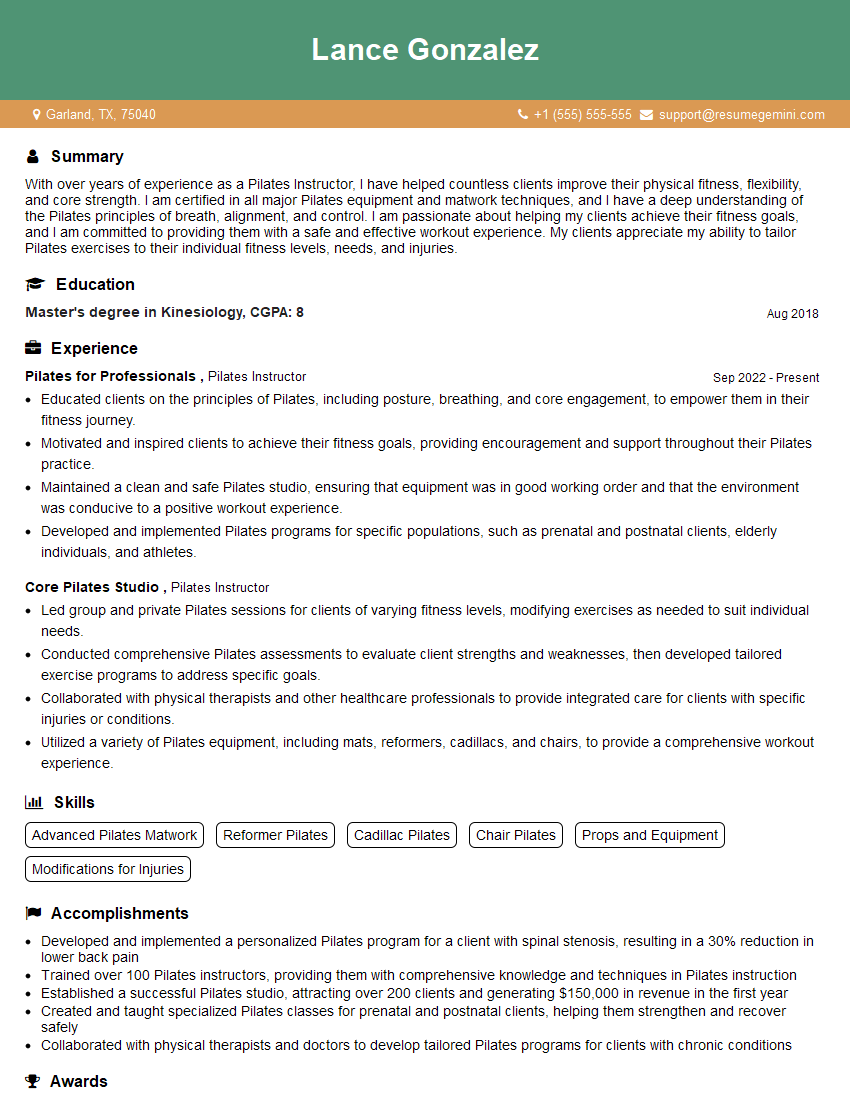
Interviewers often ask about specific skills and experiences. With ResumeGemini‘s customizable templates, you can tailor your resume to showcase the skills most relevant to the position, making a powerful first impression. Also check out Resume Template specially tailored for Pilates Instructor.
Career Expert Tips:
- Ace those interviews! Prepare effectively by reviewing the Top 50 Most Common Interview Questions on ResumeGemini.
- Navigate your job search with confidence! Explore a wide range of Career Tips on ResumeGemini. Learn about common challenges and recommendations to overcome them.
- Craft the perfect resume! Master the Art of Resume Writing with ResumeGemini’s guide. Showcase your unique qualifications and achievements effectively.
- Great Savings With New Year Deals and Discounts! In 2025, boost your job search and build your dream resume with ResumeGemini’s ATS optimized templates.
Researching the company and tailoring your answers is essential. Once you have a clear understanding of the Pilates Instructor‘s requirements, you can use ResumeGemini to adjust your resume to perfectly match the job description.
Key Job Responsibilities
Pilates Instructors are fitness professionals who specialize in teaching the Pilates method of exercise. Pilates is a low-impact, full-body workout that emphasizes core strength, flexibility, and balance.
1. Teach Pilates classes
This is the primary responsibility of a Pilates Instructor. Instructors will lead group or private classes, guiding students through the Pilates exercises.
- Demonstrate Pilates exercises correctly
- Provide clear instructions and modifications
2. Create and implement Pilates programs
Instructors may also be responsible for creating and implementing Pilates programs for their clients. These programs will be tailored to the individual needs of the client, and will help them achieve their fitness goals.
- Assess clients’ fitness levels and needs
- Design personalized Pilates programs
3. Provide guidance and support to clients
Instructors will provide guidance and support to their clients both during and outside of class. This may include answering questions, providing feedback, and offering encouragement.
- Answer clients’ questions about Pilates
- Provide feedback on clients’ progress
4. Maintain a safe and clean work environment
Instructors are responsible for maintaining a safe and clean work environment for their clients. This includes ensuring that the equipment is in good working order, and that the studio is clean and well-maintained.
- Inspect equipment regularly
- Clean and disinfect the studio
Interview Tips
Preparing for a Pilates Instructor interview can be daunting, but with the right preparation, you can ace the interview and land the job you want.
1. Research the company and the position
Before you go to your interview, take some time to research the company and the position you’re applying for. This will help you understand the company’s culture and values, and will also give you a better idea of what the job entails.
- Visit the company’s website
- Read online reviews of the company
2. Practice your answers to common interview questions
There are a few common interview questions that you’re likely to be asked, so it’s a good idea to practice your answers ahead of time. This will help you feel more confident and prepared during the interview.
- Tell me about your experience as a Pilates Instructor.
- Why are you interested in working for our company?
- What are your strengths and weaknesses as a Pilates Instructor?
3. Prepare questions to ask the interviewer
Asking thoughtful questions at the end of the interview shows that you’re interested in the position and the company. It also gives you a chance to learn more about the company and the job.
- What is the company culture like?
- What are the opportunities for professional development?
- What are the company’s goals for the future?
4. Dress professionally and arrive on time
First impressions matter, so it’s important to dress professionally and arrive on time for your interview. This shows that you respect the interviewer’s time and that you’re serious about the job.
- Wear clean, pressed clothing
- Arrive 10-15 minutes early for your interview
Next Step:
Now that you’re armed with the knowledge of Pilates Instructor interview questions and responsibilities, it’s time to take the next step. Build or refine your resume to highlight your skills and experiences that align with this role. Don’t be afraid to tailor your resume to each specific job application. Finally, start applying for Pilates Instructor positions with confidence. Remember, preparation is key, and with the right approach, you’ll be well on your way to landing your dream job. Build an amazing resume with ResumeGemini