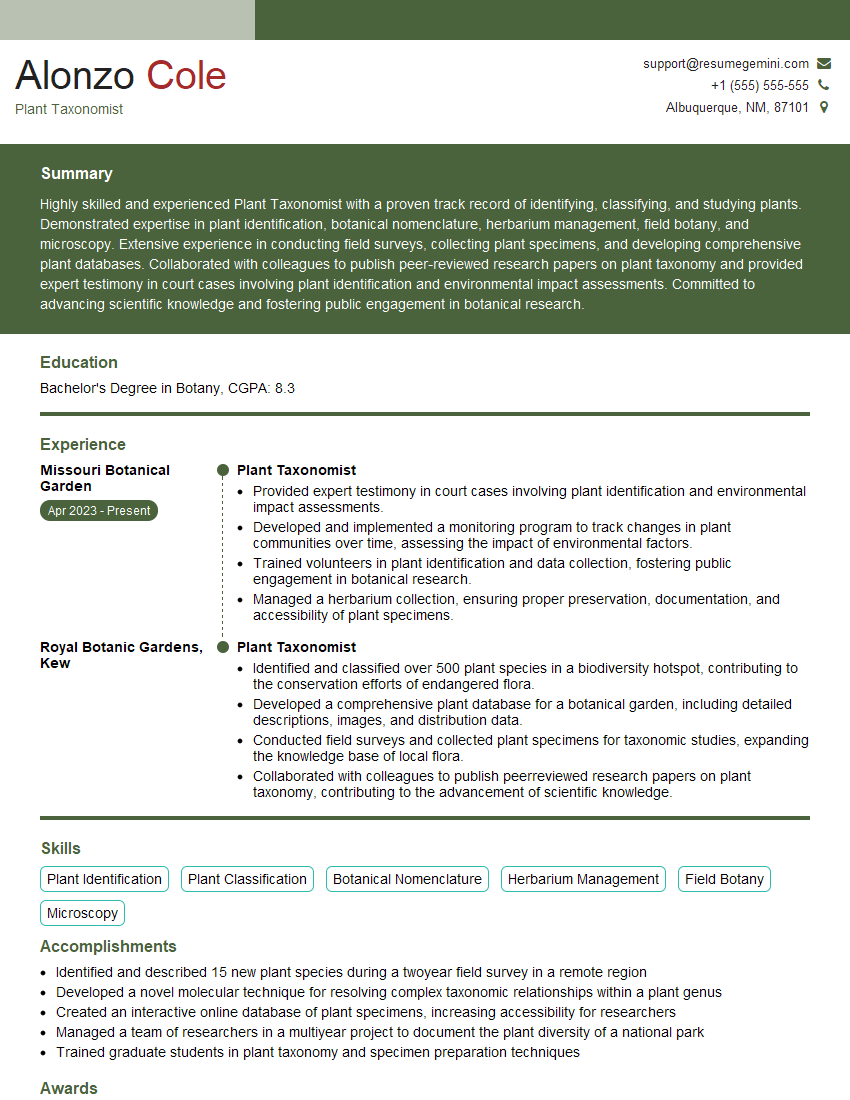
Ever felt underprepared for that crucial job interview? Or perhaps you’ve landed the interview but struggled to articulate your skills and experiences effectively? Fear not! We’ve got you covered. In this blog post, we’re diving deep into the Plant Taxonomist interview questions that you’re most likely to encounter. But that’s not all. We’ll also provide expert insights into the key responsibilities of a Plant Taxonomist so you can tailor your answers to impress potential employers.
Acing the interview is crucial, but landing one requires a compelling resume that gets you noticed. Crafting a professional document that highlights your skills and experience is the first step toward interview success. ResumeGemini can help you build a standout resume that gets you called in for that dream job.






Essential Interview Questions For Plant Taxonomist
1. Would you please describe the process of plant identification and the different techniques used for it?
The process of plant identification involves determining the scientific name and classification of a plant specimen. Various techniques are employed for this purpose, including:
- Morphological identification: Examining physical characteristics such as leaf shape, flower structure, and stem morphology.
- Microscopic identification: Utilizing a microscope to study cellular structures, trichomes, and other microscopic features.
- Chemical identification: Conducting chemical tests to determine the presence of specific compounds or secondary metabolites.
- Molecular identification: Employing techniques such as DNA barcoding to analyze genetic material and identify species.
- Literature search: Consulting botanical literature, databases, and taxonomic keys to compare specimens with existing descriptions.
2. What is the role of plant taxonomy in biodiversity conservation and ecosystem management?
Benefits for Biodiversity Conservation:
- Provides a scientific framework for understanding and classifying plant diversity.
- Facilitates the identification and prioritization of endangered or threatened species.
- Supports the establishment of protected areas and conservation strategies.
Importance in Ecosystem Management:
- Enables the identification of keystone species and their ecological roles.
- Provides a basis for understanding plant-animal interactions and food webs.
- Informs habitat restoration and revegetation efforts by selecting appropriate species.
3. How do you stay updated on the latest advancements and taxonomic revisions in plant taxonomy?
- Attend scientific conferences and workshops.
- Read peer-reviewed journals and taxonomic publications.
- Utilize online databases and resources such as The Plant List and TROPICOS.
- Network with other plant taxonomists and experts in the field.
- Participate in taxonomic research projects and collaborations.
4. Can you explain the concept of species delimitation and discuss the challenges associated with it?
Species delimitation refers to the process of determining the boundaries between species and defining their distinct characteristics. Challenges in species delimitation include:
- Morphological variation: Species may exhibit overlapping or gradual morphological transitions.
- Hybridization and introgression: Gene flow between species can blur species boundaries.
- Cryptic species: Some species may be morphologically similar but genetically distinct.
- Molecular markers: Selecting appropriate genetic markers for delimiting species can be complex.
- Subjective criteria: Species delimitation often involves subjective judgments and the integration of multiple lines of evidence.
5. What are the ethical considerations and responsibilities of plant taxonomists?
- Accuracy and objectivity: Maintaining rigor and transparency in taxonomic research.
- Conservation awareness: Recognizing the importance of plant taxonomy for biodiversity preservation.
- Proper collection and documentation: Ensuring that plant specimens are collected ethically and accompanied by accurate data.
- Indigenous knowledge and cultural significance: Respecting and incorporating traditional knowledge of plant use and classification.
- Data sharing and collaboration: Promoting open access to taxonomic data and fostering collaboration among researchers.
6. How would you approach the task of creating a plant identification key for a particular region or group of plants?
- Gather specimens: Collect a representative sample of plants from the target region or group.
- Study the specimens: Identify and analyze key morphological characters that distinguish species.
- Develop a hierarchical key: Create a series of dichotomous choices based on the characters identified.
- Test and refine the key: Use additional specimens or independent data to evaluate the accuracy and efficiency of the key.
- Document and publish the key: Make the key accessible to users through publications or online databases.
7. Explain the importance of herbarium specimens in plant taxonomy and discuss their role in scientific research.
- Preservation of biodiversity: Herbarium specimens serve as physical records of plant species and their geographic distribution.
- Taxonomic reference: Specimens provide tangible evidence for species identification and description.
- Historical documentation: Herbarium collections capture changes in plant distribution and phenology over time.
- Molecular analysis: Specimens can be used for DNA extraction and genetic studies.
- Conservation and management: Herbarium data informs conservation efforts and habitat restoration projects.
8. How do you handle taxonomic disputes or uncertainties within the scientific community?
- Critical evaluation of literature: Review and assess relevant taxonomic studies and publications.
- Examination of specimens: Study herbarium specimens or collect new materials for comparison.
- Collaboration with experts: Consult with other plant taxonomists and specialists.
- Molecular analysis: Consider genetic data to support or refute taxonomic hypotheses.
- Publication and peer review: Publish research findings and engage in wissenschaftliche discussion through peer-reviewed journals.
9. Discuss the role of computational tools and databases in modern plant taxonomy.
Computational tools and databases play a crucial role in:
- Data management and analysis: Organizing and analyzing large volumes of taxonomic data.
- Species distribution modeling: Predicting plant distributions based on environmental variables.
- DNA barcoding and molecular identification: Facilitating species identification using genetic markers.
- Taxonomic databases: Providing comprehensive information on plant names, descriptions, and distributions.
- Phylogenetic studies: Inferring evolutionary relationships among plant species.
10. How do you stay motivated and engaged in the field of plant taxonomy, given its often-solitary and meticulous nature?
- Passion for plants: A deep appreciation and curiosity about the plant world.
- Intellectual stimulation: The challenge of unraveling taxonomic complexities and discovering new species.
- Collaboration and mentorship: Connecting with other researchers and sharing knowledge.
- Conservation impact: Recognizing the importance of plant taxonomy for biodiversity conservation.
- Continuous learning: Embracing new techniques and advancements in the field.
Interviewers often ask about specific skills and experiences. With ResumeGemini‘s customizable templates, you can tailor your resume to showcase the skills most relevant to the position, making a powerful first impression. Also check out Resume Template specially tailored for Plant Taxonomist.
Career Expert Tips:
- Ace those interviews! Prepare effectively by reviewing the Top 50 Most Common Interview Questions on ResumeGemini.
- Navigate your job search with confidence! Explore a wide range of Career Tips on ResumeGemini. Learn about common challenges and recommendations to overcome them.
- Craft the perfect resume! Master the Art of Resume Writing with ResumeGemini’s guide. Showcase your unique qualifications and achievements effectively.
- Great Savings With New Year Deals and Discounts! In 2025, boost your job search and build your dream resume with ResumeGemini’s ATS optimized templates.
Researching the company and tailoring your answers is essential. Once you have a clear understanding of the Plant Taxonomist‘s requirements, you can use ResumeGemini to adjust your resume to perfectly match the job description.
Key Job Responsibilities
Plant Taxonomists are scientists who specialize in the identification, classification, and naming of plants. They play a crucial role in understanding the diversity and distribution of plant species, as well as in conservation and environmental management.
1. Plant Identification and Classification
Identify and classify plant species using morphological, anatomical, and molecular techniques.
- Collect and analyze plant specimens to determine their taxonomic characteristics.
- Use taxonomic keys and reference materials to identify and classify plants.
2. Plant Nomenclature
Apply principles of botanical nomenclature to assign scientific names to plants.
- Follow the International Code of Nomenclature for algae, fungi, and plants.
- Create new scientific names for newly discovered or revised plant species.
3. Herbarium Management
Maintain and curate plant collections (herbarium) as reference materials.
- Collect, preserve, and catalog plant specimens for research and documentation.
- Provide access to herbarium specimens to researchers and the public.
4. Research and Publications
Conduct research on plant taxonomy, systematics, and evolution.
- Publish scientific papers and contribute to taxonomic databases.
- Present research findings at conferences and workshops.
Interview Tips
Preparing for an interview as a Plant Taxonomist requires thorough knowledge of plant taxonomy and related fields. Here are some tips to help you ace the interview:
1. Research the Organization and Position
Research the organization’s mission, values, and current projects to align your skills and experience with their needs.
- Read the job description carefully and identify the key responsibilities and qualifications.
- Visit the organization’s website to learn about their ongoing research or conservation efforts.
2. Showcase Your Expertise
Highlight your knowledge of plant taxonomy, nomenclature, and herbarium management. Provide specific examples of your research or practical experience.
- Discuss your experience in identifying and classifying plants using various techniques.
- Share your knowledge of botanical nomenclature and the International Code of Nomenclature.
3. Demonstrate Your Research Skills
Emphasize your research experience in plant taxonomy and related fields. Highlight your ability to conduct independent research, analyze data, and draw meaningful conclusions.
- Present your published research papers or conference presentations as evidence of your research abilities.
- Discuss your research interests and how they align with the organization’s mission.
4. Share Your Collaboration and Communication Skills
Plant Taxonomists often work in collaborative research teams and with diverse stakeholders. Showcase your ability to work effectively in such settings.
- Highlight your experience in collaborating with colleagues, students, or volunteers in research or herbarium projects.
- Demonstrate your ability to communicate scientific information effectively to both technical and non-technical audiences.
Next Step:
Armed with this knowledge, you’re now well-equipped to tackle the Plant Taxonomist interview with confidence. Remember, preparation is key. So, start crafting your resume, highlighting your relevant skills and experiences. Don’t be afraid to tailor your application to each specific job posting. With the right approach and a bit of practice, you’ll be well on your way to landing your dream job. Build your resume now from scratch or optimize your existing resume with ResumeGemini. Wish you luck in your career journey!