Are you gearing up for a career shift or aiming to ace your next interview? Look no further! We’ve curated a comprehensive guide to help you crack the interview for the coveted Process Controller position. From understanding the key responsibilities to mastering the most commonly asked questions, this blog has you covered. So, buckle up and let’s embark on this journey together.
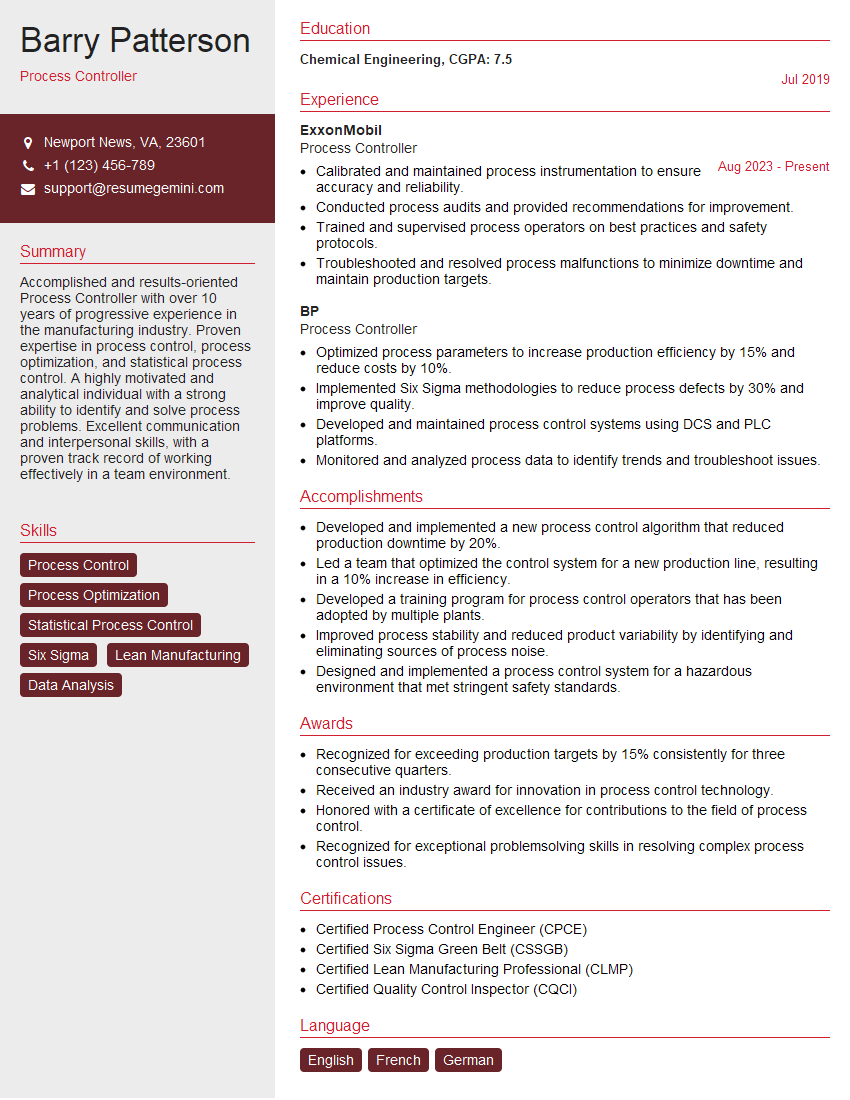
Acing the interview is crucial, but landing one requires a compelling resume that gets you noticed. Crafting a professional document that highlights your skills and experience is the first step toward interview success. ResumeGemini can help you build a standout resume that gets you called in for that dream job.






Essential Interview Questions For Process Controller
1. What is the role of a Process Controller in the manufacturing industry?
- Monitors and controls manufacturing processes to ensure they meet quality standards and production targets.
- Analyzes data to identify areas for improvement and develop process control strategies.
- Collaborates with engineers and technicians to troubleshoot and resolve process issues.
- Maintains documentation and records related to the manufacturing process.
- Provides training and support to other team members on process control procedures.
2. Describe the key responsibilities of a Process Controller in a chemical plant.
Process Monitoring and Control
- Monitors process parameters such as temperature, pressure, and flow rates.
- Adjusts control settings to maintain process stability and product quality.
- Responds promptly to process deviations and takes corrective actions.
Process Optimization
- Analyzes process data to identify areas for improvement.
- Develops and implements process control strategies to optimize performance.
- Collaborates with engineers to upgrade equipment and systems.
3. How do you handle process upsets and emergencies in a manufacturing environment?
- Remain calm and assess the situation.
- Follow established emergency procedures.
- Communicate with supervisors and plant operators.
- Take immediate actions to stabilize the process and prevent further damage.
- Investigate the root cause and develop corrective measures.
4. What are the challenges you have faced as a Process Controller? How did you overcome them?
- Challenge: Process instability due to equipment failure.
- Solution: Collaborated with maintenance team to diagnose and repair the equipment promptly.
- Challenge: Meeting production targets during peak demand.
- Solution: Optimized process control settings and implemented lean manufacturing principles to improve efficiency.
5. Describe your experience with process control software and automation systems.
- Proficient in using Distributed Control Systems (DCS) and Supervisory Control and Data Acquisition (SCADA) systems.
- Familiar with process modeling and simulation software.
- Experience with implementing automation solutions to improve process control and efficiency.
6. How do you stay up-to-date on the latest advancements in process control technology?
- Attend industry conferences and webinars.
- Read technical journals and research papers.
- Participate in online forums and discussion groups.
- Collaborate with vendors and technology providers.
7. What is your understanding of statistical process control (SPC) techniques?
- Familiar with SPC tools such as control charts, histograms, and scatter plots.
- Understand the principles of process capability analysis.
- Can apply SPC techniques to improve process stability and quality.
8. How do you ensure compliance with regulatory requirements related to process control?
- Familiar with relevant industry standards and regulations.
- Develop and implement process control procedures that meet compliance requirements.
- Maintain documentation and records to demonstrate compliance.
9. Describe your knowledge of quality management systems such as ISO 9001.
- Familiar with the principles and requirements of ISO 9001.
- Can apply quality management principles to improve process control and product quality.
- Experience in conducting internal audits and implementing corrective actions.
10. What are your strengths and weaknesses as a Process Controller?
Strengths:
- Strong technical skills in process control and automation.
- Excellent analytical and problem-solving abilities.
- Proven ability to optimize processes and improve efficiency.
- Effective communication and collaboration skills.
Weaknesses:
- Limited experience in a specific industry (if applicable).
- Still developing expertise in advanced process control techniques.
- Can be a bit detail-oriented at times.
Interviewers often ask about specific skills and experiences. With ResumeGemini‘s customizable templates, you can tailor your resume to showcase the skills most relevant to the position, making a powerful first impression. Also check out Resume Template specially tailored for Process Controller.
Career Expert Tips:
- Ace those interviews! Prepare effectively by reviewing the Top 50 Most Common Interview Questions on ResumeGemini.
- Navigate your job search with confidence! Explore a wide range of Career Tips on ResumeGemini. Learn about common challenges and recommendations to overcome them.
- Craft the perfect resume! Master the Art of Resume Writing with ResumeGemini’s guide. Showcase your unique qualifications and achievements effectively.
- Great Savings With New Year Deals and Discounts! In 2025, boost your job search and build your dream resume with ResumeGemini’s ATS optimized templates.
Researching the company and tailoring your answers is essential. Once you have a clear understanding of the Process Controller‘s requirements, you can use ResumeGemini to adjust your resume to perfectly match the job description.
Key Job Responsibilities
Process Controllers are responsible for monitoring and controlling industrial processes, ensuring that they operate efficiently and safely. Key job responsibilities include:
1. Process Monitoring
Monitoring process variables such as temperature, pressure, flow, and level using instrumentation and control systems.
2. Process Control
Adjusting control parameters to maintain desired process conditions, optimizing production and minimizing deviations.
3. Troubleshooting
Identifying and resolving process issues, investigating alarms and conducting root cause analysis to prevent recurrence.
4. Data Analysis
Analyzing process data to identify trends, develop improvement strategies, and optimize performance.
5. Documentation
Maintaining accurate records of process operations, including logs, reports, and procedures.
6. Compliance
Ensuring compliance with relevant industry standards, regulations, and safety protocols.
Interview Tips
To ace an interview for a Process Controller position, consider the following tips:
1. Research the Company and Role
Familiarize yourself with the company’s industry, products, and values. Research the specific role and its responsibilities.
2. Highlight Relevant Experience
Emphasize your experience in process control, monitoring, troubleshooting, and data analysis. Quantify your accomplishments with specific metrics.
3. Demonstrate Technical Knowledge
Show your understanding of control systems, instrumentation, and process control principles. Be prepared to discuss your knowledge of relevant software and technologies.
4. Showcase Problem-Solving Abilities
Provide examples of how you identified and resolved process issues. Highlight your analytical and problem-solving skills.
5. Emphasize Attention to Detail
Stress your meticulousness and attention to detail. Process Controllers must be able to accurately monitor and adjust process conditions.
6. Prepare for Common Interview Questions
Anticipate common interview questions, such as “Describe your experience in process control” and “How do you prioritize tasks in a fast-paced environment?”
7. Dress Professionally
First impressions matter. Dress professionally and arrive on time for your interview.
Next Step:
Armed with this knowledge, you’re now well-equipped to tackle the Process Controller interview with confidence. Remember, preparation is key. So, start crafting your resume, highlighting your relevant skills and experiences. Don’t be afraid to tailor your application to each specific job posting. With the right approach and a bit of practice, you’ll be well on your way to landing your dream job. Build your resume now from scratch or optimize your existing resume with ResumeGemini. Wish you luck in your career journey!