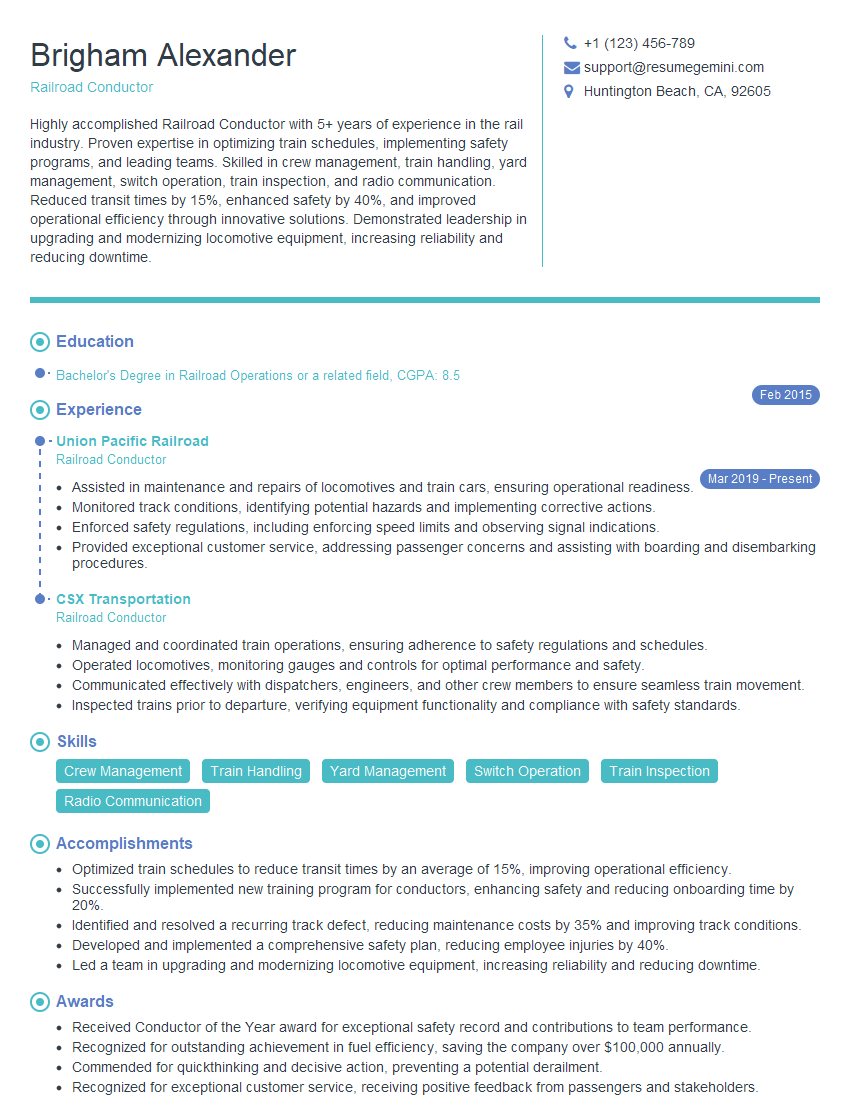
Are you gearing up for an interview for a Railroad Conductor position? Whether you’re a seasoned professional or just stepping into the role, understanding what’s expected can make all the difference. In this blog, we dive deep into the essential interview questions for Railroad Conductor and break down the key responsibilities of the role. By exploring these insights, you’ll gain a clearer picture of what employers are looking for and how you can stand out. Read on to equip yourself with the knowledge and confidence needed to ace your next interview and land your dream job!
Acing the interview is crucial, but landing one requires a compelling resume that gets you noticed. Crafting a professional document that highlights your skills and experience is the first step toward interview success. ResumeGemini can help you build a standout resume that gets you called in for that dream job.






Essential Interview Questions For Railroad Conductor
1. How do you ensure the safety of passengers and crew on board a train?
Safety is my top priority. I strictly adhere to all safety regulations and procedures, such as performing thorough pre-trip inspections, monitoring track conditions, and communicating effectively with the engineer and crew. I am also trained in emergency response procedures and regularly participate in safety training modules to enhance my knowledge and skills.
2. Describe your experience in managing train operations, including train handling, yard operations, and freight management.
Train Handling
- Skilled in operating locomotives, controlling train speed, and monitoring train systems to ensure smooth and efficient train operations.
- Experienced in managing train braking, acceleration, and handling in various weather and track conditions.
Yard Operations
- Proficient in marshalling trains, performing switching operations, and coordinating with yard personnel to ensure timely and efficient train movements.
- Familiar with yard safety procedures and regulations.
Freight Management
- Responsible for managing freight loading and unloading operations, ensuring proper cargo handling and securing.
- Experienced in coordinating with shippers and receivers to facilitate smooth freight movement.
3. How do you handle unexpected situations and emergencies while operating a train?
I remain calm and composed during unexpected situations and emergencies. I quickly assess the situation, prioritize actions, and communicate clearly with the engineer and crew. I follow established emergency procedures, such as initiating emergency braking, contacting dispatch, and evacuating passengers if necessary. I also prioritize the safety of passengers and crew while managing the situation effectively.
4. How do you communicate effectively with train crews, dispatchers, and other stakeholders?
I possess excellent communication skills and am proficient in using various communication systems, including radios, telephones, and signal systems. I maintain clear and concise communication with train crews, dispatchers, and other stakeholders to ensure smooth and efficient train operations. I am also skilled in coordinating with track maintenance teams and emergency responders to resolve any issues or incidents promptly.
5. Describe your experience in using technology and computer systems in train operations.
I am proficient in using various technologies and computer systems commonly employed in train operations. I am familiar with train control systems, dispatching software, and communication systems. I utilize these technologies to monitor train performance, track train location, and communicate effectively with dispatchers and other stakeholders. I am also adept at troubleshooting technical issues and ensuring the smooth functioning of train systems.
6. How do you stay updated with industry regulations, safety standards, and best practices in railroad operations?
I prioritize continuous learning and professional development to stay updated with industry regulations, safety standards, and best practices in railroad operations. I regularly attend training programs, workshops, and conferences organized by industry associations and regulatory bodies. I also subscribe to industry publications and engage in discussions with experienced professionals to enhance my knowledge and stay abreast of the latest developments in the field.
7. How do you handle the physical and mental demands of being a Railroad Conductor?
I am physically and mentally prepared for the demands of being a Railroad Conductor. I undergo regular physical examinations and training to maintain my fitness and meet the physical requirements of the job. Mentally, I am resilient and possess strong decision-making abilities, enabling me to handle the challenges and responsibilities of the role. I prioritize rest and self-care to ensure I am well-rested and focused during my shifts.
8. How do you prioritize tasks and manage your workload effectively?
I am organized and efficient in managing my workload. I prioritize tasks based on urgency and importance, ensuring that critical tasks are completed first. I delegate tasks to my team members when necessary and maintain clear communication to ensure smooth coordination. I am also adept at using technology and tools to enhance my productivity and streamline my workflow.
9. How do you contribute to a positive and collaborative work environment?
I believe in fostering a positive and collaborative work environment. I am respectful, supportive, and always willing to assist my colleagues. I actively participate in team discussions, share my knowledge and experience, and contribute to the overall success of the team. I am also open to feedback and suggestions, as I believe continuous improvement is essential for personal and team growth.
10. Why are you interested in working as a Railroad Conductor for our company?
I am eager to join your esteemed company as a Railroad Conductor due to its reputation for safety, efficiency, and commitment to excellence in the railroad industry. Your company’s focus on employee development and training aligns with my aspirations for continuous growth and professional advancement. I am confident that my skills and experience, combined with the opportunities provided by your company, will enable me to make significant contributions to your team and the success of your operations.
Interviewers often ask about specific skills and experiences. With ResumeGemini‘s customizable templates, you can tailor your resume to showcase the skills most relevant to the position, making a powerful first impression. Also check out Resume Template specially tailored for Railroad Conductor.
Career Expert Tips:
- Ace those interviews! Prepare effectively by reviewing the Top 50 Most Common Interview Questions on ResumeGemini.
- Navigate your job search with confidence! Explore a wide range of Career Tips on ResumeGemini. Learn about common challenges and recommendations to overcome them.
- Craft the perfect resume! Master the Art of Resume Writing with ResumeGemini’s guide. Showcase your unique qualifications and achievements effectively.
- Great Savings With New Year Deals and Discounts! In 2025, boost your job search and build your dream resume with ResumeGemini’s ATS optimized templates.
Researching the company and tailoring your answers is essential. Once you have a clear understanding of the Railroad Conductor‘s requirements, you can use ResumeGemini to adjust your resume to perfectly match the job description.
Key Job Responsibilities
Railroad conductors are responsible for the safe and efficient operation of trains. They work closely with engineers, brakemen, and other railroad personnel to ensure that trains run on time and without incident.
1. Operating Trains
Conductors are responsible for operating trains, including starting, stopping, and switching tracks. They must also monitor train speed and ensure that the train is running safely.
- Starting, stopping, and switching tracks
- Monitoring train speed
- Ensuring that the train is running safely
2. Communicating with Crew and Dispatchers
Conductors must communicate with the engineer, brakemen, and other railroad personnel to ensure that the train is running smoothly. They must also communicate with dispatchers to keep them updated on the train’s progress.
- Communicating with engineers, brakemen, and other railroad personnel
- Communicating with dispatchers to keep them updated on the train’s progress
3. Enforcing Railroad Rules
Conductors are responsible for enforcing railroad rules and regulations. They must make sure that the train is properly equipped and that all crew members are following safety procedures.
- Ensuring that the train is properly equipped
- Making sure that all crew members are following safety procedures
4. Responding to Emergencies
Conductors must be prepared to respond to emergencies, such as derailments or fires. They must be able to make quick decisions and take action to protect the train and its crew.
- Responding to derailments or fires
- Making quick decisions and taking action to protect the train and its crew
Interview Tips
Preparing for a railroad conductor interview can be daunting, but there are a few things you can do to increase your chances of success.
1. Research the Company
Before you go to your interview, take some time to research the railroad company. Learn about their history, their mission, and their values. This will show the interviewer that you are interested in the company and that you have taken the time to prepare.
- Visit the company’s website
- Read articles about the company in the news
- Talk to people who work for the company
2. Practice Answering Common Interview Questions
There are a few common interview questions that you are likely to be asked, such as “Why do you want to work for this company?” and “What are your strengths and weaknesses?” Take some time to practice answering these questions so that you can give clear and concise answers.
- “Why do you want to work for this company?”
- “What are your strengths and weaknesses?”
- “What is your experience with railroad operations?”
- “How would you handle a difficult customer or employee?”
3. Dress Professionally
First impressions matter, so make sure you dress professionally for your interview. This means wearing a suit or business casual attire. You should also make sure that your clothes are clean and pressed.
- Wear a suit or business casual attire
- Make sure your clothes are clean and pressed
4. Be Yourself
The most important thing is to be yourself during your interview. The interviewer wants to get to know the real you, so don’t try to be someone you’re not. Just be confident and let your personality shine through.
- Be confident
- Let your personality shine through
Next Step:
Now that you’re armed with the knowledge of Railroad Conductor interview questions and responsibilities, it’s time to take the next step. Build or refine your resume to highlight your skills and experiences that align with this role. Don’t be afraid to tailor your resume to each specific job application. Finally, start applying for Railroad Conductor positions with confidence. Remember, preparation is key, and with the right approach, you’ll be well on your way to landing your dream job. Build an amazing resume with ResumeGemini