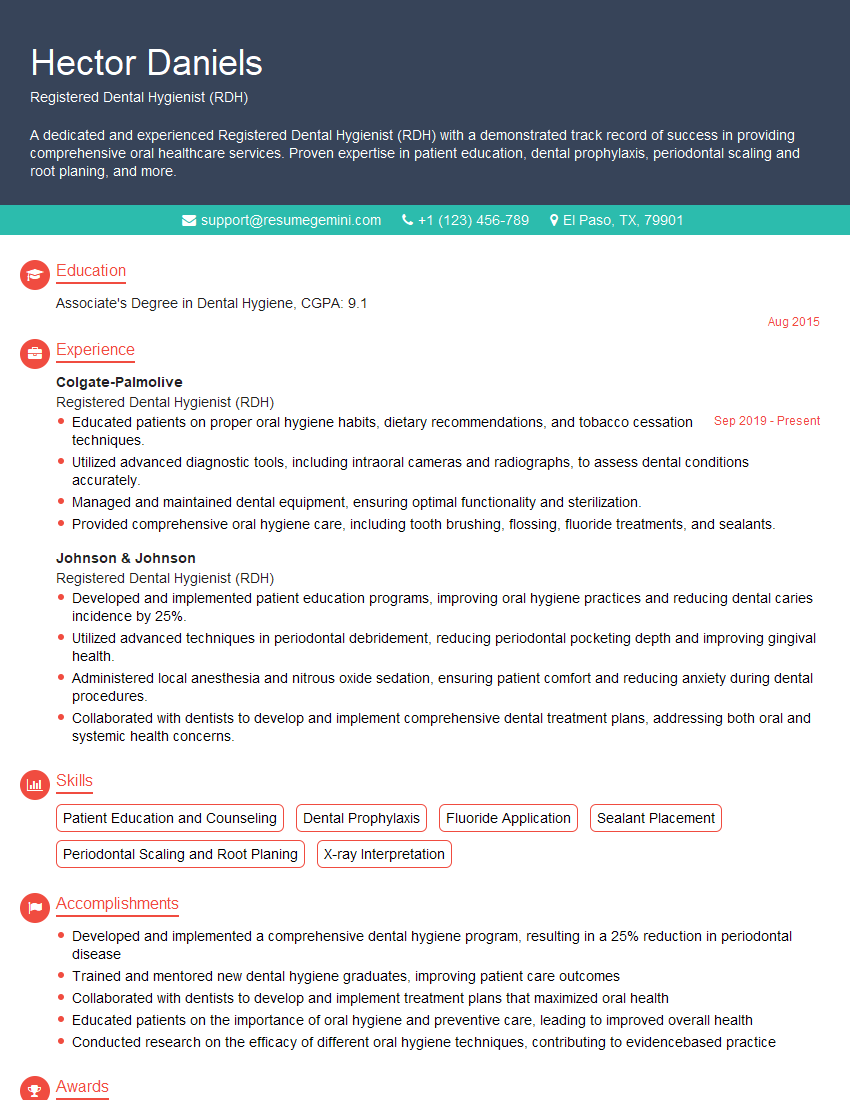
Ever felt underprepared for that crucial job interview? Or perhaps you’ve landed the interview but struggled to articulate your skills and experiences effectively? Fear not! We’ve got you covered. In this blog post, we’re diving deep into the Registered Dental Hygienist (RDH) interview questions that you’re most likely to encounter. But that’s not all. We’ll also provide expert insights into the key responsibilities of a Registered Dental Hygienist (RDH) so you can tailor your answers to impress potential employers.
Acing the interview is crucial, but landing one requires a compelling resume that gets you noticed. Crafting a professional document that highlights your skills and experience is the first step toward interview success. ResumeGemini can help you build a standout resume that gets you called in for that dream job.






Essential Interview Questions For Registered Dental Hygienist (RDH)
1. Describe the steps involved in performing a comprehensive periodontal charting?
- Gather necessary equipment and materials.
- Introduce yourself to the patient and explain the procedure.
- Assess the patient’s medical and dental history.
- Examine the patient’s oral cavity and soft tissues.
- Measure and record the patient’s probing depths at six sites per tooth.
- Record the patient’s bleeding on probing.
- Record the patient’s plaque index.
- Record the patient’s calculus index.
- Develop a treatment plan based on the findings of the periodontal charting.
2. What are the different types of dental radiographs and when are they used?
Bitewing radiographs
- Used to detect interproximal caries, calculus, and bone loss.
Periapical radiographs
- Used to detect caries, periapical pathology, and root fractures.
Occlusal radiographs
- Used to detect caries, fractures, and impacted teeth.
Panoramic radiographs
- Used to screen for caries, periodontal disease, and other oral health problems.
Cephalometric radiographs
- Used to assess the relationship between the teeth and jaws.
3. How would you educate a patient about the importance of oral hygiene?
- Explain the relationship between oral hygiene and overall health.
- Discuss the different types of oral hygiene products and how to use them effectively.
- Provide the patient with a personalized oral hygiene plan.
- Answer the patient’s questions and concerns.
- Motivate the patient to maintain good oral hygiene habits.
4. What are the signs and symptoms of periodontal disease?
- Gingival redness
- Gingival swelling
- Gingival bleeding
- Receding gums
- Loose teeth
- Pus between the teeth and gums
- Bad breath
5. How would you manage a patient with dental anxiety?
- Create a calm and relaxing environment.
- Explain the procedure to the patient in detail.
- Offer the patient a stress ball or other distraction.
- Take breaks during the procedure as needed.
- Refer the patient to a dentist who specializes in treating patients with dental anxiety.
6. Describe the role of a dental hygienist in the prevention and treatment of oral diseases.
- Providing preventive care, such as cleanings and fluoride treatments
- Educating patients on oral hygiene and nutrition
- Screening for oral diseases, such as cavities and periodontal disease
- Assisting dentists with restorative and surgical procedures
- Promoting oral health through community outreach programs
7. How would you stay up-to-date on the latest advancements in dental hygiene?
- Attending continuing education courses
- Reading dental journals and other publications
- Participating in online forums and discussion groups
- Consulting with other dental professionals
8. What are your strengths and weaknesses as a dental hygienist?
Strengths
- Excellent clinical skills
- Strong patient communication skills
- Passion for providing quality oral care
- Ability to work independently and as part of a team
Weaknesses
- I am relatively new to the field of dental hygiene.
- I am still learning how to manage my time effectively.
9. Why are you interested in working in this dental practice?
- I am impressed by the practice’s commitment to providing quality oral care.
- I believe that my skills and experience would be a valuable asset to the practice.
- I am eager to learn from the other dental professionals in the practice.
- I am confident that I can make a positive contribution to the practice and the community.
10. What are your salary expectations?
- I am open to discussing salary expectations.
- I am confident that my skills and experience are worth a competitive salary.
- I am more interested in finding a good fit than in negotiating salary.
Interviewers often ask about specific skills and experiences. With ResumeGemini‘s customizable templates, you can tailor your resume to showcase the skills most relevant to the position, making a powerful first impression. Also check out Resume Template specially tailored for Registered Dental Hygienist (RDH).
Career Expert Tips:
- Ace those interviews! Prepare effectively by reviewing the Top 50 Most Common Interview Questions on ResumeGemini.
- Navigate your job search with confidence! Explore a wide range of Career Tips on ResumeGemini. Learn about common challenges and recommendations to overcome them.
- Craft the perfect resume! Master the Art of Resume Writing with ResumeGemini’s guide. Showcase your unique qualifications and achievements effectively.
- Great Savings With New Year Deals and Discounts! In 2025, boost your job search and build your dream resume with ResumeGemini’s ATS optimized templates.
Researching the company and tailoring your answers is essential. Once you have a clear understanding of the Registered Dental Hygienist (RDH)‘s requirements, you can use ResumeGemini to adjust your resume to perfectly match the job description.
Key Job Responsibilities
A Registered Dental Hygienist (RDH) plays a vital role in maintaining optimal oral health for patients. Their key responsibilities encompass a wide range of tasks, including:
1. Patient Assessment and Treatment
Conduct thorough dental examinations, including taking x-rays, to assess patients’ oral health status.
- Clean teeth, remove plaque and tartar, and polish teeth.
- Apply sealants and fluoride treatments to prevent tooth decay.
- Educate patients on proper oral hygiene techniques and preventive measures.
2. Collaboration with Dental Professionals
Work closely with dentists and other dental professionals to develop and implement treatment plans.
- Assist dentists during dental procedures, such as fillings and extractions.
- Monitor patients’ post-operative recovery and provide follow-up care.
3. Patient Education and Counseling
Provide patients with comprehensive information about oral health and preventive measures.
- Educate patients on the importance of regular dental checkups and cleanings.
- Discuss dietary habits and other factors that impact oral health.
4. Practice Management
Contribute to the smooth functioning of the dental practice by maintaining accurate patient records and managing appointments.
- Sterilize and maintain dental instruments and equipment.
- Adhere to infection control protocols and ensure a safe work environment.
Interview Tips
To ace your interview for a Registered Dental Hygienist position, consider the following tips:
1. Research the Dental Practice
Familiarize yourself with the practice’s website, social media, and patient reviews. This will demonstrate your interest and preparedness.
- Learn about the practice’s philosophy, services offered, and patient demographics.
- Identify any areas where your skills and experience can align with the practice’s needs.
2. Practice Your Answers
Anticipate common interview questions and prepare thoughtful responses. Practice delivering your answers clearly and concisely.
- Use the STAR method to structure your answers: provide a Situation, Task, Action, and Result.
- Highlight your technical skills, patient-centered approach, and teamwork experience.
3. Showcase Your Passion for Oral Health
Convey your enthusiasm for dental hygiene and your commitment to improving patients’ oral health.
- Emphasize your dedication to continuing education and professional development.
- Share examples of your involvement in oral health outreach programs or community service.
4. Ask Thoughtful Questions
Asking informed questions at the end of the interview demonstrates your engagement and interest.
- Inquire about the practice’s patient philosophy and treatment protocols.
- Ask about opportunities for professional growth and continuing education.
Next Step:
Now that you’re armed with the knowledge of Registered Dental Hygienist (RDH) interview questions and responsibilities, it’s time to take the next step. Build or refine your resume to highlight your skills and experiences that align with this role. Don’t be afraid to tailor your resume to each specific job application. Finally, start applying for Registered Dental Hygienist (RDH) positions with confidence. Remember, preparation is key, and with the right approach, you’ll be well on your way to landing your dream job. Build an amazing resume with ResumeGemini