Are you gearing up for a career shift or aiming to ace your next interview? Look no further! We’ve curated a comprehensive guide to help you crack the interview for the coveted Rubber Mill Tender position. From understanding the key responsibilities to mastering the most commonly asked questions, this blog has you covered. So, buckle up and let’s embark on this journey together.
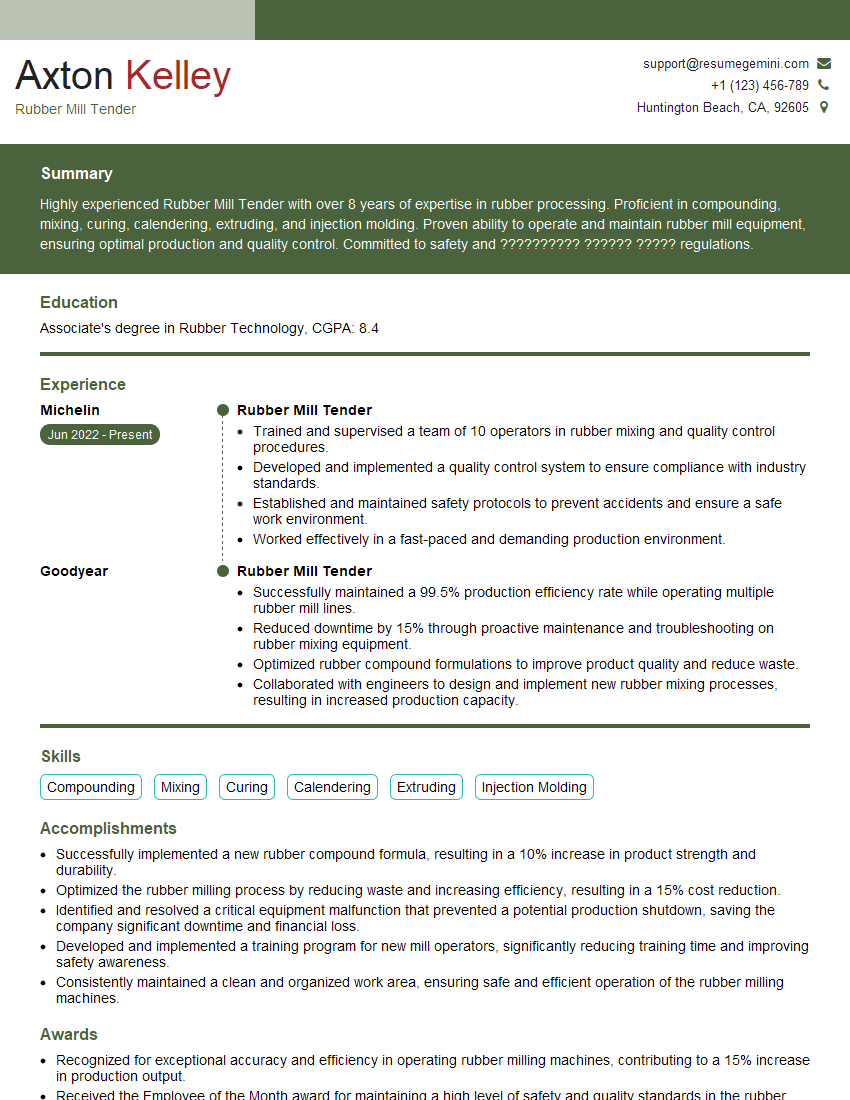
Acing the interview is crucial, but landing one requires a compelling resume that gets you noticed. Crafting a professional document that highlights your skills and experience is the first step toward interview success. ResumeGemini can help you build a standout resume that gets you called in for that dream job.






Essential Interview Questions For Rubber Mill Tender
1. What are the different types of rubber mills and their uses in the rubber industry?
Rubber mills are classified based on their construction, operation, and application. Some of the common types are:
- Two-roll mills: Used for masticating, mixing, and blending of rubber compounds. They consist of two large, cylindrical rolls rotating in opposite directions at different speeds.
- Four-roll mills: Similar to two-roll mills but have two additional rolls, which allows for continuous processing and improved mixing efficiency.
- Banbury mixers: High-shear internal mixers used for intensive mixing and mastication of rubber compounds, especially for producing high-performance tires.
- Mixing mills: Specifically designed for blending and mixing different rubber compounds together to obtain desired properties.
- Open mills: Mills with a single roll and a flat bed, used for sheeting and calendaring rubber compounds.
2. What is the purpose of Banbury mixing in rubber processing?
Advantages:
- Thorough mixing and mastication
- Faster and more efficient mixing compared to two-roll mills
- Capable of handling large batch sizes
- Suitable for high-performance rubber compounds, such as those used in tires
Disadvantages:
- Higher energy consumption
- More complex operation and maintenance
- Potential for rubber degradation due to excessive shear
3. Describe the process of rubber vulcanization.
Vulcanization is a chemical process that transforms raw rubber into a more durable and elastic material. It involves reacting the rubber with sulfur or other curing agents at elevated temperatures:
- Raw rubber: Natural or synthetic rubber in its uncured state, which is soft and sticky.
- Vulcanizing agents: Typically sulfur, which forms cross-links between rubber chains.
- Curing process: Heating the mixture of rubber and vulcanizing agents under pressure and temperature to promote the chemical reaction.
- Vulcanized rubber: The resulting material is harder, more elastic, and resistant to wear and tear.
4. What are the key parameters to monitor and control during the rubber milling process?
- Roll temperature: Critical for controlling the plasticity and flow properties of the rubber compound.
- Roll speed ratio: Affects the mixing and shearing action, which influences the compound properties.
- Compound composition: The type and amount of ingredients in the rubber compound, including rubber, fillers, and additives.
- Mixing time: The duration of the mixing process, which determines the extent of mixing and dispersion.
- Batch size: The amount of rubber compound being processed in the mill.
5. How do you ensure the quality of the rubber compound after milling?
- Visual inspection: Checking for any defects, such as lumps, streaks, or contamination.
- Rheological testing: Measuring the flow and deformation properties of the compound to assess its processability and end-use performance.
- Curing characteristics: Evaluating the compound’s curing time, scorch time, and hardness to ensure optimal vulcanization.
- Physical testing: Conducting tensile, tear, and abrasion tests to determine the mechanical properties of the vulcanized rubber.
- Compliance with specifications: Comparing the test results to the established quality standards and customer requirements.
6. What are the safety precautions that must be observed when operating a rubber mill?
- Proper PPE: Wearing protective clothing, including gloves, goggles, and earplugs.
- Roll guarding: Ensuring that all moving parts are adequately guarded to prevent contact with personnel.
- Lockout/tagout procedures: Implementing safety measures to prevent accidental startups during maintenance.
- Emergency stop buttons: Having readily accessible emergency stop buttons to shut down the machine in case of danger.
- Training and supervision: Providing proper training and supervision to operators to ensure safe operation.
7. What are the common maintenance tasks required for rubber mills?
- Roll alignment: Maintaining the proper alignment of the rolls to ensure uniform mixing and avoid premature wear.
- Bearing lubrication: Regularly lubricating the bearings to prevent overheating and premature failure.
- Cleaning: Cleaning the mill surfaces and rolls to remove any residual rubber compound and prevent contamination.
- Inspection and repair: Regularly inspecting the mill components for wear, damage, or misalignment and performing necessary repairs or replacements.
- Predictive maintenance: Using techniques such as vibration analysis or thermography to identify potential maintenance issues before they become critical.
8. How do you troubleshoot common problems encountered with rubber mills?
Some common problems and troubleshooting steps include:
- Uneven mixing: Check roll alignment, speed ratio, and compound composition.
- Roll sticking: Clean rolls, check roll temperature and rubber compound properties.
- Excessive noise or vibration: Inspect bearings, check roll alignment, balance, and lubrication.
- Batch overheating: Adjust roll temperature, reduce mixing time, optimize compound formulation.
- Poor compound quality: Review compound composition, check mixing parameters, conduct rheological and physical testing.
9. How do you maximize the efficiency and productivity of a rubber mill?
- Optimize operating parameters: Determine the optimal roll temperature, speed ratio, and mixing time based on the compound properties and desired results.
- Regular maintenance: Perform preventive maintenance tasks to minimize downtime and ensure optimal mill performance.
- Skillful operation: Train operators to use the mill effectively and avoid potential issues.
- Batch optimization: Adjust batch size and compound composition to maximize productivity while maintaining quality.
- Process integration: Integrate the rubber mill into the overall production line to improve workflow and reduce lead times.
10. What are your strengths and weaknesses as a Rubber Mill Tender?
Strengths:
- Extensive experience in operating and maintaining rubber mills, including two-roll, four-roll, and Banbury mixers.
- Thorough understanding of rubber compounding, milling processes, and vulcanization techniques.
- Proven ability to troubleshoot and resolve common mill issues to ensure production efficiency.
- Excellent attention to detail and quality control, with a strong focus on meeting customer specifications.
- Exceptional communication and teamwork skills, able to collaborate effectively with colleagues and supervisors.
Weaknesses:
- Limited experience with certain specialized rubber compounds, such as high-performance elastomers.
- Need to improve knowledge of advanced rubber testing techniques and equipment.
- Working long hours in a physically demanding environment can occasionally be challenging.
I am actively working on addressing these weaknesses through ongoing training, research, and collaboration with experienced professionals in the field.
Interviewers often ask about specific skills and experiences. With ResumeGemini‘s customizable templates, you can tailor your resume to showcase the skills most relevant to the position, making a powerful first impression. Also check out Resume Template specially tailored for Rubber Mill Tender.
Career Expert Tips:
- Ace those interviews! Prepare effectively by reviewing the Top 50 Most Common Interview Questions on ResumeGemini.
- Navigate your job search with confidence! Explore a wide range of Career Tips on ResumeGemini. Learn about common challenges and recommendations to overcome them.
- Craft the perfect resume! Master the Art of Resume Writing with ResumeGemini’s guide. Showcase your unique qualifications and achievements effectively.
- Great Savings With New Year Deals and Discounts! In 2025, boost your job search and build your dream resume with ResumeGemini’s ATS optimized templates.
Researching the company and tailoring your answers is essential. Once you have a clear understanding of the Rubber Mill Tender‘s requirements, you can use ResumeGemini to adjust your resume to perfectly match the job description.
Key Job Responsibilities
Rubber Mill Tenders have a crucial role in operating and maintaining rubber mills to produce rubber compounds.
1. Rubber Mixing and Compounding
They weigh and mix raw rubber, chemicals, and fillers following specified formulas.
- Monitor mix temperatures and viscosity to ensure optimum quality.
- Operate and maintain rubber mills, ensuring proper mixing and compounding.
2. Mill Operation and Maintenance
Set up, clean, and adjust rubber mill equipment, including rolls, blades, and conveyors.
- Maintain mill machinery, perform minor repairs, and troubleshoot operational issues.
- Adhere to safety regulations and maintain a clean and organized work area.
3. Production Monitoring and Quality Control
Monitor rubber production and ensure adherence to quality standards.
- Collect samples and perform basic quality checks, such as checking for color, consistency, and physical properties.
- Report any deviations from specifications to supervisors or technical staff.
4. Safety and Environmental Compliance
Follow established safety procedures and wear appropriate protective gear.
- Handle hazardous chemicals and rubber compounds safely.
- Dispose of waste materials in accordance with environmental regulations.
Interview Tips
Interviews for Rubber Mill Tender positions can be competitive, and preparation is key to making a strong impression.
1. Research the Company and Position
Familiarize yourself with the hiring company, its industry, and the specific requirements of the Rubber Mill Tender role.
- Visit the company website and read about their products, services, and reputation.
- Identify the skills and experience that are most relevant to the position and highlight them in your resume and during the interview.
2. Practice Your Answers to Common Interview Questions
Prepare for common interview questions by practicing your answers out loud or with a mentor or friend.
- Use the STAR method (Situation, Task, Action, Result) to structure your answers and provide specific examples of your past experiences.
- Focus on highlighting your technical skills, problem-solving abilities, and safety consciousness.
3. Showcase Your Technical Expertise
Demonstrate your knowledge of rubber mill operations and maintenance.
- Review the basics of rubber chemistry and compounding.
- Be prepared to discuss your experience with different types of rubber mills and equipment.
4. Emphasize Your Safety Awareness
Safety is paramount in Rubber Mill Tender roles.
- Highlight your understanding of safety regulations and your commitment to following them.
- Share examples of how you prioritize safety in your work.
Next Step:
Armed with this knowledge, you’re now well-equipped to tackle the Rubber Mill Tender interview with confidence. Remember, a well-crafted resume is your first impression. Take the time to tailor your resume to highlight your relevant skills and experiences. And don’t forget to practice your answers to common interview questions. With a little preparation, you’ll be on your way to landing your dream job. So what are you waiting for? Start building your resume and start applying! Build an amazing resume with ResumeGemini.