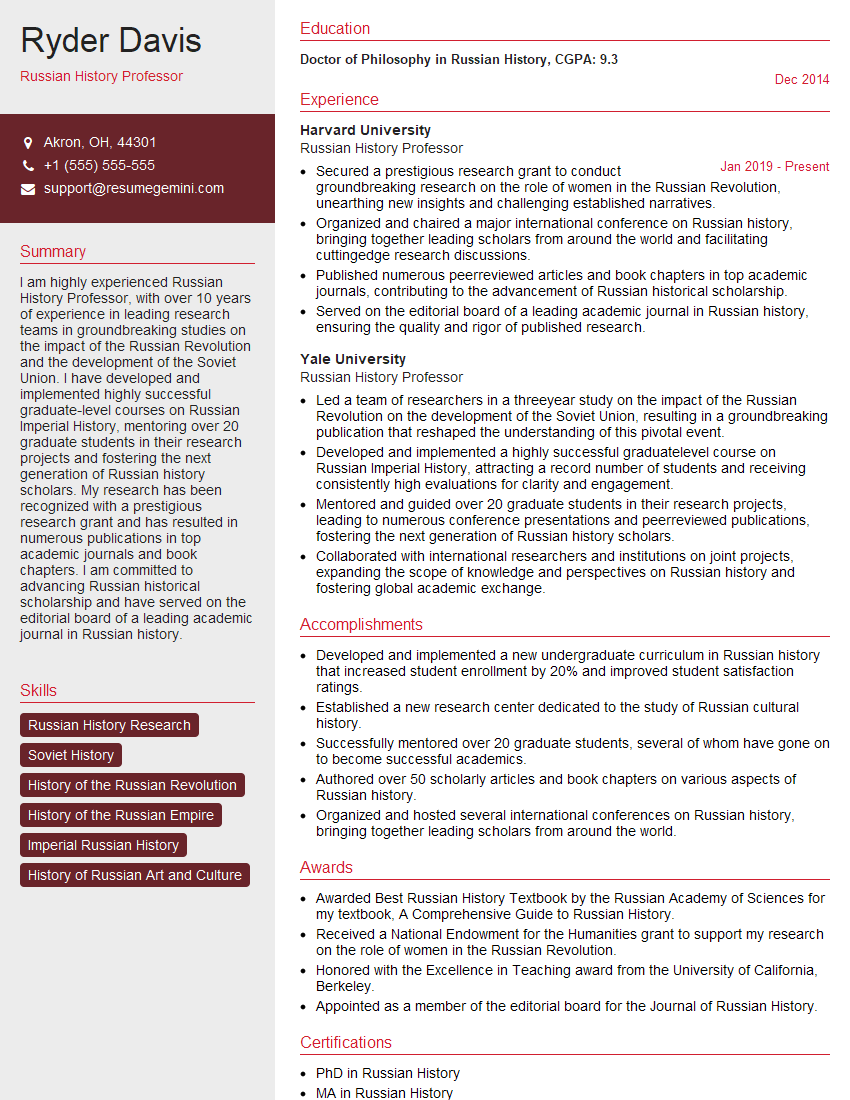
Are you gearing up for a career shift or aiming to ace your next interview? Look no further! We’ve curated a comprehensive guide to help you crack the interview for the coveted Russian History Professor position. From understanding the key responsibilities to mastering the most commonly asked questions, this blog has you covered. So, buckle up and let’s embark on this journey together.
Acing the interview is crucial, but landing one requires a compelling resume that gets you noticed. Crafting a professional document that highlights your skills and experience is the first step toward interview success. ResumeGemini can help you build a standout resume that gets you called in for that dream job.






Essential Interview Questions For Russian History Professor
1. Describe the key events and significance of the Russian Revolution of 1917.
The Russian Revolution of 1917 was a pivotal moment in Russian history that led to the overthrow of the Romanov dynasty and the establishment of the Soviet Union. The revolution consisted of two distinct phases:
- February Revolution (March Revolution): sparked by food shortages and economic hardship, this revolution forced the abdication of Tsar Nicholas II and the establishment of a provisional government.
- October Revolution (November Revolution): led by the Bolshevik Party under Vladimir Lenin, this revolution overthrew the provisional government and established the world’s first communist state.
2. Discuss the role of Grigory Rasputin in the final years of the Romanov dynasty.
Court Influence and Healing Abilities
- Rasputin gained influence over Empress Alexandra and Tsar Nicholas II due to his claimed ability to heal their son, Alexei, who suffered from hemophilia.
- He used his influence to exert political and personal control over the royal court, earning the resentment of many nobles and politicians.
Controversy and Assassination
- Rasputin’s eccentric behavior and alleged sexual misconduct created a public scandal.
- In 1916, he was assassinated by a group of nobles who feared his growing influence on the royal family.
3. Analyze the impact of the Cold War on Soviet-American relations.
The Cold War was a period of intense geopolitical tension and competition between the Soviet Union and the United States, characterized by:
- Ideological Differences: The Soviet Union’s communist ideology clashed with the United States’ capitalist ideology.
- Military Buildup: Both superpowers engaged in a massive arms race, creating a nuclear standoff.
- Proxy Conflicts: The Cold War extended beyond direct confrontation, with both sides supporting their respective allies in conflicts around the world.
- Espionage and Propaganda: Both countries engaged in espionage, propaganda, and other covert operations to undermine each other’s influence.
4. Discuss the key features of Stalin’s totalitarian regime in the Soviet Union.
- Absolute Control: Stalin ruled with an iron fist, suppressing all forms of dissent and opposition.
- Cult of Personality: Stalin promoted a cult of personality around himself, encouraging the glorification and worship of his leadership.
- Centralized Economy: The Soviet economy was centrally planned under Stalin, with the government controlling all aspects of production and distribution.
- Great Purge: Stalin carried out a series of political purges that eliminated potential rivals and anyone deemed a threat to his power.
- Expansionism: Stalin sought to expand Soviet influence and territory, leading to the annexation of several neighboring states.
5. Describe the collapse of the Soviet Union and the factors that contributed to it.
The collapse of the Soviet Union in 1991 was a complex process influenced by multiple factors:
- Economic Stagnation: The Soviet economy suffered from inefficiency, corruption, and declining productivity.
- Political Reforms: Mikhail Gorbachev’s reforms, including glasnost (openness) and perestroika (restructuring), allowed for greater political and economic freedom.
- Nationalism: Ethnic tensions and separatist movements emerged within the Soviet republics, challenging the central government’s authority.
- International Pressure: The United States and its allies pressured the Soviet Union to liberalize and reduce its military buildup.
- Coup Attempt: The failed coup attempt by hardline communists in 1991 accelerated the disintegration of the Soviet Union.
6. Discuss the historiographical debates surrounding the causes of the Bolshevik Revolution.
- Traditional Marxist Explanation: Emphasizes the economic and class contradictions within Russian society.
- Modernization Theory: Argues that rapid industrialization and urbanization contributed to social unrest and revolution.
- Peasant Mobilisation Model: Focuses on the role of rural peasantry in supporting the Bolsheviks and their land policies.
- Political Crisis Model: Attributes the revolution to the failure of the Romanov dynasty to adapt to changing political and social conditions.
7. Analyze the social and cultural transformations that occurred in the Soviet Union during the Khrushchev era.
Social Reforms
- Decentralization of economic decision-making.
- Emphasis on education and scientific advancement.
- Housing reform to address the urban housing shortage.
Cultural Thaw
- Relaxation of censorship, allowing for greater artistic freedom.
- Expansion of opportunities for travel and cultural exchange.
- Rise of non-conformist art and literature.
8. Discuss the role of ideology in shaping Soviet foreign policy during the Cold War.
- Marxist-Leninist Ideology: The Soviet Union aimed to spread communism around the world, supporting socialist revolutions and anti-imperialist movements.
- Expansionism and Security: Soviet leaders believed in securing their borders and establishing a buffer zone of friendly states.
- Containment and Rivalry: The Soviet Union sought to counter the perceived threat of Western capitalism and NATO expansion.
9. Analyze the economic policies of the Soviet Union during the Stalin era.
Command Economy and Central Planning
- The government controlled all aspects of production, distribution, and pricing.
- The economy was focused on heavy industry and military production.
Collectivization and Agricultural Crisis
- Forced collectivization of agriculture led to widespread famine and peasant resistance.
- Agricultural productivity declined, creating a chronic food shortage.
Industrial Growth and Repression
- Rapid industrialization through the use of forced labor and suppression of dissent.
- High production targets led to inefficiencies and poor-quality goods.
10. Discuss the geopolitical factors that shaped Russian history during the 19th century.
- Expansionism: Russia expanded its territory eastward, annexing Siberia and Central Asia.
- Rivalry with the Ottoman Empire: Russia sought to gain control of the Black Sea and the Balkans, leading to several wars.
- Balance of Power: Russia balanced its relations between European powers, such as France, Prussia, and Austria.
- Diplomatic Isolation: Russia’s autocratic system and conservative policies alienated it from some European states.
Interviewers often ask about specific skills and experiences. With ResumeGemini‘s customizable templates, you can tailor your resume to showcase the skills most relevant to the position, making a powerful first impression. Also check out Resume Template specially tailored for Russian History Professor.
Career Expert Tips:
- Ace those interviews! Prepare effectively by reviewing the Top 50 Most Common Interview Questions on ResumeGemini.
- Navigate your job search with confidence! Explore a wide range of Career Tips on ResumeGemini. Learn about common challenges and recommendations to overcome them.
- Craft the perfect resume! Master the Art of Resume Writing with ResumeGemini’s guide. Showcase your unique qualifications and achievements effectively.
- Great Savings With New Year Deals and Discounts! In 2025, boost your job search and build your dream resume with ResumeGemini’s ATS optimized templates.
Researching the company and tailoring your answers is essential. Once you have a clear understanding of the Russian History Professor‘s requirements, you can use ResumeGemini to adjust your resume to perfectly match the job description.
Key Job Responsibilities
Russian History Professors are responsible for teaching undergraduate and graduate courses in Russian history, as well as conducting research in their field of expertise. They may also be involved in advising students, developing curriculum, and participating in departmental and university governance. Key job responsibilities include:
1. Teaching Russian History
Professors teach undergraduate and graduate courses in Russian history. Courses may cover a variety of topics, such as Russian political, social, economic, and cultural history. Professors may also teach courses on specific periods of Russian history, such as the Romanov period or the Soviet era.
2. Researching Russian History
Professors conduct research in their field of expertise. They may publish their research in academic journals, books, and other publications. Professors may also present their research at conferences and workshops.
3. Advising Students
Professors advise undergraduate and graduate students. They may help students choose courses, develop research projects, and prepare for careers in academia or other fields.
4. Developing Curriculum
Professors may be involved in developing curriculum for Russian history courses. They may also help to develop new programs and initiatives in Russian studies.
5. Participating in Departmental and University Governance
Professors may participate in departmental and university governance. They may serve on committees, attend meetings, and vote on issues that affect the department and university.
Interview Tips
Preparing for an interview for a Russian History Professor position can be daunting, but with the right preparation, you can increase your chances of success. Here are a few tips to help you ace your interview:
1. Research the Position and the University
Before your interview, take some time to research the position and the university. This will help you to understand the specific requirements of the job and the culture of the institution. You should also be prepared to discuss your research interests and how they align with the university’s mission.
2. Practice Your Teaching Skills
As a Russian History Professor, you will be expected to teach undergraduate and graduate courses. In your interview, you may be asked to give a sample lecture or lead a discussion. It is important to practice your teaching skills in advance so that you can feel confident and articulate during your interview.
3. Highlight Your Research Experience
Research is an important part of a Russian History Professor’s job. In your interview, be sure to highlight your research experience and accomplishments. You should be able to discuss your research interests, your research methods, and the impact of your research on the field.
4. Prepare for Questions About Your Advising Experience
As a Russian History Professor, you may be asked to advise undergraduate and graduate students. In your interview, be prepared to discuss your advising experience and your approach to advising students. You should be able to articulate your goals for advising and your strategies for helping students succeed.
5. Be Prepared to Talk About Your Experience with Curriculum Development
In your interview, you may be asked about your experience with curriculum development. Be prepared to discuss your role in developing curriculum for Russian history courses. You should also be able to discuss your ideas for innovative approaches to teaching Russian history.
Next Step:
Now that you’re armed with a solid understanding of what it takes to succeed as a Russian History Professor, it’s time to turn that knowledge into action. Take a moment to revisit your resume, ensuring it highlights your relevant skills and experiences. Tailor it to reflect the insights you’ve gained from this blog and make it shine with your unique qualifications. Don’t wait for opportunities to come to you—start applying for Russian History Professor positions today and take the first step towards your next career milestone. Your dream job is within reach, and with a polished resume and targeted applications, you’ll be well on your way to achieving your career goals! Build your resume now with ResumeGemini.