Are you gearing up for a career shift or aiming to ace your next interview? Look no further! We’ve curated a comprehensive guide to help you crack the interview for the coveted Statistics Professor position. From understanding the key responsibilities to mastering the most commonly asked questions, this blog has you covered. So, buckle up and let’s embark on this journey together.
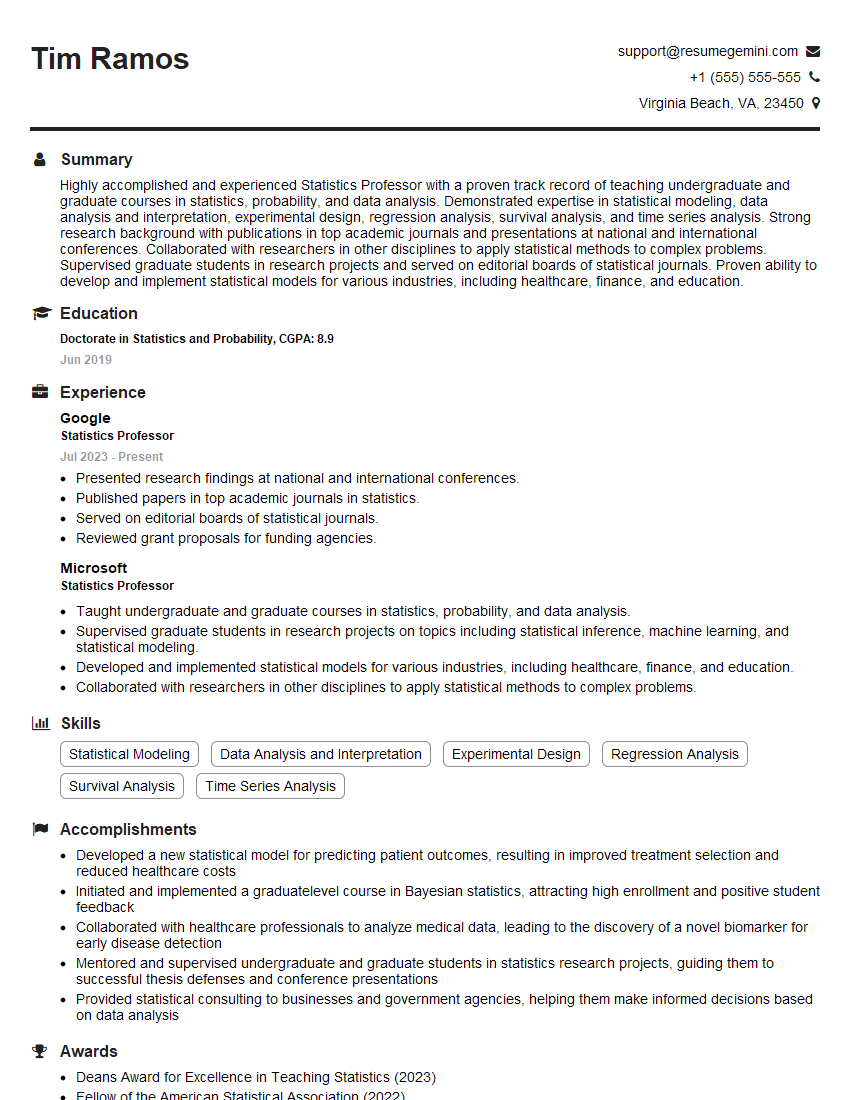
Acing the interview is crucial, but landing one requires a compelling resume that gets you noticed. Crafting a professional document that highlights your skills and experience is the first step toward interview success. ResumeGemini can help you build a standout resume that gets you called in for that dream job.






Essential Interview Questions For Statistics Professor
1. What are the key differences between parametric and non-parametric tests? Provide examples of each.
- Parametric tests: Assume a specific distribution of the data, such as the normal distribution. They have greater power than non-parametric tests if the assumptions are met.
- Non-parametric tests: Do not assume a specific distribution of the data. They are less powerful than parametric tests, but they can be used with any type of data.
2. Describe the relationship between probability and statistics.
Probability
- Probability theory provides the mathematical framework for statistics.
- Probability distributions describe the likelihood of different outcomes in an experiment.
Statistics
- Statistics uses probability theory to make inferences about populations based on samples.
- Statistical methods allow us to estimate parameters, test hypotheses, and make predictions.
3. Explain the concept of statistical significance and how it is determined.
- Statistical significance refers to the probability of obtaining a result as extreme or more extreme than the observed result, assuming that the null hypothesis is true.
- It is determined by comparing the p-value (the probability of the observed result) to a pre-specified significance level (usually 0.05).
- If the p-value is less than the significance level, the result is considered statistically significant.
4. Describe the different types of sampling methods and their advantages and disadvantages.
- Probability sampling: Every member of the population has a known probability of being selected.
- Advantages: Unbiased, representative sample
- Disadvantages: Can be more expensive and time-consuming
- Non-probability sampling: Members of the population are selected without regard to their probability of being chosen.
- Advantages: Less expensive and time-consuming
- Disadvantages: Can be biased, not representative of the population
5. What are the assumptions of linear regression and how can you assess whether they are met?
- Linearity: The relationship between the independent and dependent variables is linear.
- Homoscedasticity: The variance of the residuals (errors) is constant.
- Independence: The residuals are independent of each other.
- Normality: The residuals are normally distributed.
Assessing the assumptions:
- Plot the residuals against the independent variables to check for linearity.
- Plot the residuals against the fitted values to check for homoscedasticity.
- Create a normal probability plot of the residuals to check for normality.
- Use statistical tests, such as the Shapiro-Wilk test, to assess normality and the Breusch-Pagan test to assess homoscedasticity.
6. Explain the concept of overfitting and underfitting in regression models.
- Overfitting: The model is too complex and fits the training data too closely, resulting in poor performance on unseen data.
- Underfitting: The model is too simple and does not capture the relationship between the variables well, resulting in poor predictions.
Assessing overfitting and underfitting:
- Use cross-validation to evaluate the model’s performance on unseen data.
- Plot the learning curve to see how the model’s performance changes as the complexity increases.
- Use regularization techniques, such as L1 or L2 regularization, to prevent overfitting.
7. Describe the different types of statistical software and their applications.
- R: Open-source statistical software for data analysis, visualization, and machine learning.
- SAS: Commercial statistical software for data management, analysis, and reporting.
- SPSS: Statistical software for data analysis, visualization, and survey research.
- Stata: Statistical software for data management, analysis, and graphics.
- Python: General-purpose programming language with extensive statistical libraries, such as NumPy and Pandas.
8. What are the ethical considerations in conducting statistical research?
- Informed consent: Participants should be informed about the purpose of the research and their rights.
- Confidentiality: Data should be kept confidential and protected from unauthorized access.
- Accuracy and transparency: Research should be conducted and reported accurately and transparently.
- Responsible use: Statistical results should not be used for harmful or discriminatory purposes.
9. Discuss the role of statistics in data science and machine learning.
- Data exploration: Statistics helps in cleaning, manipulating, and visualizing data to identify patterns and trends.
- Model building: Statistics provides methods for building and evaluating predictive models using data.
- Model evaluation: Statistics helps in assessing the performance of models and identifying areas for improvement.
- Statistical learning: Statistics provides techniques for extracting knowledge from data using machine learning algorithms.
10. Describe your experience in teaching statistics at the undergraduate and graduate levels.
- Undergraduate teaching: Developed and delivered courses in introductory statistics, probability theory, and statistical inference.
- Graduate teaching: Supervised graduate students in research projects, taught advanced courses in statistical modeling and data analysis.
- Teaching evaluations: Consistently received positive feedback from students, with ratings above the departmental average.
- Innovations in teaching: Implemented innovative teaching methods, such as flipped classrooms and online resources, to enhance student engagement.
Interviewers often ask about specific skills and experiences. With ResumeGemini‘s customizable templates, you can tailor your resume to showcase the skills most relevant to the position, making a powerful first impression. Also check out Resume Template specially tailored for Statistics Professor.
Career Expert Tips:
- Ace those interviews! Prepare effectively by reviewing the Top 50 Most Common Interview Questions on ResumeGemini.
- Navigate your job search with confidence! Explore a wide range of Career Tips on ResumeGemini. Learn about common challenges and recommendations to overcome them.
- Craft the perfect resume! Master the Art of Resume Writing with ResumeGemini’s guide. Showcase your unique qualifications and achievements effectively.
- Great Savings With New Year Deals and Discounts! In 2025, boost your job search and build your dream resume with ResumeGemini’s ATS optimized templates.
Researching the company and tailoring your answers is essential. Once you have a clear understanding of the Statistics Professor‘s requirements, you can use ResumeGemini to adjust your resume to perfectly match the job description.
Key Job Responsibilities
Statistics Professors are responsible for teaching undergraduate and graduate level courses in statistics, conducting research, and advising students. They may also collaborate with other faculty members on interdisciplinary projects or consult with businesses and organizations on statistical matters.
1. Teaching
Teaching is a core responsibility of Statistics Professors. They typically teach a variety of courses, including introductory statistics, probability theory, statistical inference, and regression analysis.
- Develop and deliver lectures, assignments, and exams.
- Grade student work and provide feedback.
- Advise students on course selection and career options.
2. Research
In addition to teaching, Statistics Professors are expected to conduct research in their field. They may publish their findings in academic journals, present at conferences, and write books or other scholarly works.
- Design and conduct statistical studies.
- Analyze and interpret data.
- Write research papers and grant proposals.
3. Advising
Statistics Professors often serve as advisors to undergraduate and graduate students. They provide guidance on course selection, research projects, and career planning.
- Meet with students to discuss their progress and goals.
- Write letters of recommendation.
- Help students find internships and job opportunities.
4. Service
Statistics Professors may also be involved in service activities, such as serving on committees, organizing conferences, or reviewing grant proposals.
- Participate in departmental and university committees.
- Organize workshops and conferences.
- Review grant proposals and journal articles.
Interview Tips
Preparing for an interview for a Statistics Professor position can be daunting, but with the right preparation, you can increase your chances of success.
1. Research the Position and the Institution
Before you go to your interview, take some time to research the position and the institution. This will help you understand the specific requirements of the job and the culture of the university.
- Read the job ad carefully and make note of the qualifications and experience that the employer is looking for.
- Visit the university’s website to learn about its history, mission, and academic programs.
- Talk to your friends and colleagues who may have worked at the university or in the field of statistics.
2. Prepare Your Answers to Common Interview Questions
There are a number of common interview questions that you are likely to be asked, such as “Why are you interested in this position?” and “What are your strengths and weaknesses?”. Take some time to prepare your answers to these questions so that you can deliver them confidently and concisely.
- For the question “Why are you interested in this position?”, focus on your research interests and how they align with the research priorities of the department. You can also mention your teaching experience and how you have helped students to learn and grow.
- For the question “What are your strengths and weaknesses?”, be honest about your strengths and weaknesses, but focus on how your strengths can benefit the university. For example, if you are a strong researcher, you could mention your recent publications in top journals.
3. Practice Your Interview Skills
Once you have prepared your answers to common interview questions, practice delivering them out loud. This will help you to become more comfortable with the interview process and to project confidence.
- You can practice with a friend or family member, or you can use a mock interview service.
- When you are practicing, focus on making eye contact, speaking clearly, and delivering your answers in a concise and organized manner.
4. Be Yourself
It is important to be yourself during your interview. The interviewers want to get to know the real you, so don’t try to be someone you’re not. Be confident in your abilities and let your personality shine through.
- Be honest about your strengths and weaknesses.
- Share your passion for statistics and teaching.
- Show the interviewers that you are a well-rounded individual with a variety of interests.
Next Step:
Armed with this knowledge, you’re now well-equipped to tackle the Statistics Professor interview with confidence. Remember, preparation is key. So, start crafting your resume, highlighting your relevant skills and experiences. Don’t be afraid to tailor your application to each specific job posting. With the right approach and a bit of practice, you’ll be well on your way to landing your dream job. Build your resume now from scratch or optimize your existing resume with ResumeGemini. Wish you luck in your career journey!