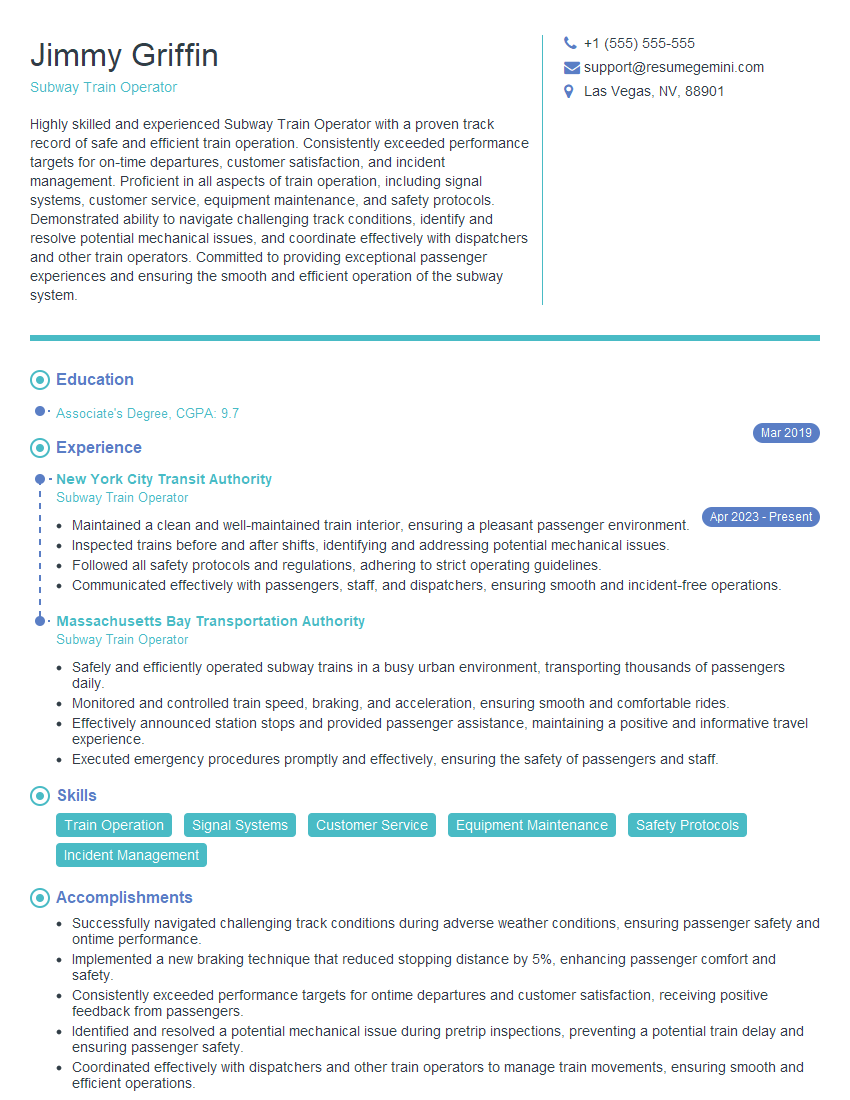
Are you gearing up for a career in Subway Train Operator? Feeling nervous about the interview questions that might come your way? Don’t worry, you’re in the right place. In this blog post, we’ll dive deep into the most common interview questions for Subway Train Operator and provide you with expert-backed answers. We’ll also explore the key responsibilities of this role so you can tailor your responses to showcase your perfect fit.
Acing the interview is crucial, but landing one requires a compelling resume that gets you noticed. Crafting a professional document that highlights your skills and experience is the first step toward interview success. ResumeGemini can help you build a standout resume that gets you called in for that dream job.






Essential Interview Questions For Subway Train Operator
1. What are the key responsibilities of a Subway Train Operator?
- Safely operating the subway train and adhering to all established safety protocols
- Monitoring the train’s systems and conditions, including the braking system, power supply, and passenger safety features
- Maintaining a clear and concise communication with the control center, passengers, and other train operators
- Responding promptly and effectively to emergencies and unexpected situations, ensuring passenger safety and minimizing disruptions
- Maintaining a professional and courteous demeanor while interacting with passengers, colleagues, and supervisors
2. How do you ensure the safety of passengers during an emergency situation?
subheading of the answer
- Remain calm and assess the situation quickly to determine the appropriate course of action
- Make clear and concise announcements to inform passengers of the situation and provide guidance
- Coordinate with the control center to request assistance and follow their instructions
- Evacuate passengers safely and efficiently if necessary, ensuring that everyone is accounted for
- Provide first aid or assistance to injured passengers as needed
subheading of the answer
- Document the incident thoroughly and accurately, including details of the situation, actions taken, and passenger information
- Cooperate fully with any investigations or inquiries into the incident
- Learn from the experience and identify opportunities for improvement in safety procedures
3. How do you handle passenger complaints or conflicts?
- Remain calm and professional, even in challenging situations
- Listen attentively to the passenger’s concerns and acknowledge their feelings
- Explain the situation or policy clearly and provide a reasonable solution whenever possible
- Apologize for any inconvenience or discomfort caused, even if it was not directly within your control
- Maintain a positive and helpful attitude, even if the passenger is agitated or upset
4. What are the different types of braking systems used on subway trains?
- Electro-pneumatic brakes: These brakes use compressed air to apply pressure to the brake pads, which in turn create friction against the wheels to slow down or stop the train
- Hydraulic brakes: These brakes use hydraulic fluid to transmit pressure to the brake pads, providing a more precise and responsive braking system
- Regenerative braking: This system converts the train’s kinetic energy into electricity during braking, which is then fed back into the power supply
- Eddy current brakes: These brakes use electromagnetic induction to create drag and slow down the train, typically used as auxiliary brakes in conjunction with other systems
5. How do you troubleshoot common technical issues that may arise while operating a subway train?
- Follow established troubleshooting procedures and consult technical manuals for guidance
- Use diagnostic equipment and tools to identify the source of the issue
- Safely isolate the affected systems or components to prevent further damage
- Contact the control center or maintenance personnel for support and assistance if necessary
- Document the troubleshooting process and any repairs or adjustments made
6. How do you maintain situational awareness while operating a subway train?
- Continuously monitor the train’s instruments, displays, and surroundings
- Pay attention to announcements, signals, and communication from the control center
- Use mirrors and cameras to observe the train’s position, speed, and any potential hazards
- Stay alert and anticipate potential issues or changes in the operating environment
- Communicate with other train operators and station staff to exchange information and ensure smooth operations
7. How do you handle distractions while operating a subway train?
- Maintain a focused and disciplined approach to the task at hand
- Minimize unnecessary conversations and personal distractions during critical operating phases
- Use technology and tools wisely, avoiding excessive use of personal devices
- Take regular breaks and practice mindfulness techniques to enhance concentration
- Seek support from supervisors or colleagues if experiencing persistent distractions
8. How do you stay updated on changes to operating procedures or safety regulations?
- Attend regular training sessions and workshops organized by the transit authority
- Review and study official manuals, bulletins, and circulars issued by the company
- Participate in discussions and share knowledge with colleagues and supervisors
- Stay informed about industry best practices and advancements through professional development
- Actively seek feedback and guidance from experienced operators and instructors
9. How do you ensure the accuracy of passenger information announcements?
- Follow established protocols and guidelines for making passenger announcements
- Verify information with the control center or station staff before making announcements
- Use clear and concise language, avoiding jargon or technical terms
- Repeat important announcements multiple times to ensure comprehension
- Be prepared to answer passenger questions or provide additional information
10. How do you deal with challenging weather conditions while operating a subway train?
- Slow down and increase following distance to account for reduced visibility and traction
- Use headlights, fog lights, and windshield wipers as necessary to enhance visibility
- Be aware of potential hazards such as fallen trees, debris, or icy tracks
- Stay in close communication with the control center for updates on weather conditions and track status
- Follow emergency procedures and evacuate passengers if conditions become unsafe
Interviewers often ask about specific skills and experiences. With ResumeGemini‘s customizable templates, you can tailor your resume to showcase the skills most relevant to the position, making a powerful first impression. Also check out Resume Template specially tailored for Subway Train Operator.
Career Expert Tips:
- Ace those interviews! Prepare effectively by reviewing the Top 50 Most Common Interview Questions on ResumeGemini.
- Navigate your job search with confidence! Explore a wide range of Career Tips on ResumeGemini. Learn about common challenges and recommendations to overcome them.
- Craft the perfect resume! Master the Art of Resume Writing with ResumeGemini’s guide. Showcase your unique qualifications and achievements effectively.
- Great Savings With New Year Deals and Discounts! In 2025, boost your job search and build your dream resume with ResumeGemini’s ATS optimized templates.
Researching the company and tailoring your answers is essential. Once you have a clear understanding of the Subway Train Operator‘s requirements, you can use ResumeGemini to adjust your resume to perfectly match the job description.
Key Job Responsibilities
Subway Train Operators are responsible for the safe and efficient operation of subway trains. They must have a thorough knowledge of the subway system, including the routes, stations, and schedules. They must also be able to operate the train controls and respond to emergencies.
1. Operate subway trains
Subway Train Operators are responsible for operating subway trains safely and efficiently. This involves:
- Starting and stopping the train
- Controlling the speed and direction of the train
- Opening and closing the doors
- Announcing station stops
2. Monitor train systems
Subway Train Operators must monitor the train’s systems to ensure that they are functioning properly. This involves:
- Checking the brakes
- Monitoring the electrical system
- Inspecting the train for any damage
3. Respond to emergencies
Subway Train Operators must be prepared to respond to emergencies. This involves:
- Stopping the train in the event of an emergency
- Evacuating the train if necessary
- Providing assistance to passengers
4. Provide customer service
Subway Train Operators must provide customer service to passengers. This involves:
- Answering questions
- Providing directions
- Assisting passengers with disabilities
Interview Tips
Preparing for a Subway Train Operator interview can be daunting, but with the right preparation, you can increase your chances of success. Here are a few tips to help you get started:
1. Research the company and the position
Before you go to your interview, take some time to research the company and the position you’re applying for. This will help you understand the company’s culture, values, and goals. It will also help you understand the specific requirements of the position.
2. Practice your answers to common interview questions
There are a number of common interview questions that you’re likely to be asked, such as “Why are you interested in this position?” and “What are your strengths and weaknesses?”. Take some time to practice your answers to these questions so that you can deliver them confidently and concisely.
3. Be prepared to talk about your experience
The interviewer will want to know about your experience operating trains. Be prepared to talk about your experience in detail, including the types of trains you’ve operated, the routes you’ve covered, and the challenges you’ve faced.
4. Be prepared to talk about your customer service skills
Subway Train Operators must be able to provide excellent customer service. Be prepared to talk about your experience providing customer service, including examples of how you’ve handled difficult passengers.
5. Be prepared to talk about your safety record
Safety is a top priority for Subway Train Operators. Be prepared to talk about your safety record and how you’ve ensured the safety of passengers and employees.
Next Step:
Now that you’re armed with interview-winning answers and a deeper understanding of the Subway Train Operator role, it’s time to take action! Does your resume accurately reflect your skills and experience for this position? If not, head over to ResumeGemini. Here, you’ll find all the tools and tips to craft a resume that gets noticed. Don’t let a weak resume hold you back from landing your dream job. Polish your resume, hit the “Build Your Resume” button, and watch your career take off! Remember, preparation is key, and ResumeGemini is your partner in interview success.