Are you gearing up for a career shift or aiming to ace your next interview? Look no further! We’ve curated a comprehensive guide to help you crack the interview for the coveted Switch Coupler position. From understanding the key responsibilities to mastering the most commonly asked questions, this blog has you covered. So, buckle up and let’s embark on this journey together.
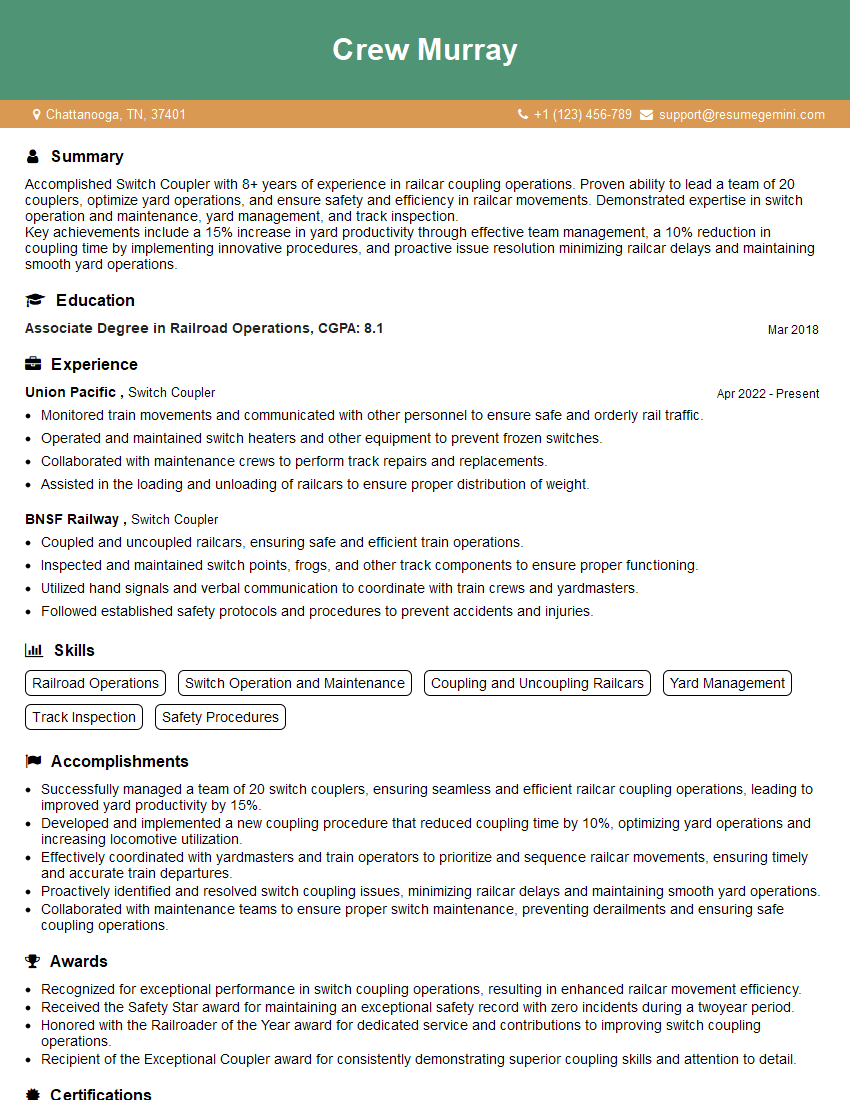
Acing the interview is crucial, but landing one requires a compelling resume that gets you noticed. Crafting a professional document that highlights your skills and experience is the first step toward interview success. ResumeGemini can help you build a standout resume that gets you called in for that dream job.






Essential Interview Questions For Switch Coupler
1. What are the main components of a switch coupler and how do they work together?
The main components of a switch coupler are:
- Coupler body: The coupler body houses the coupling mechanism and provides structural support for the coupler.
- Coupler head: The coupler head connects to the car and provides the interface for coupling and uncoupling operations.
- Coupler knuckle: The coupler knuckle is the movable part of the coupler head that engages with the coupler of another car.
- Coupler lock: The coupler lock secures the knuckle in the engaged position.
- Coupler pin: The coupler pin is used to manually uncouple the coupler.
When two couplers are brought together, the knuckles engage with each other and the coupler locks are activated. This creates a secure connection between the cars.
2. What are the different types of switch couplers and what are their advantages and disadvantages?
The two main types of switch couplers are:
- Type E coupler: The Type E coupler is the most common type of coupler used on freight cars in North America.
- Type F coupler: The Type F coupler is a newer type of coupler that is designed to be more efficient and safer than the Type E coupler.
The Type E coupler is less expensive to manufacture and maintain than the Type F coupler, but it is also less efficient and can be more dangerous to operate.
The Type F coupler is more efficient and safer to operate than the Type E coupler, but it is more expensive to manufacture and maintain.
3. What are the safety precautions that should be taken when working with switch couplers?
The following safety precautions should be taken when working with switch couplers:
- Never stand between the couplers of two cars.
- Always make sure that the couplers are properly engaged before moving the cars.
- Never attempt to uncouple cars while they are in motion.
- Always use a coupler pin to uncouple cars.
- Never use your hands to uncouple cars.
4. What are the common problems that can occur with switch couplers and how can they be fixed?
The most common problems that can occur with switch couplers are:
- Coupler knuckles that are not properly engaged.
- Coupler locks that are not properly activated.
- Coupler pins that are broken or missing.
- Coupler bodies that are cracked or damaged.
These problems can be fixed by replacing the damaged or missing parts.
5. What are the maintenance procedures that should be performed on switch couplers?
The following maintenance procedures should be performed on switch couplers:
- Inspect the couplers for damage or wear on a regular basis.
- Lubricate the coupler moving parts regularly.
- Replace any damaged or worn parts as needed.
6. What are the environmental factors that can affect the performance of switch couplers?
The following environmental factors can affect the performance of switch couplers:
- Temperature: Extreme temperatures can cause the coupler materials to expand or contract, which can affect the fit of the couplers.
- Moisture: Moisture can cause the coupler surfaces to become slippery, which can make it difficult for the couplers to engage properly.
- Dirt and debris: Dirt and debris can accumulate on the coupler surfaces, which can also make it difficult for the couplers to engage properly.
7. What are the latest trends in switch coupler technology?
The latest trends in switch coupler technology include:
- The development of new coupler designs that are more efficient and safer to operate.
- The use of new materials in coupler construction that are more durable and resistant to wear.
- The development of new coupler maintenance technologies that are more efficient and effective.
8. Describe your experience in troubleshooting and repairing switch couplers.
In my previous role, I was responsible for troubleshooting and repairing switch couplers on a regular basis. I have experience in identifying and fixing a variety of coupler problems, including coupler knuckles that are not properly engaged, coupler locks that are not properly activated, coupler pins that are broken or missing, and coupler bodies that are cracked or damaged.
9. Explain how you would go about developing a maintenance plan for switch couplers.
To develop a maintenance plan for switch couplers, I would first gather data on the types of couplers used in the operation, the operating environment, and the maintenance history of the couplers.
I would then use this data to develop a maintenance plan that includes the following elements:
- A schedule of inspections and maintenance tasks.
- A list of the spare parts that should be kept on hand.
- A training program for maintenance personnel.
10. What are your thoughts on the future of switch coupler technology?
I believe that switch coupler technology will continue to evolve in the coming years.
I expect to see the development of new coupler designs that are more efficient, safer, and more durable.
I also expect to see the development of new coupler maintenance technologies that are more efficient and effective.
Interviewers often ask about specific skills and experiences. With ResumeGemini‘s customizable templates, you can tailor your resume to showcase the skills most relevant to the position, making a powerful first impression. Also check out Resume Template specially tailored for Switch Coupler.
Career Expert Tips:
- Ace those interviews! Prepare effectively by reviewing the Top 50 Most Common Interview Questions on ResumeGemini.
- Navigate your job search with confidence! Explore a wide range of Career Tips on ResumeGemini. Learn about common challenges and recommendations to overcome them.
- Craft the perfect resume! Master the Art of Resume Writing with ResumeGemini’s guide. Showcase your unique qualifications and achievements effectively.
- Great Savings With New Year Deals and Discounts! In 2025, boost your job search and build your dream resume with ResumeGemini’s ATS optimized templates.
Researching the company and tailoring your answers is essential. Once you have a clear understanding of the Switch Coupler‘s requirements, you can use ResumeGemini to adjust your resume to perfectly match the job description.
Key Job Responsibilities
Switch Couplers play a crucial role within the rail industry by ensuring locomotives are connected to the desired rail cars. This job requires specialized knowledge of railroad procedures, safety protocols, and equipment handling.
1. Train and Locomotive Coupling
The primary responsibility of a Switch Coupler is to safely couple and uncouple locomotives and rail cars. This involves:
- Visually inspecting equipment before coupling
- Properly aligning and engaging couplers
- Securing couplers and ensuring a tight connection
2. Yard Management and Switching Operations
Switch Couplers manage rail yards by moving and organizing rail cars and locomotives efficiently. Their tasks include:
- Following switching orders and yard instructions
- Operating switches and control levers to direct rail cars
- Maintaining proper spacing and ensuring yard safety
3. Equipment Inspection and Maintenance
Ensuring the safety and functionality of equipment is crucial for Switch Couplers. Their responsibilities cover:
- Inspecting locomotives, rail cars, and couplers before operations
- Identifying and reporting any defects or potential issues
- Minor maintenance tasks, such as cleaning and lubricating
4. Communication and Documentation
Effective communication is vital for Switch Couplers. They are responsible for:
- Receiving and relaying instructions from dispatchers and supervisors
- Communicating with train crews and other personnel
- Documenting switching operations and maintaining accurate records
Interview Tips
Preparing thoroughly for a Switch Coupler interview can significantly increase your chances of success. Here are some key tips:
1. Research the Industry and Company
Familiarize yourself with the railroad industry, including its regulations, safety protocols, and common practices. Research the specific company you’re interviewing with to understand their operations and culture.
2. Highlight Your Skills and Experience
Emphasize your technical skills in coupling and uncoupling rail cars, as well as your experience in yard management and switching operations. Quantify your accomplishments and provide specific examples of your contributions.
3. Demonstrate Safety Consciousness
Safety is paramount in the rail industry. Showcase your understanding of safety regulations, your commitment to following procedures, and your ability to identify and mitigate risks.
4. Show Communication and Teamwork Abilities
Switch Couplers rely on clear communication and teamwork. Highlight your interpersonal skills, ability to work independently and as part of a team, and experience in coordinating with train crews and other personnel.
5. Prepare for Common Interview Questions
Research common interview questions for Switch Couplers, such as:
- Describe your experience in coupling and uncoupling rail cars.
- How do you ensure safety in your work environment?
- What are your strengths and weaknesses as a Switch Coupler?
- Why are you interested in working for our company?
Next Step:
Armed with this knowledge, you’re now well-equipped to tackle the Switch Coupler interview with confidence. Remember, a well-crafted resume is your first impression. Take the time to tailor your resume to highlight your relevant skills and experiences. And don’t forget to practice your answers to common interview questions. With a little preparation, you’ll be on your way to landing your dream job. So what are you waiting for? Start building your resume and start applying! Build an amazing resume with ResumeGemini.