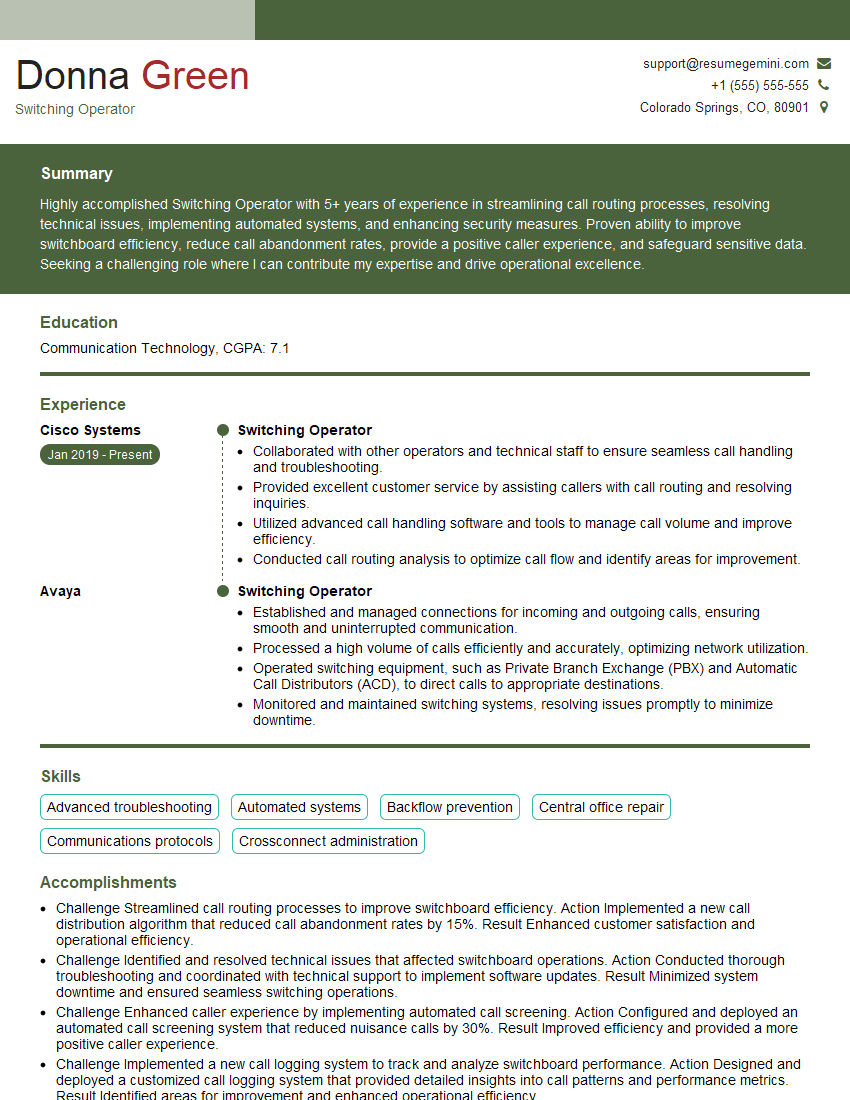
Are you gearing up for a career shift or aiming to ace your next interview? Look no further! We’ve curated a comprehensive guide to help you crack the interview for the coveted Switching Operator position. From understanding the key responsibilities to mastering the most commonly asked questions, this blog has you covered. So, buckle up and let’s embark on this journey together
Acing the interview is crucial, but landing one requires a compelling resume that gets you noticed. Crafting a professional document that highlights your skills and experience is the first step toward interview success. ResumeGemini can help you build a standout resume that gets you called in for that dream job.






Essential Interview Questions For Switching Operator
1. What is the role of a Switching Operator?
As a Switching Operator, my primary responsibility would be to manage and facilitate the flow of telecommunication traffic through the company’s switching systems.
- Establish, maintain, and terminate telephone connections between callers.
- Route calls to the appropriate destinations based on dialing patterns and network configurations.
- Monitor and troubleshoot network performance to ensure optimal call quality and connectivity.
- Assist with emergency calls and provide guidance to callers in distress.
- Maintain accurate call records and prepare reports as required.
2. Describe the different types of switching systems used in telecommunications.
Circuit Switching
- Establishes a dedicated physical path between two endpoints for the duration of the call.
- Ensures consistent bandwidth and latency, making it suitable for real-time applications like voice and video calls.
Packet Switching
- Breaks data into packets and sends them over a shared network, reassembling them at the destination.
- More efficient use of bandwidth, especially for data-intensive applications like internet browsing and file transfers.
Software-Defined Networking (SDN)
- Separates the control plane (which determines how traffic is routed) from the data plane (which handles the actual data transmission).
- Provides greater flexibility and programmability, enabling dynamic network reconfiguration and improved performance.
3. What are the key principles of network routing and how do they affect call quality?
- Shortest Path Routing: Selects the shortest path between two nodes to minimize latency.
- Least Congested Routing: Avoids congested links to ensure optimal bandwidth availability.
- Load Balancing: Distributes traffic across multiple paths to prevent overloading and improve reliability.
- Quality of Service (QoS): Prioritizes certain types of traffic (e.g., voice) to guarantee their performance.
These principles help optimize call quality by reducing delays, minimizing packet loss, and avoiding bottlenecks.
4. Explain the process of call setup and teardown in a telecommunication network.
Call Setup
- Caller dials the destination number.
- Switching system routes the call through the network based on routing tables.
- Called party’s device receives an incoming call notification.
- Called party answers the call, establishing a connection.
Call Teardown
- Either party hangs up the phone.
- Switching system releases the allocated resources and terminates the connection.
- Network updates its routing tables to reflect the availability of released resources.
5. Describe the different types of call forwarding and how they can be used.
- Unconditional Call Forwarding: Forwards all calls to a specified number regardless of the caller or time.
- Selective Call Forwarding: Forwards calls based on predefined criteria, such as caller ID, time of day, or type of call.
- Do Not Disturb (DND): Rejects all incoming calls except for those from a predefined list or emergency services.
- Voicemail: Automatically answers calls and plays a recorded message, allowing callers to leave voicemails.
6. What are the common troubleshooting techniques used to resolve call quality issues?
- Checking line integrity: Testing the physical wiring and equipment for damage or faults.
- Monitoring signal strength: Verifying that the signal strength is adequate for clear call transmission.
- Resetting network equipment: Powering off and restarting the switching system, routers, and modems to clear any temporary glitches.
- Updating software and firmware: Installing the latest updates to address bugs and improve performance.
- Analyzing call logs: Reviewing call records to identify patterns or recurring errors that may indicate underlying issues.
7. What are the safety protocols and procedures that a Switching Operator must follow?
- Emergency Call Handling: Prioritizing and handling emergency calls promptly and efficiently.
- Confidentiality: Maintaining the privacy of caller information and call content.
- Harassment Prevention: Reporting any instances of harassment or inappropriate behavior.
- Workplace Safety: Adhering to safety guidelines and reporting any potential hazards.
- Equipment Handling: Using equipment safely and following proper maintenance procedures.
8. Describe your experience in working with different types of telecommunication systems.
In my previous role, I was responsible for operating and maintaining a large-scale IP-based switching system. I was proficient in configuring and troubleshooting the system, including PBX, VoIP, and SIP components.
I also have experience working with legacy TDM systems and have successfully migrated several customers to the newer IP-based infrastructure.
9. How do you stay up-to-date with the latest advancements in telecommunications technology?
- Attending industry conferences and webinars: Learning about new technologies and best practices.
- Reading technical publications and white papers: Staying informed about industry trends and innovations.
- Participating in online forums and discussion groups: Engaging with other professionals and exchanging knowledge.
- Seeking certification and training: Pursuing professional development opportunities to enhance skills and knowledge.
10. How would you handle a situation where a caller is experiencing a technical issue and becomes frustrated?
I would approach such a situation with empathy and professionalism. First, I would actively listen to the caller’s concerns and try to understand the nature of the issue.
- Empathize and acknowledge: “I understand your frustration. It can be frustrating when technology doesn’t cooperate.”
- Troubleshoot patiently: “Let’s work together to troubleshoot the problem. Can you describe the issue in more detail?”
- Provide clear instructions: “Please try these steps. If they don’t help, let me know, and I’ll further assist you.”
- Offer alternatives: “If the issue persists, we can try a different method or connect you with a technical specialist.”
- Follow up: “I will follow up with you shortly to ensure that the issue has been resolved to your satisfaction.”
Interviewers often ask about specific skills and experiences. With ResumeGemini‘s customizable templates, you can tailor your resume to showcase the skills most relevant to the position, making a powerful first impression. Also check out Resume Template specially tailored for Switching Operator.
Career Expert Tips:
- Ace those interviews! Prepare effectively by reviewing the Top 50 Most Common Interview Questions on ResumeGemini.
- Navigate your job search with confidence! Explore a wide range of Career Tips on ResumeGemini. Learn about common challenges and recommendations to overcome them.
- Craft the perfect resume! Master the Art of Resume Writing with ResumeGemini’s guide. Showcase your unique qualifications and achievements effectively.
- Great Savings With New Year Deals and Discounts! In 2025, boost your job search and build your dream resume with ResumeGemini’s ATS optimized templates.
Researching the company and tailoring your answers is essential. Once you have a clear understanding of the Switching Operator‘s requirements, you can use ResumeGemini to adjust your resume to perfectly match the job description.
Key Job Responsibilities
Switching Operators are responsible for connecting incoming phone calls to the appropriate extension or department within a company or organization.1. Answer incoming phone calls
This involves greeting callers politely, taking down their details, and determining the nature of their query.
2. Route incoming calls
Based on the information gathered from the caller, the operator must direct the call to the correct extension or department. This may involve using a directory or a computer system.
3. Handle call queues
When multiple calls are coming in at once, the operator must manage the call queue and ensure that callers are answered in a timely manner. This may involve putting callers on hold or taking messages.
4. Provide information to callers
Operators may need to provide callers with information about the company or organization. This could include giving directions, providing contact information, or answering general questions.
5. Take messages
If the person the caller is trying to reach is unavailable, the operator will take a message. This involves getting the caller’s name, contact information, and the nature of their message.
Interview Tips
To ace an interview for a Switching Operator position, you must prepare thoroughly. Here are some tips that can help you make a great impression on the interviewer:
1. Research the company
Before the interview, take some time to learn about the company you applying to. This will show the interviewer that you are serious about the position and that you have taken the time to learn about their organization.
2. Practice your phone skills
Since the primary responsibility of a Switching Operator is to answer and route phone calls, it is important to practice your phone skills before the interview. This includes practicing your greeting, your ability to take down caller information, and your ability to route calls efficiently.
3. Be prepared to answer common interview questions
There are some common interview questions that you are likely to be asked in an interview for a Switching Operator position. These questions include “Why are you interested in this position?”, “What are your strengths and weaknesses?”, and “What is your experience with handling phone calls?”. It is important to prepare your answers to these questions in advance so that you can deliver them confidently and professionally.
4. Dress appropriately
The way you dress for an interview can make a big impression on the interviewer. For a Switching Operator position, it is important to dress professionally. This means wearing a suit or business casual attire.
5. Be polite and respectful
Throughout the interview, it is important to be polite and respectful to the interviewer. This includes making eye contact, speaking clearly, and listening attentively to the interviewer’s questions.
6. Follow up after the interview
After the interview, it is important to follow up with the interviewer. This can be done by sending a thank-you note or an email. This shows the interviewer that you are still interested in the position and that you appreciate their time.
Next Step:
Now that you’re armed with a solid understanding of what it takes to succeed as a Switching Operator, it’s time to turn that knowledge into action. Take a moment to revisit your resume, ensuring it highlights your relevant skills and experiences. Tailor it to reflect the insights you’ve gained from this blog and make it shine with your unique qualifications. Don’t wait for opportunities to come to you—start applying for Switching Operator positions today and take the first step towards your next career milestone. Your dream job is within reach, and with a polished resume and targeted applications, you’ll be well on your way to achieving your career goals! Build your resume now with ResumeGemini.