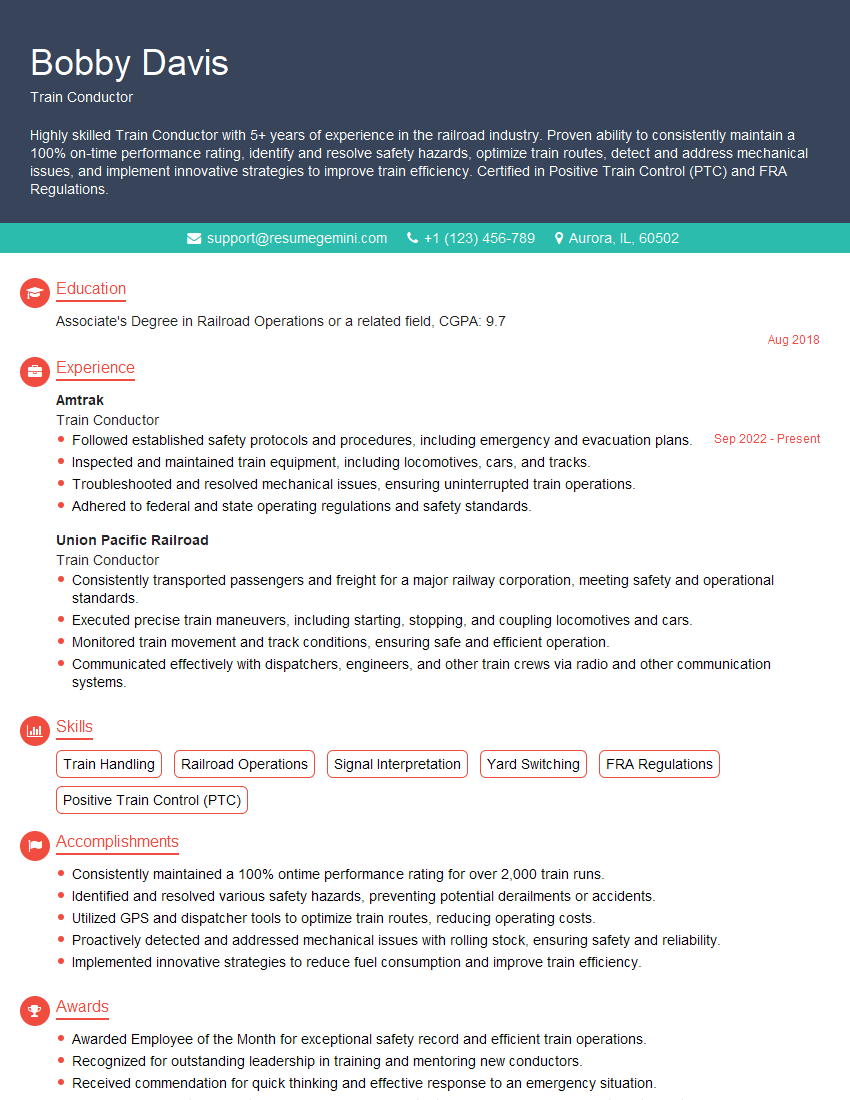
Are you gearing up for an interview for a Train Conductor position? Whether you’re a seasoned professional or just stepping into the role, understanding what’s expected can make all the difference. In this blog, we dive deep into the essential interview questions for Train Conductor and break down the key responsibilities of the role. By exploring these insights, you’ll gain a clearer picture of what employers are looking for and how you can stand out. Read on to equip yourself with the knowledge and confidence needed to ace your next interview and land your dream job!
Acing the interview is crucial, but landing one requires a compelling resume that gets you noticed. Crafting a professional document that highlights your skills and experience is the first step toward interview success. ResumeGemini can help you build a standout resume that gets you called in for that dream job.






Essential Interview Questions For Train Conductor
1. What are the key responsibilities of a Train Conductor?
As a Train Conductor, my primary responsibilities would be to ensure the safe and efficient operation of trains. This includes:
- Controlling the movement of trains
- Monitoring train operations and adhering to schedules
- Communicating with dispatchers, engineers, and other crew members
- Ensuring the safety of passengers and crew
- Responding to emergencies and managing incidents
2. Describe your experience with train signaling systems.
I have a comprehensive understanding of various train signaling systems, including:
- Positive Train Control (PTC): I am proficient in operating PTC systems, which enhance safety by automatically controlling train speed and preventing collisions.
- Centralized Traffic Control (CTC): I have experience working with CTC systems that allow dispatchers to remotely control train movements.
- Automatic Block Signaling (ABS): I am familiar with ABS systems that use track circuits to detect train presence and prevent collisions.
3. How do you handle emergencies such as a track obstruction or a medical emergency onboard?
In the event of an emergency, I follow established protocols and take immediate action to ensure the safety of passengers and crew:
- Track Obstruction: I would immediately contact the dispatcher and activate emergency braking procedures. I would also coordinate with the engineer to assess the situation and determine the necessary course of action.
- Medical Emergency: I would request medical assistance and provide first aid as required. I would also communicate with the dispatcher to inform them of the situation and request further assistance.
4. How do you work with other members of the train crew, such as the Engineer and Assistant Conductor?
Effective teamwork is crucial for the smooth operation of trains. I maintain open communication and work closely with other crew members:
- Engineer: I coordinate with the Engineer on matters related to train handling, speed control, and operating procedures.
- Assistant Conductor: I delegate responsibilities to the Assistant Conductor, who assists with passenger safety, ticket collection, and other tasks.
5. What are the safety precautions you take when performing pre-departure inspections?
Prior to every departure, I conduct thorough pre-departure inspections to ensure the safety of the train and passengers:
- Mechanical inspections: I check the brakes, wheels, couplers, and other mechanical components for any defects or malfunctions.
- Electrical inspections: I verify the functionality of lights, signals, and communication systems.
- Safety equipment: I ensure that all safety equipment, such as fire extinguishers, first aid kits, and emergency exits, are present and in working order.
6. How do you ensure the comfort and satisfaction of passengers during their journey?
Providing excellent customer service is an integral part of my role. I prioritize passenger comfort and satisfaction by:
- Ensuring a clean and well-maintained train environment
- Communicating with passengers clearly and providing regular updates
- Responding promptly to passenger inquiries and requests
- Handling complaints professionally and finding resolutions
7. How do you stay updated on changes in railway regulations and operating procedures?
To ensure compliance and maintain safety, I actively stay abreast of changes in railway regulations and operating procedures:
- Attending training sessions and workshops
- Reading industry publications and manuals
- Consulting with experienced colleagues and supervisors
8. Describe your experience in managing train delays and disruptions.
Train delays and disruptions are inevitable at times. I manage these situations effectively by:
- Communicating with passengers clearly and promptly about the delay
- Exploring alternative routes or arrangements to minimize the impact
- Coordinating with dispatchers and other train crews to resolve issues
9. How do you prioritize tasks and allocate responsibilities to your subordinates?
Effective task management is crucial to the smooth operation of trains. I prioritize tasks based on their impact on safety, schedule, and passenger satisfaction:
- safety-related tasks
- schedule adherence
- passenger comfort and service
10. What motivates you to be a Train Conductor?
My passion for trains and my commitment to ensuring the safety and comfort of passengers drive my motivation to be a Train Conductor. I find immense satisfaction in:
- Contributing to the transportation industry
- Operating trains safely and efficiently
- Providing a positive experience for passengers
Interviewers often ask about specific skills and experiences. With ResumeGemini‘s customizable templates, you can tailor your resume to showcase the skills most relevant to the position, making a powerful first impression. Also check out Resume Template specially tailored for Train Conductor.
Career Expert Tips:
- Ace those interviews! Prepare effectively by reviewing the Top 50 Most Common Interview Questions on ResumeGemini.
- Navigate your job search with confidence! Explore a wide range of Career Tips on ResumeGemini. Learn about common challenges and recommendations to overcome them.
- Craft the perfect resume! Master the Art of Resume Writing with ResumeGemini’s guide. Showcase your unique qualifications and achievements effectively.
- Great Savings With New Year Deals and Discounts! In 2025, boost your job search and build your dream resume with ResumeGemini’s ATS optimized templates.
Researching the company and tailoring your answers is essential. Once you have a clear understanding of the Train Conductor‘s requirements, you can use ResumeGemini to adjust your resume to perfectly match the job description.
Key Job Responsibilities
Train Conductors are responsible for the safe and efficient operation of trains. They ensure that trains depart and arrive on time, and that passengers and freight are transported safely.
1. Operating Trains
Train Conductors operate trains by controlling the throttle, brakes, and other train controls. They must be able to read and interpret signals and track conditions, and they must be able to make quick decisions in emergency situations.
- Control the speed and direction of trains
- Monitor track conditions and signals
- Respond to emergencies
2. Passenger Safety
Train Conductors are responsible for the safety of passengers. They must ensure that passengers are safely boarded and disembarked from trains, and they must be able to handle emergencies such as medical emergencies or unruly passengers.
- Ensure that passengers are safely boarded and disembarked from trains
- Handle emergencies such as medical emergencies or unruly passengers
- Provide customer service to passengers
3. Freight Management
Train Conductors are responsible for the management of freight. They must ensure that freight is loaded and unloaded safely and efficiently, and they must be able to track the movement of freight.
- Ensure that freight is loaded and unloaded safely and efficiently
- Track the movement of freight
- Coordinate with other railroad employees to ensure the smooth flow of freight
4. Communication
Train Conductors must be able to communicate effectively with other railroad employees, passengers, and freight customers. They must be able to give clear instructions, and they must be able to understand and respond to communications from others.
- Give clear instructions to other railroad employees
- Understand and respond to communications from others
- Communicate with passengers and freight customers
Interview Tips
To ace the interview for a Train Conductor position, it is important to be prepared. Here are a few tips:
1. Research the Company and the Position
Before the interview, take some time to research the company and the specific Train Conductor position. This will help you to understand the company’s culture and the specific requirements of the job.
- Visit the company’s website to learn about their history, mission, and values.
- Read online reviews of the company to get a sense of the company culture.
- Review the job posting carefully to identify the specific requirements of the job.
2. Prepare Your Answers to Common Interview Questions
There are a number of common interview questions that you are likely to be asked. It is helpful to prepare your answers to these questions in advance so that you can deliver them confidently and concisely.
- Tell me about yourself.
- Why are you interested in this position?
- What are your strengths and weaknesses?
- What is your experience with train operations?
- How do you handle emergencies?
3. Practice Your Interview Skills
The best way to prepare for an interview is to practice. Ask a friend or family member to conduct a mock interview with you. This will give you an opportunity to practice your answers to common interview questions and to get feedback on your interviewing skills.
- Practice answering common interview questions out loud.
- Ask a friend or family member to conduct a mock interview with you.
- Record yourself answering interview questions and then review your performance.
4. Be Yourself
It is important to be yourself during the interview. The interviewer wants to get to know the real you, so don’t try to be someone you’re not. Just relax and be yourself, and you’ll be more likely to make a good impression.
- Don’t try to be someone you’re not.
- Be confident and enthusiastic.
- Make eye contact with the interviewer.
Next Step:
Armed with this knowledge, you’re now well-equipped to tackle the Train Conductor interview with confidence. Remember, preparation is key. So, start crafting your resume, highlighting your relevant skills and experiences. Don’t be afraid to tailor your application to each specific job posting. With the right approach and a bit of practice, you’ll be well on your way to landing your dream job. Build your resume now from scratch or optimize your existing resume with ResumeGemini. Wish you luck in your career journey!