Are you gearing up for an interview for a Unit Controller position? Whether you’re a seasoned professional or just stepping into the role, understanding what’s expected can make all the difference. In this blog, we dive deep into the essential interview questions for Unit Controller and break down the key responsibilities of the role. By exploring these insights, you’ll gain a clearer picture of what employers are looking for and how you can stand out. Read on to equip yourself with the knowledge and confidence needed to ace your next interview and land your dream job!
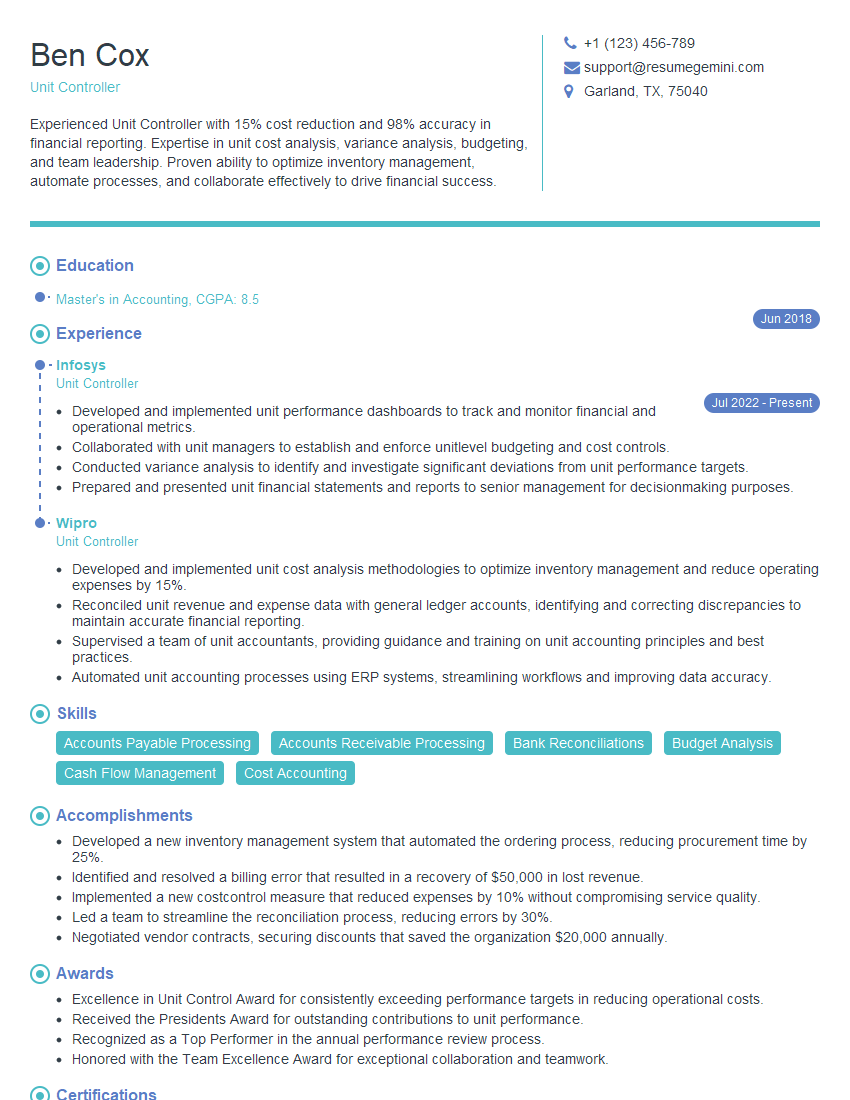
Acing the interview is crucial, but landing one requires a compelling resume that gets you noticed. Crafting a professional document that highlights your skills and experience is the first step toward interview success. ResumeGemini can help you build a standout resume that gets you called in for that dream job.






Essential Interview Questions For Unit Controller
1. Describe your understanding of the role of a Unit Controller?
A Unit Controller is responsible for overseeing and managing financial operations within a specific business unit or department. Key responsibilities include:
- Preparing and monitoring financial budgets
- Analyzing financial performance and identifying areas for improvement
- Developing and implementing cost-saving strategies
- Ensuring compliance with financial regulations and reporting standards
2. How do you stay up-to-date on the latest accounting principles and regulations?
As a Unit Controller, it’s imperative to possess in-depth knowledge of accounting principles and regulations. I make a conscious effort to keep abreast of the latest updates through several strategies:
Continuing Professional Education:
- Attending industry conferences and workshops
- Enrolling in online courses and webinars
Professional Development:
- Reading industry publications and journals
- Actively participating in professional organizations like the Institute of Management Accountants (IMA)
3. Explain your experience in developing and implementing cost-saving strategies?
In my previous role, I spearheaded a project to optimize operational efficiency and reduce expenses. Through a comprehensive analysis of business processes and identifying areas of waste, I devised and implemented a series of cost-saving measures that resulted in:
- Negotiating more favorable vendor contracts
- Streamlining inventory management
- Improving operational efficiency through automation
4. How do you ensure the accuracy and reliability of financial data?
Accuracy and reliability in financial data are of utmost importance. I employ a combination of measures to ensure data integrity:
- Implementing robust internal controls and procedures
- Regularly reconciling accounts and reviewing financial statements
- Utilizing data analytics tools to identify and correct errors promptly
- Maintaining open communication with the accounting team and external auditors
5. Describe your experience with financial planning and budgeting?
Financial planning and budgeting play a vital role in guiding business operations. My expertise in this area includes:
- Developing and monitoring detailed financial plans and budgets
- Collaborating with business leaders to set financial targets
- Analyzing financial performance and providing timely insights
- Adjusting plans and budgets based on changing business conditions
6. How do you communicate complex financial information effectively to stakeholders?
Effective communication is essential for conveying financial information. I have developed strong communication skills to present complex data in a clear and digestible manner:
- Using visual aids and storytelling to make financial concepts relatable
- Tailoring communication to the audience’s level of understanding
- Encouraging active participation and feedback to ensure comprehension
7. What software and tools are you proficient in for financial analysis?
My proficiency in financial analysis software and tools includes:
- Microsoft Excel for data analysis and modeling
- Financial planning and budgeting software (e.g., SAP BPC, Oracle Hyperion)
- Data visualization and reporting tools (e.g., Power BI, Tableau)
8. Describe your experience in working with cross-functional teams?
Collaboration is essential in a business environment. I possess strong interpersonal skills and a proven track record of working effectively with cross-functional teams:
- Communicating effectively with colleagues from diverse backgrounds
- Understanding and considering different perspectives
- Building strong relationships and fostering teamwork
9. How do you prioritize and manage multiple projects and responsibilities?
Prioritization and effective time management are key to success in a demanding role:
- Assessing the importance and urgency of tasks
- Creating and adhering to realistic timelines
- Delegating tasks when necessary
- Utilizing technology and tools for efficient project management
10. How do you stay motivated and maintain a positive attitude in a challenging environment?
Maintaining motivation and positivity in challenging environments requires resilience and a proactive approach:
- Setting realistic goals and breaking large tasks into smaller ones
- Focusing on accomplishments and recognizing progress
- Seeking support and encouragement from colleagues
- Maintaining a healthy work-life balance
Interviewers often ask about specific skills and experiences. With ResumeGemini‘s customizable templates, you can tailor your resume to showcase the skills most relevant to the position, making a powerful first impression. Also check out Resume Template specially tailored for Unit Controller.
Career Expert Tips:
- Ace those interviews! Prepare effectively by reviewing the Top 50 Most Common Interview Questions on ResumeGemini.
- Navigate your job search with confidence! Explore a wide range of Career Tips on ResumeGemini. Learn about common challenges and recommendations to overcome them.
- Craft the perfect resume! Master the Art of Resume Writing with ResumeGemini’s guide. Showcase your unique qualifications and achievements effectively.
- Great Savings With New Year Deals and Discounts! In 2025, boost your job search and build your dream resume with ResumeGemini’s ATS optimized templates.
Researching the company and tailoring your answers is essential. Once you have a clear understanding of the Unit Controller‘s requirements, you can use ResumeGemini to adjust your resume to perfectly match the job description.
Key Job Responsibilities
Unit Controllers are responsible for the day-to-day financial operations of a specific business unit or department. They play a crucial role in ensuring the accuracy and integrity of financial data, as well as providing timely financial information to management for decision-making.
1. Financial Reporting and Analysis
Unit Controllers are responsible for preparing and analyzing financial statements, such as income statements, balance sheets, and cash flow statements. They must ensure that these statements are accurate and compliant with all applicable accounting standards.
- Prepare and analyze financial statements, including income statements, balance sheets, and cash flow statements
- Monitor financial performance and identify trends and areas for improvement
2. Budgeting and Forecasting
Unit Controllers are involved in the budgeting process, helping to develop and manage budgets for their business unit. They also provide forecasts of future financial performance to help management make informed decisions.
- Develop and manage budgets for their business unit
- Provide forecasts of future financial performance
3. Cost Control and Expense Management
Unit Controllers are responsible for controlling costs and managing expenses within their business unit. They must identify opportunities for cost savings and develop strategies to reduce expenses.
- Control costs and manage expenses within their business unit
- Identify opportunities for cost savings
4. Internal Controls and Compliance
Unit Controllers are responsible for establishing and maintaining internal controls to ensure the accuracy and integrity of financial data. They must also comply with all applicable laws and regulations.
- Establish and maintain internal controls
- Comply with all applicable laws and regulations
Interview Tips
Preparing thoroughly for an interview can significantly increase your chances of success. Here are some tips to help you ace your Unit Controller interview:
1. Research the Company and Position
Before the interview, take the time to research the company and the specific Unit Controller position. This will help you understand the company’s culture, business model, and the challenges and opportunities associated with the role.
- Visit the company’s website and read about their mission, values, and financial performance.
- Review the job description carefully and identify the key responsibilities and qualifications.
2. Practice Your Answers
Once you have a good understanding of the company and the position, take some time to practice your answers to common interview questions. This will help you feel more confident and prepared during the actual interview.
- Prepare answers to questions about your experience, skills, and qualifications.
- Practice answering behavioral questions, such as “Tell me about a time when you faced a challenge and how you overcame it.”
3. Dress Professionally and Arrive on Time
First impressions matter, so it’s important to dress professionally and arrive on time for your interview. This shows the interviewer that you are respectful of their time and that you take the interview seriously.
- Choose clothing that is clean, pressed, and appropriate for a business setting.
- Arrive at the interview location 10-15 minutes early to give yourself time to relax and prepare.
4. Be Enthusiastic and Ask Questions
During the interview, be enthusiastic and show the interviewer that you are genuinely interested in the position. Ask thoughtful questions about the company, the role, and the team. This shows that you are engaged and that you are interested in learning more about the opportunity.
- Ask questions about the company’s culture, growth plans, and financial performance.
- Ask about the specific role and the responsibilities and challenges involved.
5. Follow Up
After the interview, be sure to follow up with the interviewer. This shows that you are interested in the position and that you appreciate their time. In your follow-up email, thank the interviewer for their time and reiterate your interest in the position.
- Send a thank-you email within 24 hours of the interview.
- Reiterate your interest in the position and highlight your key qualifications.
Next Step:
Now that you’re armed with a solid understanding of what it takes to succeed as a Unit Controller, it’s time to turn that knowledge into action. Take a moment to revisit your resume, ensuring it highlights your relevant skills and experiences. Tailor it to reflect the insights you’ve gained from this blog and make it shine with your unique qualifications. Don’t wait for opportunities to come to you—start applying for Unit Controller positions today and take the first step towards your next career milestone. Your dream job is within reach, and with a polished resume and targeted applications, you’ll be well on your way to achieving your career goals! Build your resume now with ResumeGemini.