Are you gearing up for a career shift or aiming to ace your next interview? Look no further! We’ve curated a comprehensive guide to help you crack the interview for the coveted Wage Adjuster position. From understanding the key responsibilities to mastering the most commonly asked questions, this blog has you covered. So, buckle up and let’s embark on this journey together.
Acing the interview is crucial, but landing one requires a compelling resume that gets you noticed. Crafting a professional document that highlights your skills and experience is the first step toward interview success. ResumeGemini can help you build a standout resume that gets you called in for that dream job.






Essential Interview Questions For Wage Adjuster
1. What are the key responsibilities of a Wage Adjuster?
As a Wage Adjuster, my primary responsibilities include:
- Conducting job evaluations to determine relative job worth and compensation levels.
- Analyzing market data, industry trends, and company policies to ensure competitive and equitable pay practices.
2. Describe the different methods used for job evaluation.
Analytical Methods
- Point Method: Assigns points to jobs based on factors such as skill, effort, responsibility, and working conditions.
- Factor Comparison Method: Compares jobs to a set of predetermined factors and assigns weights to each factor.
Non-Analytical Methods
- Ranking Method: Jobs are ranked based on their overall value to the organization.
- Classification Method: Jobs are categorized into different classes based on their level of skill, complexity, and responsibility.
3. How do you stay up-to-date on current compensation trends and regulations?
To ensure the accuracy and relevance of my work, I regularly engage in the following activities:
- Attend industry conferences and workshops.
- Subscribe to compensation and human resources publications.
- Network with other professionals in the field.
- Monitor government and regulatory updates related to compensation practices.
4. Explain the concept of “total rewards” and how it relates to wage adjustment.
Total rewards encompass all forms of compensation and benefits provided to employees. It extends beyond base pay and includes elements such as:
- Incentives
- Bonuses
- Health insurance
- Paid time off
When considering wage adjustments, it’s important to take these elements into account to ensure a holistic approach to compensation.
5. What factors should be considered when determining an appropriate wage adjustment?
To determine an appropriate wage adjustment, I consider the following factors:
- Market data and industry benchmarks
- Job evaluation results
- Employee performance and contributions
- Company budget and financial constraints
- Legal and regulatory requirements
6. How do you handle situations where employees request wage adjustments outside of established guidelines?
When employees request wage adjustments outside of established guidelines, I approach the situation with the following steps:
- Meet with the employee to discuss their request and understand their reasons.
- Review their job performance, contributions, and market data to assess the validity of their request.
- If the request is not supported by objective evidence, I explain the company’s compensation guidelines and provide guidance on how they can improve their performance to qualify for future adjustments.
- If the request is reasonable and supported by data, I work with management to determine if an exception can be made.
7. What are some of the challenges you have faced in your role as a Wage Adjuster?
Some of the challenges I have faced include:
- Maintaining objectivity and avoiding bias when conducting job evaluations.
- Balancing the need to ensure competitive compensation with the company’s financial constraints.
- Communicating wage adjustment decisions to employees in a fair and transparent manner.
- Keeping up with rapidly changing compensation laws and regulations.
8. How do you measure the effectiveness of your work as a Wage Adjuster?
I measure the effectiveness of my work based on the following metrics:
- Employee satisfaction with their compensation
- Retention rates
- Alignment of compensation practices with market trends and industry best practices
- Compliance with legal and regulatory requirements
9. What software or tools do you use in your role as a Wage Adjuster?
I am proficient in the following software and tools:
- Compensation management systems
- Job evaluation software
- Market data analysis tools
- Payroll systems
10. Describe a successful project or initiative you have worked on as a Wage Adjuster.
One of my most successful projects was leading a compensation equity review for our company. I used a combination of job evaluations and market data analysis to identify and address any pay gaps or disparities. The project resulted in a more equitable and competitive compensation structure, which improved employee morale and reduced turnover.
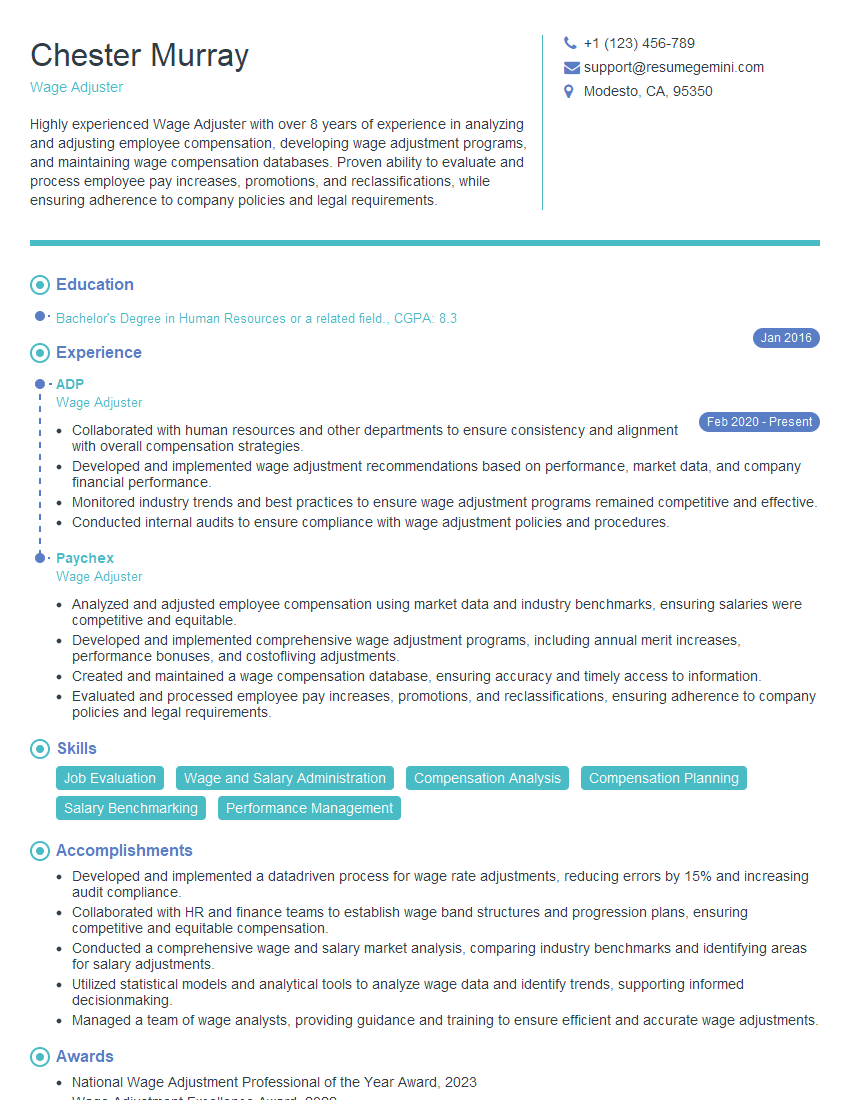
Interviewers often ask about specific skills and experiences. With ResumeGemini‘s customizable templates, you can tailor your resume to showcase the skills most relevant to the position, making a powerful first impression. Also check out Resume Template specially tailored for Wage Adjuster.
Career Expert Tips:
- Ace those interviews! Prepare effectively by reviewing the Top 50 Most Common Interview Questions on ResumeGemini.
- Navigate your job search with confidence! Explore a wide range of Career Tips on ResumeGemini. Learn about common challenges and recommendations to overcome them.
- Craft the perfect resume! Master the Art of Resume Writing with ResumeGemini’s guide. Showcase your unique qualifications and achievements effectively.
- Great Savings With New Year Deals and Discounts! In 2025, boost your job search and build your dream resume with ResumeGemini’s ATS optimized templates.
Researching the company and tailoring your answers is essential. Once you have a clear understanding of the Wage Adjuster‘s requirements, you can use ResumeGemini to adjust your resume to perfectly match the job description.
Key Job Responsibilities
Wage Adjusters play a pivotal role in maintaining equitable and competitive compensation structures within organizations. Their key responsibilities include:
1. Wage Analysis and Benchmarking:
Conducting in-depth market research and industry benchmarking to identify prevailing wage rates for specific job positions.
- Analyzing compensation data from credible sources, such as salary surveys, industry reports, and government databases.
- Comparing internal wage structures with external benchmarks to identify areas for adjustment.
2. Wage Policy Development and Implementation:
Developing and implementing wage policies that align with the organization’s compensation philosophy and objectives.
- Establishing wage ranges, job grades, and salary structures based on market data and internal equity.
- Ensuring compliance with all applicable wage and salary laws and regulations.
3. Wage Adjustment Process:
Evaluating and adjusting employee wages based on performance, market conditions, and internal equity considerations.
- Conducting salary reviews and recommending wage adjustments to ensure fairness and competitiveness.
- Negotiating and finalizing salary offers with new and existing employees.
4. Employee Communication and Training:
Communicating compensation and wage adjustment decisions to employees in a clear and transparent manner.
- Providing explanations for wage adjustments and answering employee inquiries.
- Developing and delivering training programs on compensation-related topics, such as salary negotiation and financial literacy.
Interview Tips
To ace an interview for a Wage Adjuster position, it’s crucial to showcase your knowledge, skills, and preparation. Here are some tips:
1. Research the Company and Industry:
Gain a thorough understanding of the organization’s compensation philosophy, industry benchmarks, and recent wage adjustment trends.
- Visit the company’s website, LinkedIn profile, and industry publications to gather information.
- Prepare questions that demonstrate your knowledge and interest in the specific industry and organization.
2. Highlight Relevant Experience and Skills:
Emphasize your experience in conducting wage analysis, developing wage policies, and implementing wage adjustment processes.
- Quantify your accomplishments and provide specific examples of how you have successfully managed compensation programs.
- Showcase your understanding of labor laws and regulations related to compensation.
3. Demonstrate Analytical and Communication Skills:
Wage Adjusters need strong analytical skills to interpret market data and make informed recommendations.
- Explain how you analyze compensation data and identify trends and patterns.
- Provide examples of how you have effectively communicated compensation decisions to employees and stakeholders.
4. Prepare for Behavioral Interview Questions:
Interviewers often use behavioral interview questions to assess your work style and problem-solving abilities.
- Review common behavioral interview questions and prepare thoughtful answers using the STAR method (Situation, Task, Action, Result).
- Focus on highlighting your ability to work independently, negotiate effectively, and handle confidential information.
5. Ask Informed Questions:
Prepare thoughtful questions that demonstrate your interest in the position and the organization.
- Ask about the organization’s compensation philosophy and its approach to wage adjustments.
- Inquire about opportunities for professional development and career growth within the company.
Next Step:
Now that you’re armed with interview-winning answers and a deeper understanding of the Wage Adjuster role, it’s time to take action! Does your resume accurately reflect your skills and experience for this position? If not, head over to ResumeGemini. Here, you’ll find all the tools and tips to craft a resume that gets noticed. Don’t let a weak resume hold you back from landing your dream job. Polish your resume, hit the “Build Your Resume” button, and watch your career take off! Remember, preparation is key, and ResumeGemini is your partner in interview success.