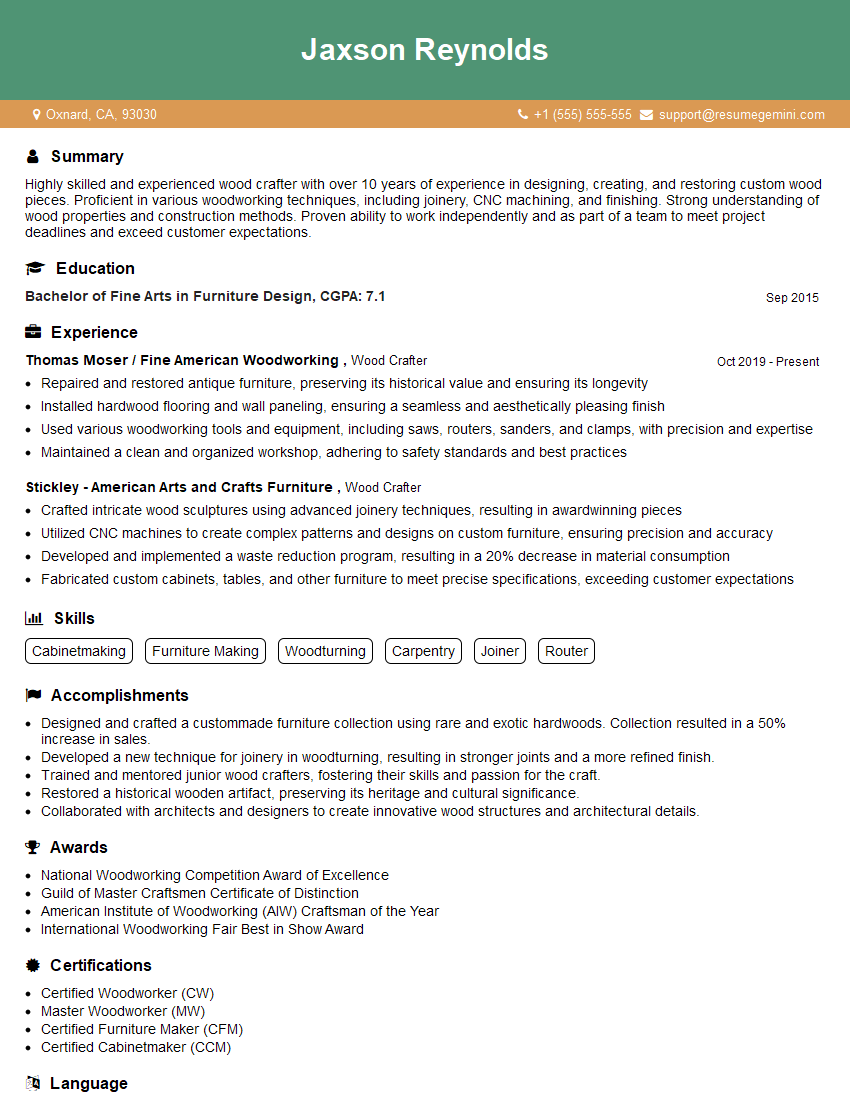
Are you gearing up for an interview for a Wood Crafter position? Whether you’re a seasoned professional or just stepping into the role, understanding what’s expected can make all the difference. In this blog, we dive deep into the essential interview questions for Wood Crafter and break down the key responsibilities of the role. By exploring these insights, you’ll gain a clearer picture of what employers are looking for and how you can stand out. Read on to equip yourself with the knowledge and confidence needed to ace your next interview and land your dream job!
Acing the interview is crucial, but landing one requires a compelling resume that gets you noticed. Crafting a professional document that highlights your skills and experience is the first step toward interview success. ResumeGemini can help you build a standout resume that gets you called in for that dream job.






Essential Interview Questions For Wood Crafter
1. What types of wood joints are you familiar with, and which ones do you most frequently use?
- Butt joint
- Miter joint
- Lap joint
- Dado joint
- Mortise and tenon joint
2. What are the different types of wood finishes, and what are their pros and cons?
Pros and Cons of Different Wood Finishes
- Oil-based finishes: Pros – Durable, easy to apply, water-resistant. Cons – Can yellow over time, requires multiple coats.
- Water-based finishes: Pros – Environmentally friendly, easy to clean up, dries quickly. Cons – Not as durable as oil-based finishes, can raise the grain of the wood.
- Lacquer finishes: Pros – Durable, high-gloss finish, resistant to scratches. Cons – Can be difficult to apply, requires multiple coats.
- Shellac finishes: Pros – Natural, food-safe, easy to apply. Cons – Not as durable as other finishes, can be damaged by water.
3. What are the most common types of woodworking tools, and what are their uses?
- Saws: Cutting wood
- Drills: Making holes in wood
- Sanders: Smoothing wood surfaces
- Planers: Leveling and smoothing wood surfaces
- Jointers: Creating straight edges on wood
4. What are the different types of wood stains, and what are their uses?
- Oil-based stains: Penetrate deep into the wood, provide a rich color, and are durable.
- Water-based stains: Less penetrating than oil-based stains, easier to clean up, and can be used on damp wood.
- Gel stains: Thick, easy to apply, and can be used to create different effects.
- Penetrating stains: Soak into the wood, provide a transparent color, and are ideal for highlighting the wood’s grain.
5. What are the different types of wood adhesives, and what are their uses?
- PVA glue: General-purpose adhesive, easy to use, and dries clear.
- Epoxy adhesive: Strong, durable adhesive, resistant to water and chemicals.
- Cyanoacrylate adhesive: Fast-acting adhesive, ideal for small repairs.
- Hot melt adhesive: Melts when heated, providing a strong bond.
6. What are the different types of wood preservatives, and what are their uses?
- Oil-based preservatives: Penetrate deep into the wood, providing protection against rot and insects.
- Water-based preservatives: Less penetrating than oil-based preservatives, easier to clean up, and can be used on damp wood.
- Borate preservatives: Environmentally friendly, non-toxic, and effective against rot and insects.
7. What are the different types of woodworking machines, and what are their uses?
- Table saw: Cutting wood
- Band saw: Cutting curves in wood
- Scroll saw: Cutting intricate shapes in wood
- Jointer: Leveling and smoothing wood surfaces
- Planer: Leveling and smoothing wood surfaces
8. What are the different types of woodturning tools, and what are their uses?
- Gouges: Carving wood
- Chisels: Carving and shaping wood
- Scrapers: Smoothing and shaping wood
- Sanders: Smoothing wood surfaces
9. What are the different types of woodworking projects, and what are the skills required to complete them?
- Furniture making: Requires skills in joinery, finishing, and design.
- Cabinet making: Requires skills in joinery, finishing, and design.
- Woodturning: Requires skills in using woodturning tools and techniques.
- Carving: Requires skills in using carving tools and techniques.
10. What are the different types of woodworking businesses, and what are the skills required to run them?
- Furniture making business: Requires skills in furniture making, marketing, and business management.
- Cabinet making business: Requires skills in cabinet making, marketing, and business management.
- Woodturning business: Requires skills in woodturning, marketing, and business management.
- Carving business: Requires skills in carving, marketing, and business management.
Interviewers often ask about specific skills and experiences. With ResumeGemini‘s customizable templates, you can tailor your resume to showcase the skills most relevant to the position, making a powerful first impression. Also check out Resume Template specially tailored for Wood Crafter.
Career Expert Tips:
- Ace those interviews! Prepare effectively by reviewing the Top 50 Most Common Interview Questions on ResumeGemini.
- Navigate your job search with confidence! Explore a wide range of Career Tips on ResumeGemini. Learn about common challenges and recommendations to overcome them.
- Craft the perfect resume! Master the Art of Resume Writing with ResumeGemini’s guide. Showcase your unique qualifications and achievements effectively.
- Great Savings With New Year Deals and Discounts! In 2025, boost your job search and build your dream resume with ResumeGemini’s ATS optimized templates.
Researching the company and tailoring your answers is essential. Once you have a clear understanding of the Wood Crafter‘s requirements, you can use ResumeGemini to adjust your resume to perfectly match the job description.
Key Job Responsibilities
Wood Crafters are responsible for creating and repairing wooden items. They use hand and power tools to cut, shape, and assemble wood pieces, and they may also apply finishes such as paint or stain. Wood Crafters need to have a strong understanding of woodworking principles and techniques, and they must be able to work independently and as part of a team.
1. Materials Handling
Wood Crafters need to be able to handle heavy materials, including lumber, plywood, and other wood products. They must also be able to use hand and power tools to cut, shape, and assemble wood pieces.
- Inspect raw materials
- Load and unload materials
2. Machine Operation
Wood Crafters use a variety of machines to cut, shape, and assemble wood pieces. These machines include saws, drills, lathes, and sanders. Wood Crafters need to be able to operate these machines safely and efficiently.
- Operate saws
- Operate drills
- Operate lathes
- Operate sanders
3. Finishing
Wood Crafters may also apply finishes to wood pieces, such as paint or stain. They need to be able to mix and apply finishes correctly, and they must also be able to sand and polish finishes to achieve desired results.
- Mix and apply finishes
- Sand and polish finishes
4. Quality Control
Wood Crafters need to be able to inspect their work and ensure that it meets quality standards. They need to be able to identify defects in wood pieces and correct them.
- Inspect wood products
- Identify and correct defects
Interview Tips
Preparing for a job interview can be stressful, but there are a few things you can do to increase your chances of success. Here are a few tips for acing your Wood Crafter interview:
1. Research the company and the position
Before you go to your interview, take some time to research the company and the position you are applying for. This will help you to understand the company’s culture and values, and it will also help you to tailor your answers to the interviewer’s questions.
- Visit the company’s website
- Read articles about the company
- Talk to people who work for the company
2. Practice answering common interview questions
There are a few common interview questions that you are likely to be asked, such as “Tell me about yourself” and “Why are you interested in this position?”. It is helpful to practice answering these questions in advance so that you can deliver your answers confidently and concisely.
- Write out your answers to common interview questions
- Practice saying your answers out loud
- Get feedback from a friend or family member
3. Dress professionally
First impressions matter, so it is important to dress professionally for your interview. This means wearing clean, pressed clothing that is appropriate for the workplace. You should also make sure that your shoes are clean and polished.
- Wear a suit or dress pants and a button-down shirt
- Make sure your clothes are clean and pressed
- Wear clean, polished shoes
4. Be on time
Punctuality is important, so make sure that you arrive for your interview on time. This shows the interviewer that you are respectful of their time.
- Plan your route to the interview in advance
- Leave early to allow for traffic and other delays
- Arrive at the interview location a few minutes early
5. Be yourself
The most important thing is to be yourself during your interview. The interviewer wants to get to know the real you, so don’t try to be someone you’re not. Just be confident, honest, and enthusiastic about the position.
- Be honest about your skills and experience
- Show the interviewer your passion for woodworking
- Be yourself and let your personality shine through
Next Step:
Armed with this knowledge, you’re now well-equipped to tackle the Wood Crafter interview with confidence. Remember, a well-crafted resume is your first impression. Take the time to tailor your resume to highlight your relevant skills and experiences. And don’t forget to practice your answers to common interview questions. With a little preparation, you’ll be on your way to landing your dream job. So what are you waiting for? Start building your resume and start applying! Build an amazing resume with ResumeGemini.