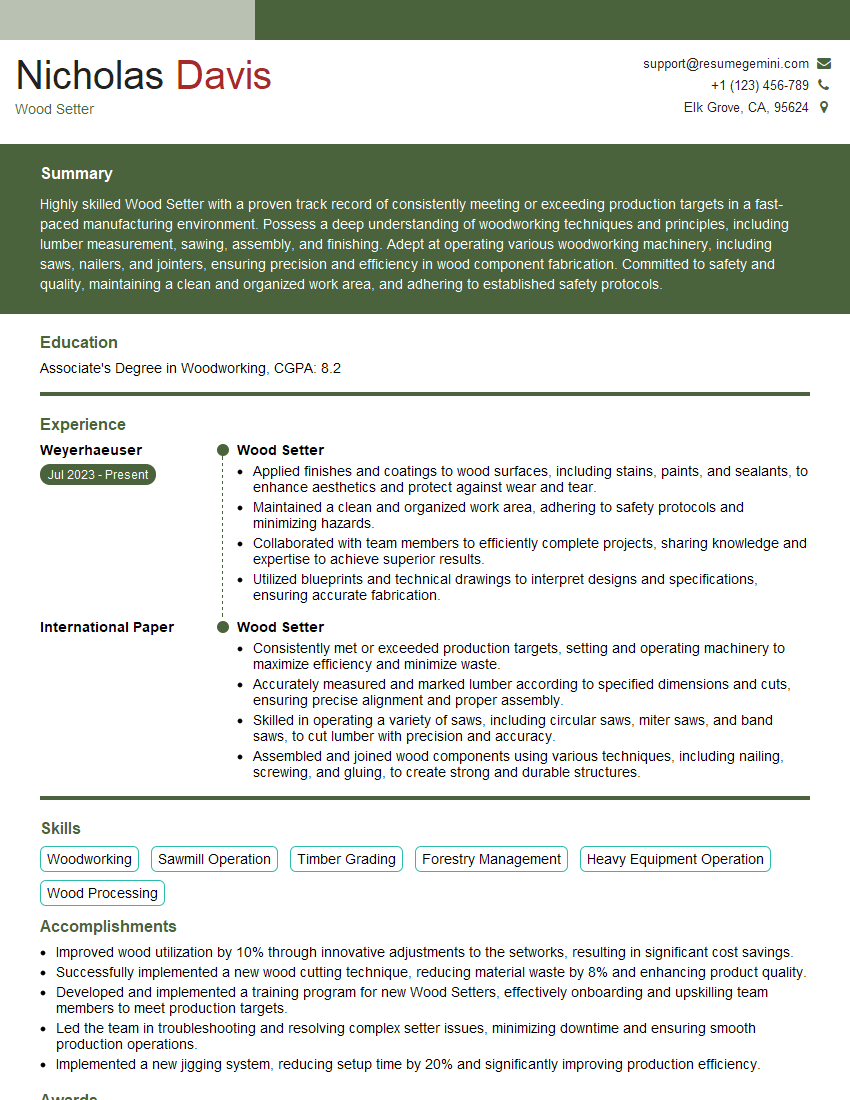
Feeling lost in a sea of interview questions? Landed that dream interview for Wood Setter but worried you might not have the answers? You’re not alone! This blog is your guide for interview success. We’ll break down the most common Wood Setter interview questions, providing insightful answers and tips to leave a lasting impression. Plus, we’ll delve into the key responsibilities of this exciting role, so you can walk into your interview feeling confident and prepared.
Acing the interview is crucial, but landing one requires a compelling resume that gets you noticed. Crafting a professional document that highlights your skills and experience is the first step toward interview success. ResumeGemini can help you build a standout resume that gets you called in for that dream job.






Essential Interview Questions For Wood Setter
1. How would you ensure accuracy in setting up woodworking machines?
To ensure accuracy in setting up woodworking machines, I would follow these steps:
- Read and understand the manufacturer’s instructions for the machine.
- Use a level to ensure that the machine is level and stable.
- Use a ruler or tape measure to set the correct dimensions for the workpiece.
- Use a protractor or other angle-measuring tool to set the correct angles for the workpiece.
- Use a torque wrench to tighten the bolts and screws that secure the workpiece to the machine.
- Double-check all of the settings before starting the machine.
2. What are some common woodworking joints and how do you make them?
Miter Joint
- Cut a 45-degree angle on the end of each piece of wood.
- Apply wood glue to the angled surfaces.
- Clamp the pieces together and allow the glue to dry.
Mortise and Tenon Joint
- Cut a mortise (a square or rectangular hole) into one piece of wood.
- Cut a tenon (a square or rectangular peg) on the end of the other piece of wood.
- Apply wood glue to the tenon and insert it into the mortise.
- Clamp the pieces together and allow the glue to dry.
3. What is the difference between a planer and a jointer?
A planer is used to flatten the surface of a workpiece, while a jointer is used to flatten the edge of a workpiece. A planer has a rotating cutter head with knives that shave off thin layers of wood, while a jointer has a straight cutter head with knives that cut across the grain of the wood.
4. How do you safely operate a table saw?
To safely operate a table saw, I would follow these steps:
- Wear appropriate safety gear, including eye protection, ear protection, and a dust mask.
- Make sure that the saw blade is sharp and properly installed.
- Set the blade guard and riving knife to the correct height and position.
- Use a push stick or block to push the workpiece through the saw blade.
- Never reach over the saw blade.
- Unplug the saw when not in use.
5. How do you maintain woodworking tools?
To maintain woodworking tools, I would follow these steps:
- Clean the tools after each use.
- Sharpen the tools regularly.
- Lubricate the tools according to the manufacturer’s instructions.
- Store the tools in a dry place.
- Inspect the tools regularly for damage.
6. What are some common problems that can occur with woodworking machines and how do you troubleshoot them?
Some common problems that can occur with woodworking machines include:
- The machine is not cutting accurately.
- The machine is making excessive noise.
- The machine is vibrating excessively.
- The machine is not starting.
To troubleshoot these problems, I would:
- Check the machine’s settings.
- Check the machine’s blade or cutter head.
- Check the machine’s belts and pulleys.
- Check the machine’s electrical connections.
7. What are some safety precautions that you should take when working with woodworking machines?
Some safety precautions that I would take when working with woodworking machines include:
- Wear appropriate safety gear, including eye protection, ear protection, and a dust mask.
- Make sure that the machine is properly set up and maintained.
- Use sharp tools and keep them sharp.
- Never reach over the cutting tool.
- Unplug the machine when not in use.
8. What is your experience with using woodworking machinery?
I have over 10 years of experience using woodworking machinery. I have worked with a variety of machines, including table saws, miter saws, jointers, planers, and sanders. I am proficient in using these machines to create a variety of woodworking projects.
9. What are your strengths as a Wood Setter?
10. What are your salary expectations?
My salary expectations are commensurate with my experience and skills. I am confident that I can be a valuable asset to your company and I am willing to negotiate a salary that is fair to both parties.
Interviewers often ask about specific skills and experiences. With ResumeGemini‘s customizable templates, you can tailor your resume to showcase the skills most relevant to the position, making a powerful first impression. Also check out Resume Template specially tailored for Wood Setter.
Career Expert Tips:
- Ace those interviews! Prepare effectively by reviewing the Top 50 Most Common Interview Questions on ResumeGemini.
- Navigate your job search with confidence! Explore a wide range of Career Tips on ResumeGemini. Learn about common challenges and recommendations to overcome them.
- Craft the perfect resume! Master the Art of Resume Writing with ResumeGemini’s guide. Showcase your unique qualifications and achievements effectively.
- Great Savings With New Year Deals and Discounts! In 2025, boost your job search and build your dream resume with ResumeGemini’s ATS optimized templates.
Researching the company and tailoring your answers is essential. Once you have a clear understanding of the Wood Setter‘s requirements, you can use ResumeGemini to adjust your resume to perfectly match the job description.
Key Job Responsibilities
Wood Setters are responsible for preparing and setting up wood materials for further processing in a manufacturing or construction environment. They ensure that the wood is correctly aligned, secured, and ready for cutting, shaping, or assembly.
1. Material Preparation
Wood Setters are responsible for inspecting wood materials for quality, checking for defects or damage.
- Measure and cut wood to the required dimensions.
- Plane and sand wood surfaces to prepare for bonding or finishing.
2. Machine Setup
They set up and adjust woodworking machines, including saws, planers, and jointers, to ensure accurate cutting and shaping.
- Install and adjust saw blades, router bits, and other cutting tools.
- Set up and operate jigs and fixtures to guide the wood through the machines.
3. Wood Alignment and Securing
Wood Setters align and secure wood pieces using clamps, nails, or glue to ensure proper fit and stability during processing.
- Position and align wood pieces according to blueprints or instructions.
- Secure wood pieces using appropriate methods, such as nailing, gluing, or clamping.
4. Quality Assurance
Wood Setters perform quality checks throughout the process to ensure that the wood is properly prepared and meets specifications.
- Inspect wood for defects, damage, or dimensional accuracy.
- Make adjustments to the setup or process as needed to maintain quality.
Interview Tips
To ace the Wood Setter interview, candidates should prepare by researching the industry, practicing common interview questions, and showcasing their skills and experience.
1. Research the Industry and Company
Learn about the woodworking industry and the specific company you’re applying to. This will help you understand the job requirements and demonstrate your interest in the role.
- Research the types of woodworking machinery and materials used in the industry.
- Visit the company’s website to learn about their products, services, and culture.
2. Practice Common Interview Questions
Prepare for common interview questions by practicing your answers. This will help you feel confident and articulate during the interview.
- Describe your experience with woodworking machinery, such as saws, planers, and jointers.
- Explain how you ensure that wood is properly aligned and secured before processing.
3. Showcase Your Skills and Experience
Highlight your relevant skills and experience that demonstrate your ability as a Wood Setter.
- Emphasize your attention to detail and accuracy in preparing wood materials.
- Provide examples of your problem-solving abilities when resolving issues with woodworking machinery or materials.
4. Demonstrate Your Enthusiasm
Show the interviewer that you’re enthusiastic about woodworking and that you’re eager to contribute to the team.
- Share any personal projects or hobbies that involve woodworking.
- Express your interest in learning new techniques and technologies in the industry.
Next Step:
Armed with this knowledge, you’re now well-equipped to tackle the Wood Setter interview with confidence. Remember, preparation is key. So, start crafting your resume, highlighting your relevant skills and experiences. Don’t be afraid to tailor your application to each specific job posting. With the right approach and a bit of practice, you’ll be well on your way to landing your dream job. Build your resume now from scratch or optimize your existing resume with ResumeGemini. Wish you luck in your career journey!