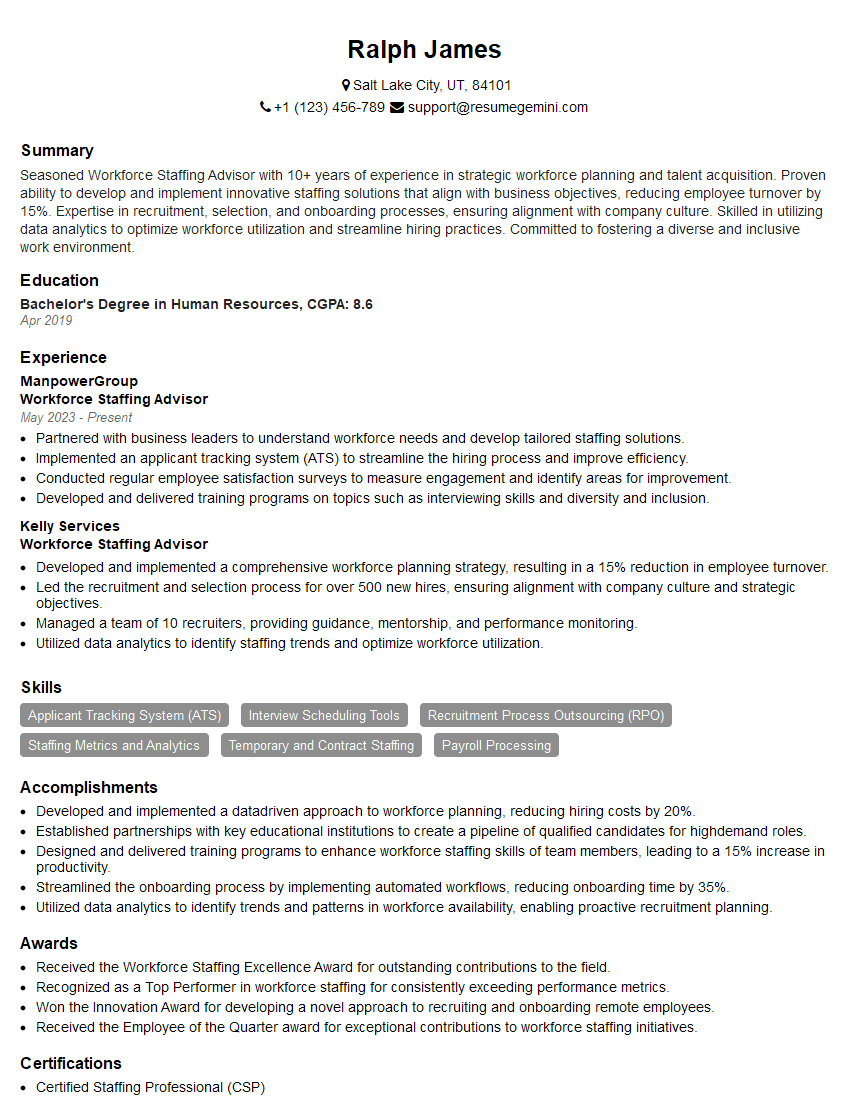
Are you gearing up for an interview for a Workforce Staffing Advisor position? Whether you’re a seasoned professional or just stepping into the role, understanding what’s expected can make all the difference. In this blog, we dive deep into the essential interview questions for Workforce Staffing Advisor and break down the key responsibilities of the role. By exploring these insights, you’ll gain a clearer picture of what employers are looking for and how you can stand out. Read on to equip yourself with the knowledge and confidence needed to ace your next interview and land your dream job!
Acing the interview is crucial, but landing one requires a compelling resume that gets you noticed. Crafting a professional document that highlights your skills and experience is the first step toward interview success. ResumeGemini can help you build a standout resume that gets you called in for that dream job.






Essential Interview Questions For Workforce Staffing Advisor
1. How do you develop a workforce staffing plan that aligns with the organization’s strategic goals?
To develop a workforce staffing plan aligned with strategic goals, I follow these steps:
- Analyze current workforce: Assess existing workforce, including skills, demographics, and roles.
- Forecast future demand: Use historical data, industry trends, and business objectives to project future staffing needs.
- Identify gaps: Compare future demand with current workforce to determine gaps in skills, experience, and headcount.
- Plan for recruitment and retention: Develop strategies to attract, hire, and retain qualified candidates based on identified gaps.
- Monitor and evaluate: Regularly track progress and adjust the plan as needed to ensure alignment with strategic goals.
2. Describe your experience in using data and analytics to inform staffing decisions.
- Key performance indicators (KPIs): I use KPIs such as employee turnover, time-to-fill, and job satisfaction to measure staffing effectiveness.
- Predictive analytics: I leverage predictive analytics to identify future staffing trends and forecast labor market demands.
- Benchmarking: I compare our staffing metrics against industry benchmarks to identify areas for improvement.
- Data visualization: I use data visualization tools to present staffing data in clear and compelling ways to support decision-making.
3. How do you assess the effectiveness of your workforce staffing strategies?
To assess the effectiveness of my workforce staffing strategies, I use the following metrics:
- Employee retention rate: I track the rate at which employees are leaving the organization to measure effectiveness in retaining talent.
- Time-to-fill: I monitor the time it takes to fill open positions to evaluate the efficiency of the hiring process.
- Cost-per-hire: I calculate the cost associated with hiring new employees to assess the financial impact of staffing strategies.
- Employee satisfaction: I conduct surveys and gather feedback to assess employee satisfaction with the staffing process and working environment.
4. What are the key challenges you have faced in workforce staffing and how did you overcome them?
One of the key challenges I faced was a shortage of skilled candidates in a specific technical area. To overcome this, I implemented several strategies:
- Expanded recruiting efforts: I expanded our outreach to universities, professional organizations, and industry events to reach a wider pool of candidates.
- Developed training programs: I partnered with internal training teams to develop training programs to upskill current employees and prepare them for roles requiring new skills.
- Reevaluated hiring criteria: I reviewed and adjusted hiring criteria to focus on transferable skills and potential, rather than solely on specific experience.
5. Describe your approach to employee onboarding and development.
My approach to employee onboarding and development includes the following steps:
- Structured onboarding program: I ensure new hires are welcomed into the organization with a comprehensive onboarding program that covers company culture, policies, and role-specific training.
- Mentorship and coaching: I assign new hires with mentors to provide guidance and support during their transition.
- Career development plans: I work with employees to develop personalized career development plans that align with their goals and the organization’s needs.
- Training and development opportunities: I provide access to training and development opportunities to enhance employees’ skills and knowledge.
6. How do you stay up-to-date on emerging trends in workforce staffing?
- Attend industry conferences and webinars: I attend industry events to learn about best practices and innovations in workforce staffing.
- Read industry publications and research: I stay informed by reading industry articles, white papers, and research reports.
- Network with other staffing professionals: I connect with staffing professionals through online forums and LinkedIn to exchange ideas and insights.
7. What is your approach to diversity and inclusion in workforce staffing?
My approach to diversity and inclusion in workforce staffing includes the following initiatives:
- Unbiased hiring practices: I use unbiased hiring practices to ensure that all candidates are evaluated fairly and without discrimination.
- Outreach to underrepresented groups: I actively reach out to underrepresented groups through partnerships with minority-serving organizations.
- Inclusive workplace culture: I foster an inclusive workplace culture where all employees feel valued and respected.
8. How do you manage the risks associated with workforce planning?
- Scenario planning: I conduct scenario planning exercises to anticipate and prepare for potential risks to workforce planning.
- Contingency plans: I develop contingency plans to address potential disruptions to staffing, such as economic downturns or labor shortages.
- Regular monitoring and evaluation: I regularly monitor and evaluate workforce planning assumptions and adjust strategies as needed to mitigate risks.
9. What is your experience in using technology to enhance workforce staffing processes?
- Applicant tracking systems (ATS): I have extensive experience using ATS to manage the hiring process, from candidate screening to offer management.
- Data analytics tools: I use data analytics tools to analyze workforce data and identify trends and patterns.
- Online assessment platforms: I leverage online assessment platforms to evaluate candidate skills and competencies.
10. How do you measure the success of your workforce staffing initiatives?
I measure the success of my workforce staffing initiatives through the following key metrics:
- Employee turnover: I track employee turnover rates to assess the effectiveness of retention strategies.
- Time-to-fill: I monitor the time it takes to fill open positions to evaluate the efficiency of the hiring process.
- Cost-per-hire: I calculate the cost associated with hiring new employees to assess the financial impact of staffing strategies.
- Employee satisfaction: I conduct surveys and gather feedback to assess employee satisfaction with the staffing process and working environment.
Interviewers often ask about specific skills and experiences. With ResumeGemini‘s customizable templates, you can tailor your resume to showcase the skills most relevant to the position, making a powerful first impression. Also check out Resume Template specially tailored for Workforce Staffing Advisor.
Career Expert Tips:
- Ace those interviews! Prepare effectively by reviewing the Top 50 Most Common Interview Questions on ResumeGemini.
- Navigate your job search with confidence! Explore a wide range of Career Tips on ResumeGemini. Learn about common challenges and recommendations to overcome them.
- Craft the perfect resume! Master the Art of Resume Writing with ResumeGemini’s guide. Showcase your unique qualifications and achievements effectively.
- Great Savings With New Year Deals and Discounts! In 2025, boost your job search and build your dream resume with ResumeGemini’s ATS optimized templates.
Researching the company and tailoring your answers is essential. Once you have a clear understanding of the Workforce Staffing Advisor‘s requirements, you can use ResumeGemini to adjust your resume to perfectly match the job description.
Key Job Responsibilities
Workforce Staffing Advisors are responsible for providing strategic guidance and support to organizations on all aspects of workforce planning and staffing.
1. Strategic Workforce Planning
This includes developing and implementing workforce plans that align with the organization’s overall business goals, conducting workforce analysis to identify current and future staffing needs, and forecasting future labor market trends.
- Developing and implementing workforce plans that align with the organization’s overall business goals
- Conducting workforce analysis to identify current and future staffing needs
- Forecasting future labor market trends
2. Staffing Operations
Advisors also manage the day-to-day operations of the staffing function, including recruiting, hiring, onboarding, and employee retention.
- Developing and implementing recruiting strategies
- Screening and interviewing candidates
- Making hiring decisions
- Onboarding new employees
- Managing employee performance
- Developing and implementing employee retention strategies
3. Talent Management
They also play a role in talent management, by identifying and developing high-potential employees, and creating programs to attract and retain top talent.
- Identifying and developing high-potential employees
- Creating programs to attract and retain top talent
- Developing and implementing performance management systems
- Providing career counseling and development
4. Data Analysis and Reporting
Finally, Advisors use data analysis and reporting to track and measure the effectiveness of their staffing programs, and to identify areas for improvement.
- Collecting and analyzing data on staffing metrics
- Preparing reports on staffing trends and performance
- Using data to identify areas for improvement
Interview Tips
To prepare for an interview for a Workforce Staffing Advisor position, candidates should familiarize themselves with the key job responsibilities outlined above, and be prepared to discuss their experience and qualifications in each area.
1. Research the Organization
Candidates should also research the organization they are interviewing with, to understand their business goals and culture, and to be able to speak to how their skills and experience can contribute to the organization’s success.
- Visit the organization’s website
- Read the organization’s annual report
- Follow the organization on social media
- Talk to people who work at the organization
2. Practice Your Answers to Common Interview Questions
There are a number of common interview questions that candidates should be prepared to answer, such as:
- “Tell me about yourself.”
- “Why are you interested in this position?”
- “What are your strengths and weaknesses?”
- “What is your experience with workforce planning?”
- “What is your experience with staffing operations?”
- “What is your experience with talent management?”
- “What is your experience with data analysis and reporting?”
Candidates should take the time to prepare thoughtful and concise answers to these questions, and practice delivering them in a clear and engaging manner.
3. Be Prepared to Ask Questions
At the end of the interview, candidates should be prepared to ask the interviewer questions about the position and the organization. This shows that they are interested in the opportunity and that they have taken the time to prepare for the interview.
- “What are the biggest challenges facing the organization in the next year?”
- “What is the organization’s culture like?”
- “What are the opportunities for advancement within the organization?”
4. Follow Up After the Interview
After the interview, candidates should send a thank-you note to the interviewer, reiterating their interest in the position and thanking them for their time.
Next Step:
Armed with this knowledge, you’re now well-equipped to tackle the Workforce Staffing Advisor interview with confidence. Remember, preparation is key. So, start crafting your resume, highlighting your relevant skills and experiences. Don’t be afraid to tailor your application to each specific job posting. With the right approach and a bit of practice, you’ll be well on your way to landing your dream job. Build your resume now from scratch or optimize your existing resume with ResumeGemini. Wish you luck in your career journey!