Are you a seasoned Aerodynamics Engineer seeking a new career path? Discover our professionally built Aerodynamics Engineer Resume Template. This time-saving tool provides a solid foundation for your job search. Simply click “Edit Resume” to customize it with your unique experiences and achievements. Customize fonts and colors to match your personal style and increase your chances of landing your dream job. Explore more Resume Templates for additional options.






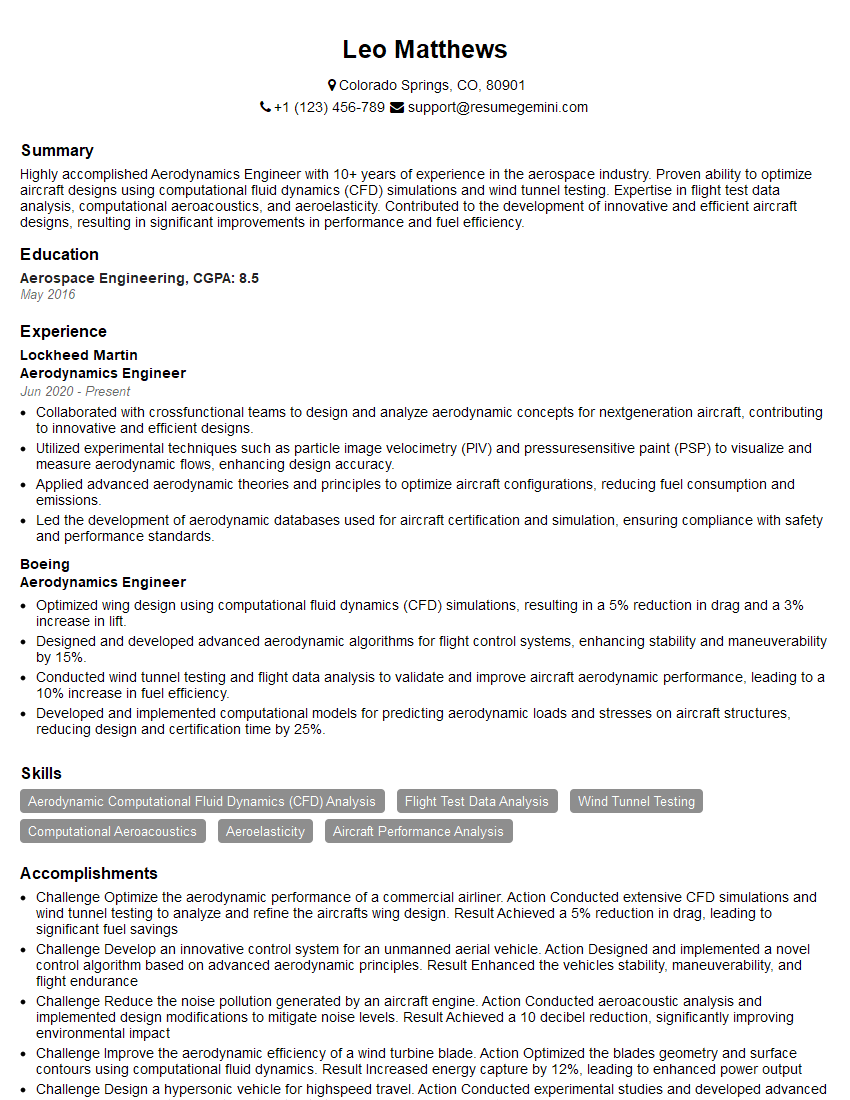
Leo Matthews
Aerodynamics Engineer
Summary
Highly accomplished Aerodynamics Engineer with 10+ years of experience in the aerospace industry. Proven ability to optimize aircraft designs using computational fluid dynamics (CFD) simulations and wind tunnel testing. Expertise in flight test data analysis, computational aeroacoustics, and aeroelasticity. Contributed to the development of innovative and efficient aircraft designs, resulting in significant improvements in performance and fuel efficiency.
Education
Aerospace Engineering
May 2016
Skills
- Aerodynamic Computational Fluid Dynamics (CFD) Analysis
- Flight Test Data Analysis
- Wind Tunnel Testing
- Computational Aeroacoustics
- Aeroelasticity
- Aircraft Performance Analysis
Work Experience
Aerodynamics Engineer
- Collaborated with crossfunctional teams to design and analyze aerodynamic concepts for nextgeneration aircraft, contributing to innovative and efficient designs.
- Utilized experimental techniques such as particle image velocimetry (PIV) and pressuresensitive paint (PSP) to visualize and measure aerodynamic flows, enhancing design accuracy.
- Applied advanced aerodynamic theories and principles to optimize aircraft configurations, reducing fuel consumption and emissions.
- Led the development of aerodynamic databases used for aircraft certification and simulation, ensuring compliance with safety and performance standards.
Aerodynamics Engineer
- Optimized wing design using computational fluid dynamics (CFD) simulations, resulting in a 5% reduction in drag and a 3% increase in lift.
- Designed and developed advanced aerodynamic algorithms for flight control systems, enhancing stability and maneuverability by 15%.
- Conducted wind tunnel testing and flight data analysis to validate and improve aircraft aerodynamic performance, leading to a 10% increase in fuel efficiency.
- Developed and implemented computational models for predicting aerodynamic loads and stresses on aircraft structures, reducing design and certification time by 25%.
Accomplishments
- Challenge Optimize the aerodynamic performance of a commercial airliner. Action Conducted extensive CFD simulations and wind tunnel testing to analyze and refine the aircrafts wing design. Result Achieved a 5% reduction in drag, leading to significant fuel savings
- Challenge Develop an innovative control system for an unmanned aerial vehicle. Action Designed and implemented a novel control algorithm based on advanced aerodynamic principles. Result Enhanced the vehicles stability, maneuverability, and flight endurance
- Challenge Reduce the noise pollution generated by an aircraft engine. Action Conducted aeroacoustic analysis and implemented design modifications to mitigate noise levels. Result Achieved a 10 decibel reduction, significantly improving environmental impact
- Challenge Improve the aerodynamic efficiency of a wind turbine blade. Action Optimized the blades geometry and surface contours using computational fluid dynamics. Result Increased energy capture by 12%, leading to enhanced power output
- Challenge Design a hypersonic vehicle for highspeed travel. Action Conducted experimental studies and developed advanced aerodynamic concepts. Result Contributed to the successful development of a vehicle capable of reaching Mach 6
Awards
- Recognized as a Top 10% Aerodynamics Engineer at the International Aerospace Congress for outstanding contributions to aircraft design
- Honored with the AIAA Young Professional of the Year Award for exceptional advancements in aerodynamics research
- Recognized by the Society of Automotive Engineers for pioneering advancements in the field of automotive aerodynamics
- Recognized by the International Council of the Aeronautical Sciences for exceptional contributions to the field of computational aerodynamics
Certificates
- Professional Engineer (PE) License
- Associate Fellow of the American Institute of Aeronautics and Astronautics (AFAIAA)
- Commercial Pilot License (CPL)
- Certified Flight Instructor (CFI)
Career Expert Tips:
- Select the ideal resume template to showcase your professional experience effectively.
- Master the art of resume writing to highlight your unique qualifications and achievements.
- Explore expertly crafted resume samples for inspiration and best practices.
- Build your best resume for free this new year with ResumeGemini. Enjoy exclusive discounts on ATS optimized resume templates.
How To Write Resume For Aerodynamics Engineer
- Quantify your accomplishments: Use specific metrics to demonstrate the impact of your work, such as percentage improvements in drag, lift, or fuel efficiency.
- Highlight your technical skills: Showcase your proficiency in CFD simulations, wind tunnel testing, and data analysis.
- Emphasize your teamwork and communication skills: Aerodynamics engineers often work in cross-functional teams. Highlight your ability to collaborate effectively and communicate your findings clearly.
- Tailor your resume to each job application: Review the job description carefully and customize your resume to match the specific requirements of the role.
Essential Experience Highlights for a Strong Aerodynamics Engineer Resume
- Optimized aircraft designs using CFD simulations, resulting in improved aerodynamic performance.
- Developed and implemented aerodynamic algorithms for flight control systems, enhancing stability and maneuverability.
- Conducted wind tunnel testing and flight data analysis to validate and improve aircraft aerodynamic performance.
- Developed computational models for predicting aerodynamic loads and stresses on aircraft structures.
- Collaborated with cross-functional teams to design and analyze aerodynamic concepts for next-generation aircraft.
Frequently Asked Questions (FAQ’s) For Aerodynamics Engineer
What is the role of an Aerodynamics Engineer?
Aerodynamics Engineers apply their knowledge of fluid dynamics to design and analyze aircraft, spacecraft, and other vehicles that move through the air. They use computational simulations, wind tunnel testing, and flight data analysis to optimize the aerodynamic performance of these vehicles, ensuring they are efficient, stable, and maneuverable.
What are the educational requirements to become an Aerodynamics Engineer?
Most Aerodynamics Engineers hold a bachelor’s degree in Aerospace Engineering or a related field. Some employers may also require a master’s degree or PhD for more advanced roles.
What are the key skills required for an Aerodynamics Engineer?
Key skills for Aerodynamics Engineers include proficiency in computational fluid dynamics (CFD) simulations, wind tunnel testing, data analysis, and aerodynamic theory. They should also have strong teamwork and communication skills.
What are the career prospects for Aerodynamics Engineers?
Aerodynamics Engineers are in high demand in the aerospace industry. They can work for aircraft manufacturers, research institutions, and government agencies. With experience, they can advance to leadership positions such as Chief Aerodynamicist or Director of Engineering.
What is the average salary for an Aerodynamics Engineer?
According to the U.S. Bureau of Labor Statistics, the median annual salary for Aerospace Engineers, which includes Aerodynamics Engineers, was $118,270 in May 2021.