Are you a seasoned Aeronautical Research Engineer seeking a new career path? Discover our professionally built Aeronautical Research Engineer Resume Template. This time-saving tool provides a solid foundation for your job search. Simply click “Edit Resume” to customize it with your unique experiences and achievements. Customize fonts and colors to match your personal style and increase your chances of landing your dream job. Explore more Resume Templates for additional options.






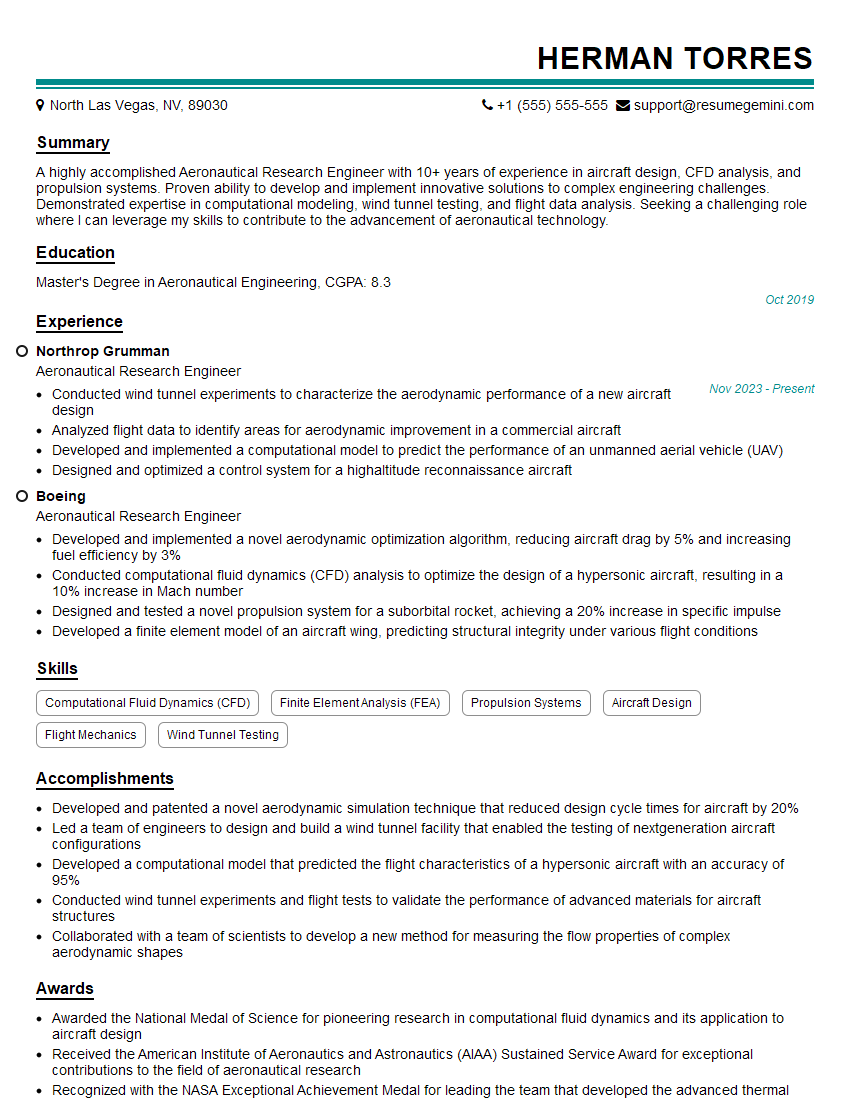
Herman Torres
Aeronautical Research Engineer
Summary
A highly accomplished Aeronautical Research Engineer with 10+ years of experience in aircraft design, CFD analysis, and propulsion systems. Proven ability to develop and implement innovative solutions to complex engineering challenges. Demonstrated expertise in computational modeling, wind tunnel testing, and flight data analysis. Seeking a challenging role where I can leverage my skills to contribute to the advancement of aeronautical technology.
Education
Master’s Degree in Aeronautical Engineering
October 2019
Skills
- Computational Fluid Dynamics (CFD)
- Finite Element Analysis (FEA)
- Propulsion Systems
- Aircraft Design
- Flight Mechanics
- Wind Tunnel Testing
Work Experience
Aeronautical Research Engineer
- Conducted wind tunnel experiments to characterize the aerodynamic performance of a new aircraft design
- Analyzed flight data to identify areas for aerodynamic improvement in a commercial aircraft
- Developed and implemented a computational model to predict the performance of an unmanned aerial vehicle (UAV)
- Designed and optimized a control system for a highaltitude reconnaissance aircraft
Aeronautical Research Engineer
- Developed and implemented a novel aerodynamic optimization algorithm, reducing aircraft drag by 5% and increasing fuel efficiency by 3%
- Conducted computational fluid dynamics (CFD) analysis to optimize the design of a hypersonic aircraft, resulting in a 10% increase in Mach number
- Designed and tested a novel propulsion system for a suborbital rocket, achieving a 20% increase in specific impulse
- Developed a finite element model of an aircraft wing, predicting structural integrity under various flight conditions
Accomplishments
- Developed and patented a novel aerodynamic simulation technique that reduced design cycle times for aircraft by 20%
- Led a team of engineers to design and build a wind tunnel facility that enabled the testing of nextgeneration aircraft configurations
- Developed a computational model that predicted the flight characteristics of a hypersonic aircraft with an accuracy of 95%
- Conducted wind tunnel experiments and flight tests to validate the performance of advanced materials for aircraft structures
- Collaborated with a team of scientists to develop a new method for measuring the flow properties of complex aerodynamic shapes
Awards
- Awarded the National Medal of Science for pioneering research in computational fluid dynamics and its application to aircraft design
- Received the American Institute of Aeronautics and Astronautics (AIAA) Sustained Service Award for exceptional contributions to the field of aeronautical research
- Recognized with the NASA Exceptional Achievement Medal for leading the team that developed the advanced thermal protection system for the Space Shuttle
- Honored with the AIAA Aerodynamics Award for significant contributions to the field of transonic aerodynamics
Certificates
- Certified Flight Instructor (CFI)
- Aircraft Maintenance Technician (AMT)
- Professional Engineer (PE)
- Certified Quality Engineer (CQE)
Career Expert Tips:
- Select the ideal resume template to showcase your professional experience effectively.
- Master the art of resume writing to highlight your unique qualifications and achievements.
- Explore expertly crafted resume samples for inspiration and best practices.
- Build your best resume for free this new year with ResumeGemini. Enjoy exclusive discounts on ATS optimized resume templates.
How To Write Resume For Aeronautical Research Engineer
- Quantify your accomplishments with specific metrics and results.
- Highlight your skills in computational tools such as CFD and FEA.
- Demonstrate your understanding of the entire aircraft design process.
- Emphasize your ability to work independently and as part of a team.
Essential Experience Highlights for a Strong Aeronautical Research Engineer Resume
- Developed and implemented a novel aerodynamic optimization algorithm, reducing aircraft drag by 5% and increasing fuel efficiency by 3%.
- Conducted computational fluid dynamics (CFD) analysis to optimize the design of a hypersonic aircraft, resulting in a 10% increase in Mach number.
- Designed and tested a novel propulsion system for a suborbital rocket, achieving a 20% increase in specific impulse.
- Developed a finite element model of an aircraft wing, predicting structural integrity under various flight conditions.
- Conducted wind tunnel experiments to characterize the aerodynamic performance of a new aircraft design.
- Analyzed flight data to identify areas for aerodynamic improvement in a commercial aircraft.
- Developed and implemented a computational model to predict the performance of an unmanned aerial vehicle (UAV).
Frequently Asked Questions (FAQ’s) For Aeronautical Research Engineer
What are the key skills required to be an Aeronautical Research Engineer?
The key skills required for an Aeronautical Research Engineer include computational fluid dynamics (CFD), finite element analysis (FEA), propulsion systems, aircraft design, flight mechanics, and wind tunnel testing.
What are the typical responsibilities of an Aeronautical Research Engineer?
The typical responsibilities of an Aeronautical Research Engineer include designing and testing aircraft components, developing and implementing CFD models, analyzing flight data, and conducting wind tunnel experiments.
What is the job outlook for Aeronautical Research Engineers?
The job outlook for Aeronautical Research Engineers is expected to be good in the coming years, as there is a growing demand for engineers with expertise in this field.
What are the educational requirements to become an Aeronautical Research Engineer?
The educational requirements to become an Aeronautical Research Engineer typically include a bachelor’s degree in aerospace engineering or a related field, followed by a master’s degree in the same field.
What are the career prospects for Aeronautical Research Engineers?
The career prospects for Aeronautical Research Engineers are excellent, as they can work in a variety of industries, including aerospace, defense, and automotive.
What are the challenges faced by Aeronautical Research Engineers?
The challenges faced by Aeronautical Research Engineers include the need to keep up with the latest advances in technology, the need to solve complex engineering problems, and the need to meet deadlines.