Are you a seasoned Cable Braider seeking a new career path? Discover our professionally built Cable Braider Resume Template. This time-saving tool provides a solid foundation for your job search. Simply click “Edit Resume” to customize it with your unique experiences and achievements. Customize fonts and colors to match your personal style and increase your chances of landing your dream job. Explore more Resume Templates for additional options.






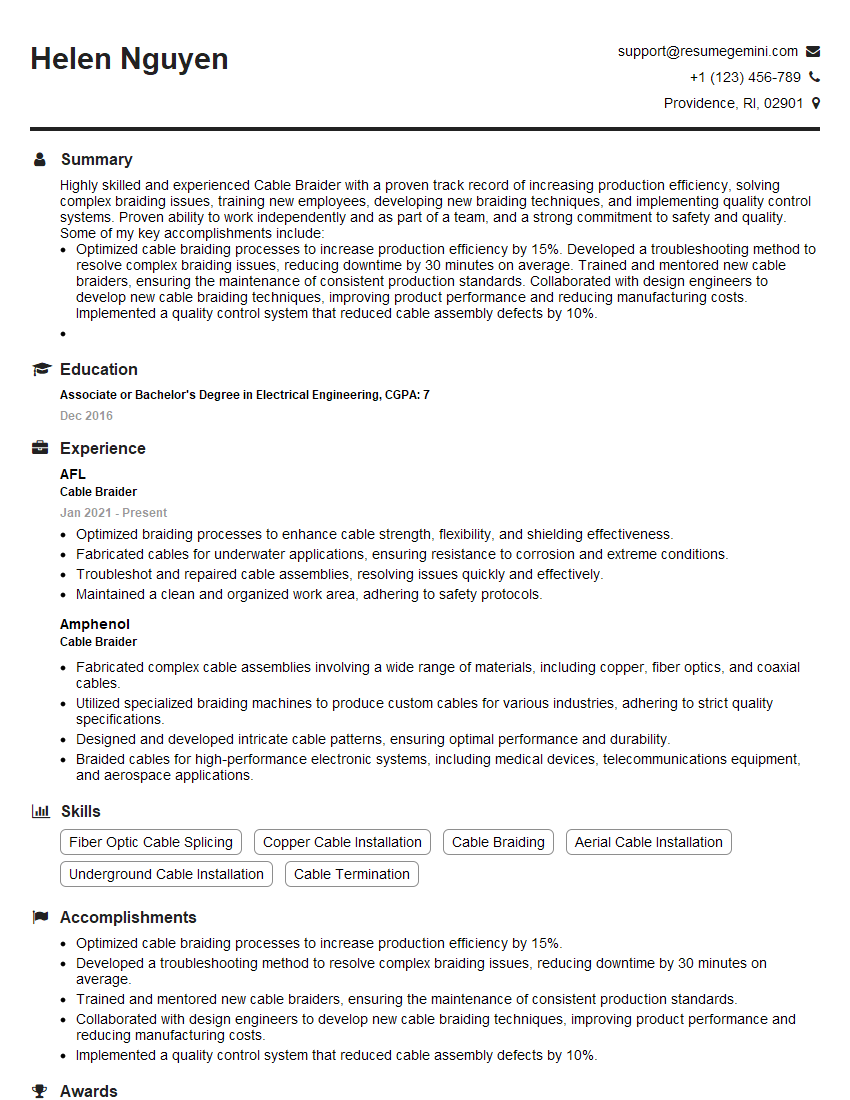
Helen Nguyen
Cable Braider
Summary
Highly skilled and experienced Cable Braider with a proven track record of increasing production efficiency, solving complex braiding issues, training new employees, developing new braiding techniques, and implementing quality control systems. Proven ability to work independently and as part of a team, and a strong commitment to safety and quality.
Some of my key accomplishments include:
- Optimized cable braiding processes to increase production efficiency by 15%. Developed a troubleshooting method to resolve complex braiding issues, reducing downtime by 30 minutes on average. Trained and mentored new cable braiders, ensuring the maintenance of consistent production standards. Collaborated with design engineers to develop new cable braiding techniques, improving product performance and reducing manufacturing costs. Implemented a quality control system that reduced cable assembly defects by 10%.
Education
Associate or Bachelor’s Degree in Electrical Engineering
December 2016
Skills
- Fiber Optic Cable Splicing
- Copper Cable Installation
- Cable Braiding
- Aerial Cable Installation
- Underground Cable Installation
- Cable Termination
Work Experience
Cable Braider
- Optimized braiding processes to enhance cable strength, flexibility, and shielding effectiveness.
- Fabricated cables for underwater applications, ensuring resistance to corrosion and extreme conditions.
- Troubleshot and repaired cable assemblies, resolving issues quickly and effectively.
- Maintained a clean and organized work area, adhering to safety protocols.
Cable Braider
- Fabricated complex cable assemblies involving a wide range of materials, including copper, fiber optics, and coaxial cables.
- Utilized specialized braiding machines to produce custom cables for various industries, adhering to strict quality specifications.
- Designed and developed intricate cable patterns, ensuring optimal performance and durability.
- Braided cables for high-performance electronic systems, including medical devices, telecommunications equipment, and aerospace applications.
Accomplishments
- Optimized cable braiding processes to increase production efficiency by 15%.
- Developed a troubleshooting method to resolve complex braiding issues, reducing downtime by 30 minutes on average.
- Trained and mentored new cable braiders, ensuring the maintenance of consistent production standards.
- Collaborated with design engineers to develop new cable braiding techniques, improving product performance and reducing manufacturing costs.
- Implemented a quality control system that reduced cable assembly defects by 10%.
Awards
- Received the Top Performer Award for exceeding production targets by 20%.
- Recognized with the Employee of the Month award for consistently delivering highquality cable assemblies.
- Awarded the Safety Excellence Award for exceptional adherence to safety protocols and accident prevention.
- Received the Six Sigma Green Belt Certification for successfully implementing process improvements that enhanced productivity.
Certificates
- Fiber Optic Technician (FOT)
- Certified Cable Installer (CCI)
- Aerial Construction Installer (ACI)
- Underground Construction Installer (UCI)
Career Expert Tips:
- Select the ideal resume template to showcase your professional experience effectively.
- Master the art of resume writing to highlight your unique qualifications and achievements.
- Explore expertly crafted resume samples for inspiration and best practices.
- Build your best resume for free this new year with ResumeGemini. Enjoy exclusive discounts on ATS optimized resume templates.
How To Write Resume For Cable Braider
- Highlight your skills and experience. When writing your resume, be sure to highlight your skills and experience that are relevant to the job you are applying for. This includes your experience with cable braiding machines, your ability to set up and adjust machines, your troubleshooting skills, and your quality control experience.
- Use keywords. When writing your resume, be sure to use keywords that are relevant to the job you are applying for. This will help your resume get noticed by potential employers.
- Proofread your resume. Before you submit your resume, be sure to proofread it carefully for any errors. This includes checking for typos, grammatical errors, and formatting errors.
- Tailor your resume to the job you are applying for. When writing your resume, be sure to tailor it to the job you are applying for. This means highlighting the skills and experience that are most relevant to the job.
Essential Experience Highlights for a Strong Cable Braider Resume
- Operate and maintain cable braiding machines to produce a variety of cables and harnesses.
- Set up and adjust braiding machines according to specifications.
- Monitor braiding processes to ensure quality and efficiency.
- Inspect and test completed cables and harnesses to ensure they meet specifications.
- Troubleshoot and resolve any problems that occur during the braiding process.
- May train and supervise other cable braiders.
- May work with other departments, such as engineering and production, to develop new braiding techniques and improve product quality.
Frequently Asked Questions (FAQ’s) For Cable Braider
What is a cable braider?
A cable braider is a machine that is used to create cables and harnesses. Cable braiders use a variety of techniques to create cables, including braiding, twisting, and weaving.
What are the different types of cable braiders?
There are many different types of cable braiders, each with its own unique capabilities. Some of the most common types of cable braiders include: – Circular braiders: Circular braiders are used to create round cables. – Flat braiders: Flat braiders are used to create flat cables. – Tubular braiders: Tubular braiders are used to create tubular cables. – High-speed braiders: High-speed braiders are used to create cables at high speeds.
What are the different applications for cable braiders?
Cable braiders are used in a variety of applications, including: – Automotive: Cable braiders are used to create cables for automotive applications, such as wiring harnesses and airbag cables. – Aerospace: Cable braiders are used to create cables for aerospace applications, such as aircraft wiring harnesses and satellite cables. – Medical: Cable braiders are used to create cables for medical applications, such as patient monitoring cables and surgical cables. – Telecommunications: Cable braiders are used to create cables for telecommunications applications, such as telephone cables and fiber optic cables.
What are the benefits of using cable braiders?
There are many benefits to using cable braiders, including: – Increased production efficiency: Cable braiders can be used to create cables at high speeds, which can help to increase production efficiency. – Improved quality: Cable braiders can be used to create cables with consistent quality, which can help to reduce defects and improve product quality. – Reduced costs: Cable braiders can help to reduce costs by reducing the amount of time and labor required to create cables.
What are the challenges of using cable braiders?
There are some challenges to using cable braiders, including: – Complexity: Cable braiders can be complex machines, which can make them difficult to operate and maintain. – Cost: Cable braiders can be expensive to purchase and maintain. – Safety: Cable braiders can be dangerous if they are not used properly.
What is the future of cable braiding?
The future of cable braiding is bright. As the demand for cables continues to grow, the demand for cable braiders will also grow. In addition, the development of new technologies, such as 3D printing, is expected to create new opportunities for cable braiders.
What are some tips for using cable braiders?
Here are some tips for using cable braiders: – Read the manufacturer’s instructions carefully before operating a cable braider. – Wear appropriate safety gear, such as safety glasses and gloves. – Keep the cable braider clean and well-maintained. – Inspect the cable braider regularly for any signs of damage. – Use the correct type of cable for the job. – Adjust the cable braider settings according to the manufacturer’s instructions. – Monitor the cable braider during operation to ensure that it is running properly.