Are you a seasoned Industrial Aerial Installer seeking a new career path? Discover our professionally built Industrial Aerial Installer Resume Template. This time-saving tool provides a solid foundation for your job search. Simply click “Edit Resume” to customize it with your unique experiences and achievements. Customize fonts and colors to match your personal style and increase your chances of landing your dream job. Explore more Resume Templates for additional options.






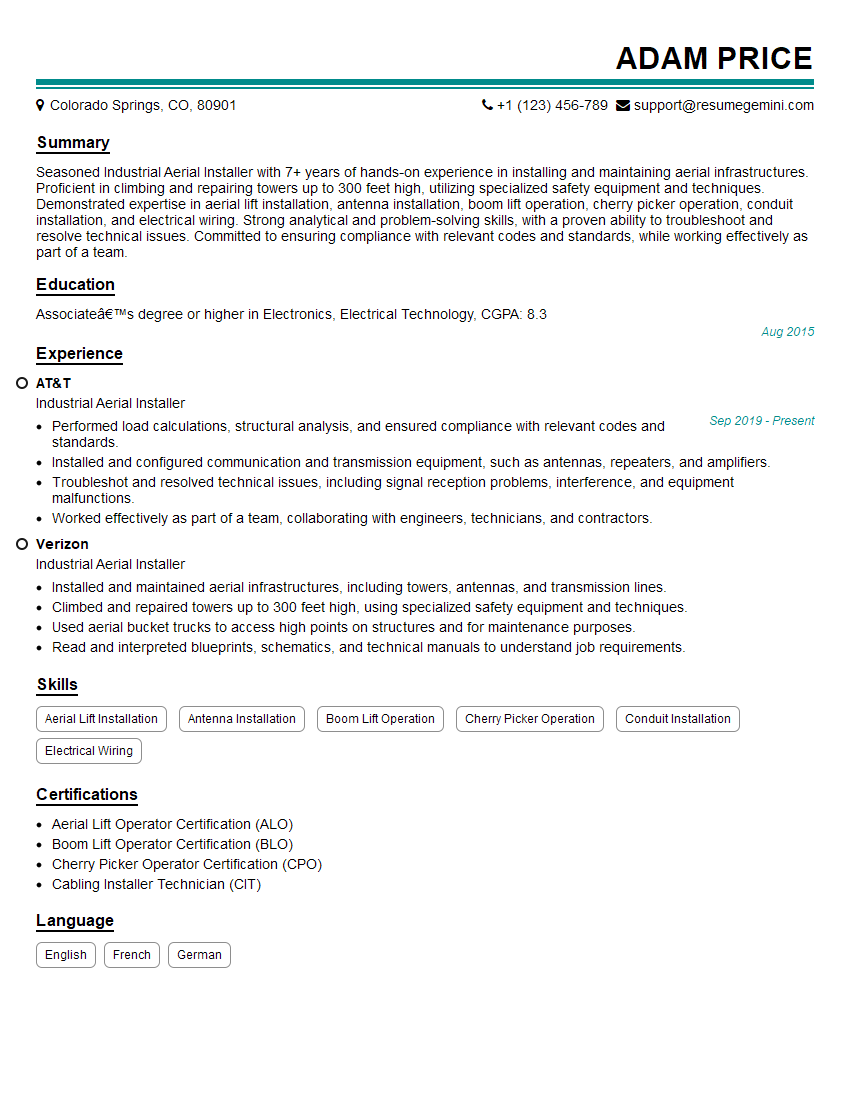
Adam Price
Industrial Aerial Installer
Summary
Seasoned Industrial Aerial Installer with 7+ years of hands-on experience in installing and maintaining aerial infrastructures. Proficient in climbing and repairing towers up to 300 feet high, utilizing specialized safety equipment and techniques. Demonstrated expertise in aerial lift installation, antenna installation, boom lift operation, cherry picker operation, conduit installation, and electrical wiring. Strong analytical and problem-solving skills, with a proven ability to troubleshoot and resolve technical issues. Committed to ensuring compliance with relevant codes and standards, while working effectively as part of a team.
Education
Associate’s degree or higher in Electronics, Electrical Technology
August 2015
Skills
- Aerial Lift Installation
- Antenna Installation
- Boom Lift Operation
- Cherry Picker Operation
- Conduit Installation
- Electrical Wiring
Work Experience
Industrial Aerial Installer
- Performed load calculations, structural analysis, and ensured compliance with relevant codes and standards.
- Installed and configured communication and transmission equipment, such as antennas, repeaters, and amplifiers.
- Troubleshot and resolved technical issues, including signal reception problems, interference, and equipment malfunctions.
- Worked effectively as part of a team, collaborating with engineers, technicians, and contractors.
Industrial Aerial Installer
- Installed and maintained aerial infrastructures, including towers, antennas, and transmission lines.
- Climbed and repaired towers up to 300 feet high, using specialized safety equipment and techniques.
- Used aerial bucket trucks to access high points on structures and for maintenance purposes.
- Read and interpreted blueprints, schematics, and technical manuals to understand job requirements.
Certificates
- Aerial Lift Operator Certification (ALO)
- Boom Lift Operator Certification (BLO)
- Cherry Picker Operator Certification (CPO)
- Cabling Installer Technician (CIT)
Languages
- English
- French
- German
Career Expert Tips:
- Select the ideal resume template to showcase your professional experience effectively.
- Master the art of resume writing to highlight your unique qualifications and achievements.
- Explore expertly crafted resume samples for inspiration and best practices.
- Build your best resume for free this new year with ResumeGemini. Enjoy exclusive discounts on ATS optimized resume templates.
How To Write Resume For Industrial Aerial Installer
Highlight your technical skills.
Industrial Aerial Installers need to demonstrate expertise in a wide range of technical skills, from electrical wiring to aerial lift operation. Be sure to list your relevant skills prominently on your resume, and provide specific examples of how you’ve used them in your work.
Showcase your safety experience.
Working as an Industrial Aerial Installer requires a strong commitment to safety. Highlight your experience with safety equipment and procedures on your resume, and emphasize your ability to work safely at heights.
Quantify your accomplishments.
Whenever possible, use numbers to quantify your accomplishments as an Industrial Aerial Installer. This will help employers to understand the scope and impact of your work.
Tailor your resume to each job you apply for.
Take the time to tailor your resume to each job you apply for. Be sure to highlight the skills and experience that are most relevant to the specific position. Including keywords from the job description will also help your resume to stand out.
Essential Experience Highlights for a Strong Industrial Aerial Installer Resume
- Installed and maintained aerial infrastructures, including towers, antennas, and transmission lines.
- Climbed and repaired towers up to 300 feet high, using specialized safety equipment and techniques.
- Used aerial bucket trucks to access high points on structures and for maintenance purposes.
- Read and interpreted blueprints, schematics, and technical manuals to understand job requirements.
- Performed load calculations, structural analysis, and ensured compliance with relevant codes and standards.
- Installed and configured communication and transmission equipment, such as antennas, repeaters, and amplifiers.
- Troubleshot and resolved technical issues, including signal reception problems, interference, and equipment malfunctions.
Frequently Asked Questions (FAQ’s) For Industrial Aerial Installer
What is the average salary for an Industrial Aerial Installer?
According to the U.S. Bureau of Labor Statistics, the median annual salary for Industrial Aerial Installers was $63,030 in May 2021. The lowest 10 percent earned less than $36,890, and the highest 10 percent earned more than $106,680.
What is the job outlook for Industrial Aerial Installers?
The job outlook for Industrial Aerial Installers is expected to be good over the next few years. The growing demand for wireless communications services is expected to lead to increased demand for workers who can install and maintain aerial infrastructures.
What are the educational requirements for becoming an Industrial Aerial Installer?
Most Industrial Aerial Installers have a high school diploma or equivalent. Some employers may prefer candidates with an associate’s degree or higher in electronics, electrical technology, or a related field.
What are the safety requirements for working as an Industrial Aerial Installer?
Industrial Aerial Installers must be able to work safely at heights. They must be able to use fall protection equipment and be familiar with safety procedures. They must also be able to pass a physical exam and a drug test.
What are the career opportunities for Industrial Aerial Installers?
Industrial Aerial Installers can advance to positions such as lead installer, supervisor, or manager. They may also start their own businesses.
What are the challenges of working as an Industrial Aerial Installer?
Industrial Aerial Installers face a number of challenges, including working at heights, in inclement weather, and in confined spaces. They must also be able to work independently and as part of a team.
What are the rewards of working as an Industrial Aerial Installer?
Industrial Aerial Installers can earn a good salary and benefits. They also have the opportunity to work outdoors and to learn new skills. They can also make a difference in the world by helping to keep communication networks up and running.