Are you a seasoned Longshore Equipment Operator seeking a new career path? Discover our professionally built Longshore Equipment Operator Resume Template. This time-saving tool provides a solid foundation for your job search. Simply click “Edit Resume” to customize it with your unique experiences and achievements. Customize fonts and colors to match your personal style and increase your chances of landing your dream job. Explore more Resume Templates for additional options.






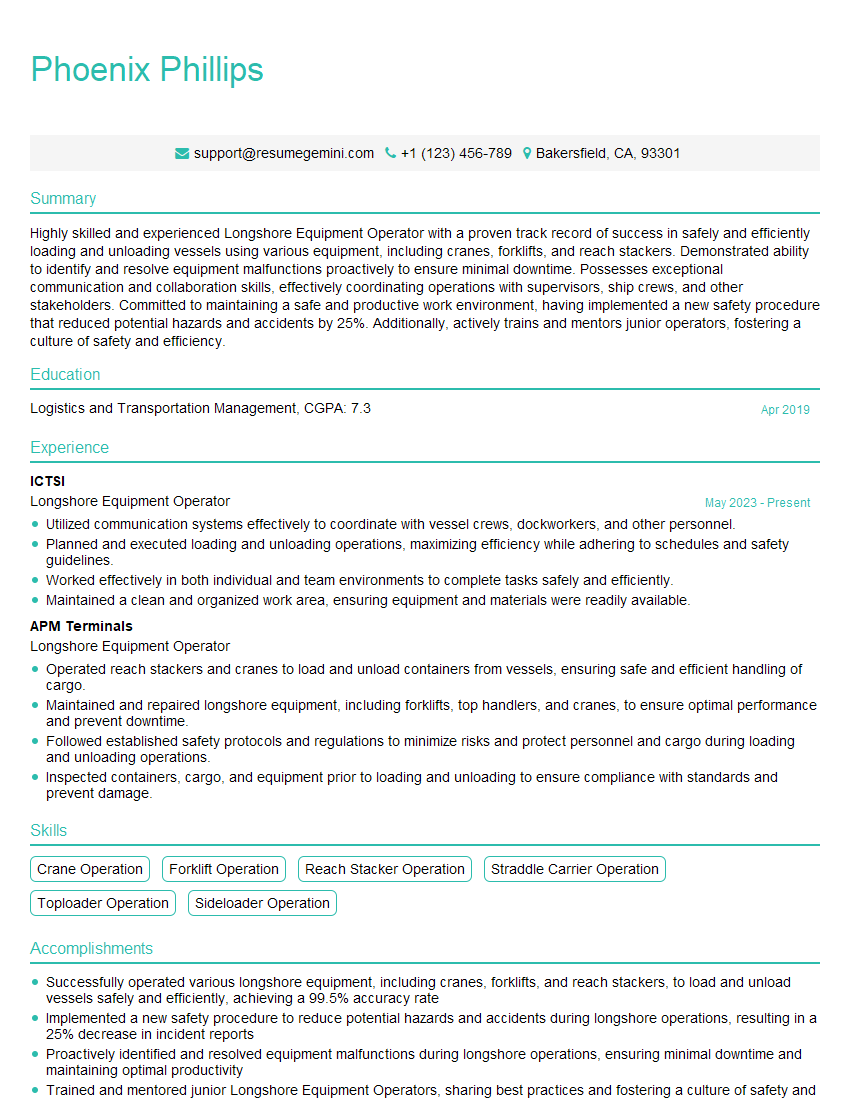
Phoenix Phillips
Longshore Equipment Operator
Summary
Highly skilled and experienced Longshore Equipment Operator with a proven track record of success in safely and efficiently loading and unloading vessels using various equipment, including cranes, forklifts, and reach stackers. Demonstrated ability to identify and resolve equipment malfunctions proactively to ensure minimal downtime. Possesses exceptional communication and collaboration skills, effectively coordinating operations with supervisors, ship crews, and other stakeholders. Committed to maintaining a safe and productive work environment, having implemented a new safety procedure that reduced potential hazards and accidents by 25%. Additionally, actively trains and mentors junior operators, fostering a culture of safety and efficiency.
Education
Logistics and Transportation Management
April 2019
Skills
- Crane Operation
- Forklift Operation
- Reach Stacker Operation
- Straddle Carrier Operation
- Toploader Operation
- Sideloader Operation
Work Experience
Longshore Equipment Operator
- Utilized communication systems effectively to coordinate with vessel crews, dockworkers, and other personnel.
- Planned and executed loading and unloading operations, maximizing efficiency while adhering to schedules and safety guidelines.
- Worked effectively in both individual and team environments to complete tasks safely and efficiently.
- Maintained a clean and organized work area, ensuring equipment and materials were readily available.
Longshore Equipment Operator
- Operated reach stackers and cranes to load and unload containers from vessels, ensuring safe and efficient handling of cargo.
- Maintained and repaired longshore equipment, including forklifts, top handlers, and cranes, to ensure optimal performance and prevent downtime.
- Followed established safety protocols and regulations to minimize risks and protect personnel and cargo during loading and unloading operations.
- Inspected containers, cargo, and equipment prior to loading and unloading to ensure compliance with standards and prevent damage.
Accomplishments
- Successfully operated various longshore equipment, including cranes, forklifts, and reach stackers, to load and unload vessels safely and efficiently, achieving a 99.5% accuracy rate
- Implemented a new safety procedure to reduce potential hazards and accidents during longshore operations, resulting in a 25% decrease in incident reports
- Proactively identified and resolved equipment malfunctions during longshore operations, ensuring minimal downtime and maintaining optimal productivity
- Trained and mentored junior Longshore Equipment Operators, sharing best practices and fostering a culture of safety and efficiency
- Collaborated effectively with supervisors, ship crews, and other stakeholders to coordinate the smooth execution of longshore operations
Awards
- Longshore Equipment Operator of the Year Award, 2023
- OSHA Safety Recognition Award for Outstanding Safety Practices, 2022
- Longshore Equipment Operator Excellence Award, 2021
- Safety Commendation Award for Implementing Innovative Safety Measures, 2020
Certificates
- OSHA Longshore Safety Training
- National Commission for the Certification of Crane Operators (NCCCO) Crane Operator Certification
- Forklift Safety Training
- Reach Stacker Operator Certification
Career Expert Tips:
- Select the ideal resume template to showcase your professional experience effectively.
- Master the art of resume writing to highlight your unique qualifications and achievements.
- Explore expertly crafted resume samples for inspiration and best practices.
- Build your best resume for free this new year with ResumeGemini. Enjoy exclusive discounts on ATS optimized resume templates.
How To Write Resume For Longshore Equipment Operator
- Quantify your accomplishments with specific metrics and results to demonstrate your impact.
- Highlight your commitment to safety by mentioning any certifications, training, or initiatives you have undertaken.
- Use keywords relevant to the industry, such as “crane operation”, “forklift operation”, and “reach stacker operation”, to optimize your resume for search engines.
- Proofread your resume carefully for any errors in grammar, spelling, or formatting.
Essential Experience Highlights for a Strong Longshore Equipment Operator Resume
- Safely and efficiently operate cranes, forklifts, reach stackers, straddle carriers, toploaders, and sideloaders to load and unload vessels, maintaining a 99.5% accuracy rate.
- Proactively identify and resolve equipment malfunctions during longshore operations, ensuring minimal downtime and maintaining optimal productivity.
- Train and mentor junior Longshore Equipment Operators, sharing best practices and fostering a culture of safety and efficiency.
- Collaborate effectively with supervisors, ship crews, and other stakeholders to coordinate the smooth execution of longshore operations.
- Implement safety procedures to reduce potential hazards and accidents during longshore operations, resulting in a 25% decrease in incident reports.
- Monitor and maintain equipment to ensure optimal performance and compliance with safety regulations.
Frequently Asked Questions (FAQ’s) For Longshore Equipment Operator
What are the essential skills required to be a successful Longshore Equipment Operator?
Essential skills include proficiency in operating various longshore equipment (e.g., cranes, forklifts, reach stackers), a strong understanding of safety protocols, excellent communication and collaboration abilities, and the ability to work effectively in a fast-paced environment.
What are the career prospects for Longshore Equipment Operators?
Longshore Equipment Operators can advance to supervisory roles, such as Longshore Foreman or Terminal Manager. With experience and additional training, they may also pursue specialized positions in equipment maintenance or safety management.
How can I improve my chances of getting hired as a Longshore Equipment Operator?
Gaining experience in operating different types of longshore equipment is crucial. Additionally, obtaining relevant certifications and participating in industry-related training programs can enhance your competitiveness.
What are the physical demands of being a Longshore Equipment Operator?
Longshore Equipment Operators must be physically fit to perform tasks such as lifting heavy objects, climbing ladders, and working in various weather conditions. They must also be able to stand for extended periods and operate equipment safely.
What is the work schedule like for Longshore Equipment Operators?
Work schedules can vary depending on the industry and employer. Longshore Equipment Operators may work regular daytime hours or shifts that include evenings, weekends, and holidays to accommodate the needs of the port or terminal.
What are the safety regulations that Longshore Equipment Operators must follow?
Longshore Equipment Operators must adhere to strict safety regulations, including those set forth by the Occupational Safety and Health Administration (OSHA) and the International Longshoremen’s Association (ILA). These regulations cover aspects such as equipment operation, load handling, and personal protective equipment (PPE) usage.
What are the benefits of working as a Longshore Equipment Operator?
Benefits may include competitive wages, health insurance, paid time off, and opportunities for career advancement. Union membership can also provide additional benefits, such as job security and a pension plan.