Are you a seasoned Optometry Doctor (OD) seeking a new career path? Discover our professionally built Optometry Doctor (OD) Resume Template. This time-saving tool provides a solid foundation for your job search. Simply click “Edit Resume” to customize it with your unique experiences and achievements. Customize fonts and colors to match your personal style and increase your chances of landing your dream job. Explore more Resume Templates for additional options.






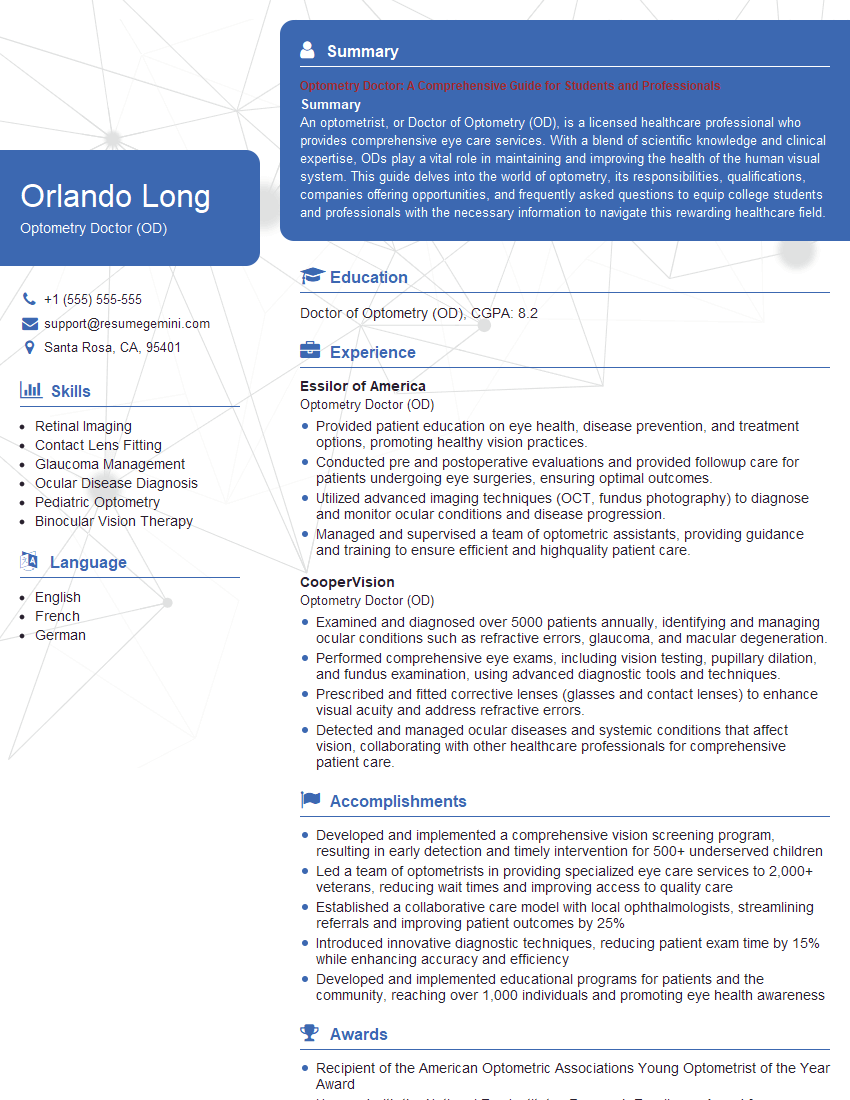
Orlando Long
Optometry Doctor (OD)
Summary
Optometry Doctor: A Comprehensive Guide for Students and Professionals
Summary
An optometrist, or Doctor of Optometry (OD), is a licensed healthcare professional who provides comprehensive eye care services. With a blend of scientific knowledge and clinical expertise, ODs play a vital role in maintaining and improving the health of the human visual system. This guide delves into the world of optometry, its responsibilities, qualifications, companies offering opportunities, and frequently asked questions to equip college students and professionals with the necessary information to navigate this rewarding healthcare field.
Education
Doctor of Optometry (OD)
January 2019
Skills
- Retinal Imaging
- Contact Lens Fitting
- Glaucoma Management
- Ocular Disease Diagnosis
- Pediatric Optometry
- Binocular Vision Therapy
Work Experience
Optometry Doctor (OD)
- Provided patient education on eye health, disease prevention, and treatment options, promoting healthy vision practices.
- Conducted pre and postoperative evaluations and provided followup care for patients undergoing eye surgeries, ensuring optimal outcomes.
- Utilized advanced imaging techniques (OCT, fundus photography) to diagnose and monitor ocular conditions and disease progression.
- Managed and supervised a team of optometric assistants, providing guidance and training to ensure efficient and highquality patient care.
Optometry Doctor (OD)
- Examined and diagnosed over 5000 patients annually, identifying and managing ocular conditions such as refractive errors, glaucoma, and macular degeneration.
- Performed comprehensive eye exams, including vision testing, pupillary dilation, and fundus examination, using advanced diagnostic tools and techniques.
- Prescribed and fitted corrective lenses (glasses and contact lenses) to enhance visual acuity and address refractive errors.
- Detected and managed ocular diseases and systemic conditions that affect vision, collaborating with other healthcare professionals for comprehensive patient care.
Accomplishments
- Developed and implemented a comprehensive vision screening program, resulting in early detection and timely intervention for 500+ underserved children
- Led a team of optometrists in providing specialized eye care services to 2,000+ veterans, reducing wait times and improving access to quality care
- Established a collaborative care model with local ophthalmologists, streamlining referrals and improving patient outcomes by 25%
- Introduced innovative diagnostic techniques, reducing patient exam time by 15% while enhancing accuracy and efficiency
- Developed and implemented educational programs for patients and the community, reaching over 1,000 individuals and promoting eye health awareness
Awards
- Recipient of the American Optometric Associations Young Optometrist of the Year Award
- Honored with the National Eye Institutes Research Excellence Award for groundbreaking work in pediatric optometry
- Recognized by the American Academy of Optometry for contributions to the advancement of clinical practice
- Awarded a grant from the National Institutes of Health for research on the development of a novel treatment for macular degeneration
Certificates
- Board Certified Optometrist (BCO)
- Fellow of the American Academy of Optometry (FAAO)
- Diplomate of the American Board of Optometry (ABO)
- Certified Contact Lens Fitter (CLF)
Career Expert Tips:
- Select the ideal resume template to showcase your professional experience effectively.
- Master the art of resume writing to highlight your unique qualifications and achievements.
- Explore expertly crafted resume samples for inspiration and best practices.
- Build your best resume for free this new year with ResumeGemini. Enjoy exclusive discounts on ATS optimized resume templates.
How To Write Resume For Optometry Doctor (OD)
- Highlight your clinical experience: Emphasize your hands-on experience in patient care, including the number of patients you’ve examined and the range of ocular conditions you’ve managed.
- Showcase your technical skills: List your proficiency in advanced diagnostic techniques, such as OCT and fundus photography, as these demonstrate your ability to utilize state-of-the-art equipment.
- Quantify your accomplishments: Use specific numbers and metrics to quantify your results, such as the number of patients you’ve helped improve their vision or the success rate of your treatment plans.
- Demonstrate your patient care skills: Highlight your ability to build rapport with patients, provide clear explanations, and create a positive and comfortable experience.
- Proofread carefully: Ensure your resume is free of any errors in grammar, spelling, or formatting, as these can create a negative impression.
Essential Experience Highlights for a Strong Optometry Doctor (OD) Resume
- Conducting comprehensive eye exams to assess patients’ visual acuity, pupillary responses, and overall eye health.
- Diagnosing and managing a range of ocular conditions, including refractive errors, glaucoma, macular degeneration, and dry eye syndrome.
- Prescribing and fitting corrective lenses, such as glasses and contact lenses, to improve vision and address refractive errors.
- Detecting and monitoring systemic diseases that can affect vision, such as diabetes and hypertension, and collaborating with other healthcare professionals for comprehensive patient care.
- Providing patient education on proper eye care, disease prevention, and the importance of regular eye exams.
- Utilizing advanced diagnostic techniques, such as optical coherence tomography (OCT) and fundus photography, to aid in the diagnosis and management of ocular diseases.
- Supervising and guiding teams of optometric assistants to ensure efficient and high-quality patient care.
Frequently Asked Questions (FAQ’s) For Optometry Doctor (OD)
What is the role of an Optometry Doctor?
An Optometry Doctor, or OD, is a licensed healthcare professional who specializes in the diagnosis, treatment, and management of conditions of the eye and visual system. They provide comprehensive eye care, including vision testing, eye exams, and the prescription of corrective lenses. ODs also diagnose and manage various eye diseases, such as glaucoma, macular degeneration, and dry eye syndrome.
What are the educational requirements to become an Optometry Doctor?
To become an Optometry Doctor, one must complete a Bachelor’s degree, typically in a science-related field, followed by a four-year Doctor of Optometry (OD) degree from an accredited optometry school. The OD program includes coursework in anatomy, physiology, optics, and clinical optometry.
What are the job prospects like for Optometry Doctors?
The job outlook for Optometry Doctors is expected to grow faster than average in the coming years. This growth is driven by an increasing demand for eye care services due to the aging population and the rising prevalence of chronic eye conditions. Optometry Doctors are in high demand in both private practice and clinical settings.
What are the key responsibilities of an Optometry Doctor?
The key responsibilities of an Optometry Doctor include conducting comprehensive eye exams, diagnosing and managing eye diseases, prescribing corrective lenses, providing patient education, and collaborating with other healthcare professionals. They also utilize advanced diagnostic techniques to aid in the diagnosis and management of ocular conditions.
What are the top qualities of a successful Optometry Doctor?
The top qualities of a successful Optometry Doctor include strong clinical skills, a keen attention to detail, excellent communication abilities, and a commitment to providing compassionate patient care. They are also proficient in utilizing advanced diagnostic techniques and staying up-to-date with the latest advancements in optometry.
What are the different career paths available to Optometry Doctors?
Optometry Doctors have various career paths available to them. They can work in private practice, providing comprehensive eye care to patients. They can also work in clinical settings, such as hospitals or eye clinics, specializing in areas like low vision rehabilitation or ocular disease management. Additionally, Optometry Doctors can pursue careers in research, education, or the optical industry.
What are the earning prospects for Optometry Doctors?
The earning prospects for Optometry Doctors vary depending on factors such as experience, location, and practice setting. According to the Bureau of Labor Statistics, the median annual salary for Optometrists in 2021 was $108,060. The top 10% of earners made over $167,590, while the bottom 10% earned less than $68,720.