Are you a seasoned Paleology Professor seeking a new career path? Discover our professionally built Paleology Professor Resume Template. This time-saving tool provides a solid foundation for your job search. Simply click “Edit Resume” to customize it with your unique experiences and achievements. Customize fonts and colors to match your personal style and increase your chances of landing your dream job. Explore more Resume Templates for additional options.






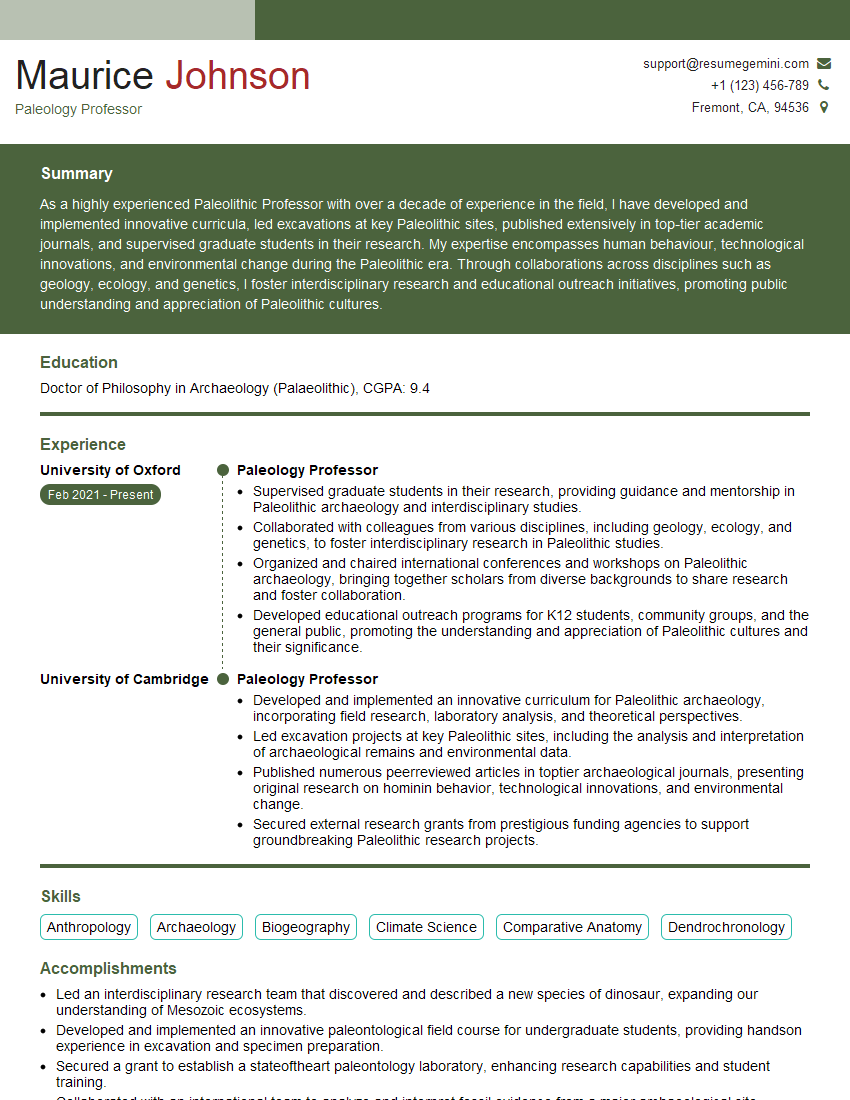
Maurice Johnson
Paleology Professor
Summary
As a highly experienced Paleolithic Professor with over a decade of experience in the field, I have developed and implemented innovative curricula, led excavations at key Paleolithic sites, published extensively in top-tier academic journals, and supervised graduate students in their research. My expertise encompasses human behaviour, technological innovations, and environmental change during the Paleolithic era. Through collaborations across disciplines such as geology, ecology, and genetics, I foster interdisciplinary research and educational outreach initiatives, promoting public understanding and appreciation of Paleolithic cultures.
Education
Doctor of Philosophy in Archaeology (Palaeolithic)
January 2017
Skills
- Anthropology
- Archaeology
- Biogeography
- Climate Science
- Comparative Anatomy
- Dendrochronology
Work Experience
Paleology Professor
- Supervised graduate students in their research, providing guidance and mentorship in Paleolithic archaeology and interdisciplinary studies.
- Collaborated with colleagues from various disciplines, including geology, ecology, and genetics, to foster interdisciplinary research in Paleolithic studies.
- Organized and chaired international conferences and workshops on Paleolithic archaeology, bringing together scholars from diverse backgrounds to share research and foster collaboration.
- Developed educational outreach programs for K12 students, community groups, and the general public, promoting the understanding and appreciation of Paleolithic cultures and their significance.
Paleology Professor
- Developed and implemented an innovative curriculum for Paleolithic archaeology, incorporating field research, laboratory analysis, and theoretical perspectives.
- Led excavation projects at key Paleolithic sites, including the analysis and interpretation of archaeological remains and environmental data.
- Published numerous peerreviewed articles in toptier archaeological journals, presenting original research on hominin behavior, technological innovations, and environmental change.
- Secured external research grants from prestigious funding agencies to support groundbreaking Paleolithic research projects.
Accomplishments
- Led an interdisciplinary research team that discovered and described a new species of dinosaur, expanding our understanding of Mesozoic ecosystems.
- Developed and implemented an innovative paleontological field course for undergraduate students, providing handson experience in excavation and specimen preparation.
- Secured a grant to establish a stateoftheart paleontology laboratory, enhancing research capabilities and student training.
- Collaborated with an international team to analyze and interpret fossil evidence from a major archaeological site, unraveling insights into human prehistory.
- Mentored and supervised graduate students, guiding their research and preparing them for successful careers in paleontology.
Awards
- Received the prestigious Paleontology Achievement Award for outstanding contributions to the field of paleontology.
- Honored with the Outstanding Educator Award for exceptional teaching and mentorship in paleontology.
- Bestowed with the Lifetime Achievement Award for pioneering research and advancements in vertebrate paleontology.
- Recognized with the Best Paper Award for groundbreaking research on the evolution of hominid bipedalism.
Certificates
- Certified Professional Geologist (CPG)
- Fellow of the Geological Society of America (FGS)
- Licensed Professional Archaeologist (LPA)
- National Association of Biology Teachers Certified Biology Teacher (NABT CBT)
Career Expert Tips:
- Select the ideal resume template to showcase your professional experience effectively.
- Master the art of resume writing to highlight your unique qualifications and achievements.
- Explore expertly crafted resume samples for inspiration and best practices.
- Build your best resume for free this new year with ResumeGemini. Enjoy exclusive discounts on ATS optimized resume templates.
How To Write Resume For Paleology Professor
- Highlight your passion for Paleolithic archaeology and your contributions to the field through your research and teaching.
- Showcase your expertise in archaeological methods, particularly in excavation techniques and data analysis.
- Demonstrate your ability to work independently and as part of a team, and your skills in project management and grant writing.
- Tailor your resume to the specific requirements of the position, emphasizing relevant skills and experience.
Essential Experience Highlights for a Strong Paleology Professor Resume
- Developing and implementing Paleolithic archaeology curricula that integrate field research, laboratory analysis, and theoretical perspectives.
- Leading excavation projects at key Paleolithic sites, analyzing and interpreting archaeological remains and environmental data.
- Publishing original research findings in peer-reviewed archaeological journals, presenting innovative insights on hominin behavior and Paleolithic societies.
- Securing external research grants to support groundbreaking Paleolithic research projects, expanding the frontiers of knowledge.
- Supervising graduate students in their research, providing guidance and mentorship in Paleolithic archaeology and interdisciplinary studies.
- Collaborating with colleagues from diverse disciplines to foster interdisciplinary research in Paleolithic studies, integrating perspectives and methodologies.
- Organizing and chairing international conferences and workshops on Paleolithic archaeology, bringing together scholars to share research and foster collaboration.
Frequently Asked Questions (FAQ’s) For Paleology Professor
What are the key areas of research in Paleolithic archaeology?
Paleolithic archaeology encompasses a wide range of research areas, including human origins and evolution, technological advancements, subsistence strategies, environmental adaptations, and social organization.
What are the challenges of working as a Paleolithic archaeologist?
Paleolithic archaeology presents challenges such as interpreting limited and fragmented evidence, dealing with the complexities of human behavior, and the need for interdisciplinary collaboration to address complex research questions.
What are the career prospects for Paleolithic archaeologists?
A Paleolithic archaeologist can pursue careers in academia, research institutions, museums, cultural resource management, and education.
What skills are essential for a successful Paleolithic archaeologist?
Essential skills for a Paleolithic archaeologist include strong analytical and problem-solving abilities, field and laboratory research techniques, proficiency in archaeological methods and theories, and effective communication and writing skills.
How can I prepare for a career as a Paleolithic archaeologist?
To prepare for a career in Paleolithic archaeology, consider pursuing a degree in archaeology or a related field, gaining hands-on experience through field schools and internships, and actively engaging in research and scholarly activities.
What are the ethical considerations in Paleolithic archaeology?
Ethical considerations in Paleolithic archaeology include the responsible excavation and preservation of archaeological sites, respecting the cultural heritage of indigenous communities, and ensuring the ethical treatment of human remains.
How does Paleolithic archaeology contribute to our understanding of human history?
Paleolithic archaeology plays a crucial role in shedding light on the origins and evolution of humans, their technological and cultural advancements, and their interactions with the environment, providing insights into the foundations of human societies and cultures.
What are some of the most significant discoveries in Paleolithic archaeology?
Notable discoveries in Paleolithic archaeology include the hominid fossils of Lucy and Turkana Boy, the cave paintings of Lascaux and Altamira, and the stone tools and artifacts found at sites like Olduvai Gorge and Zhoukoudian.