Are you a seasoned Pipe Buffer seeking a new career path? Discover our professionally built Pipe Buffer Resume Template. This time-saving tool provides a solid foundation for your job search. Simply click “Edit Resume” to customize it with your unique experiences and achievements. Customize fonts and colors to match your personal style and increase your chances of landing your dream job. Explore more Resume Templates for additional options.






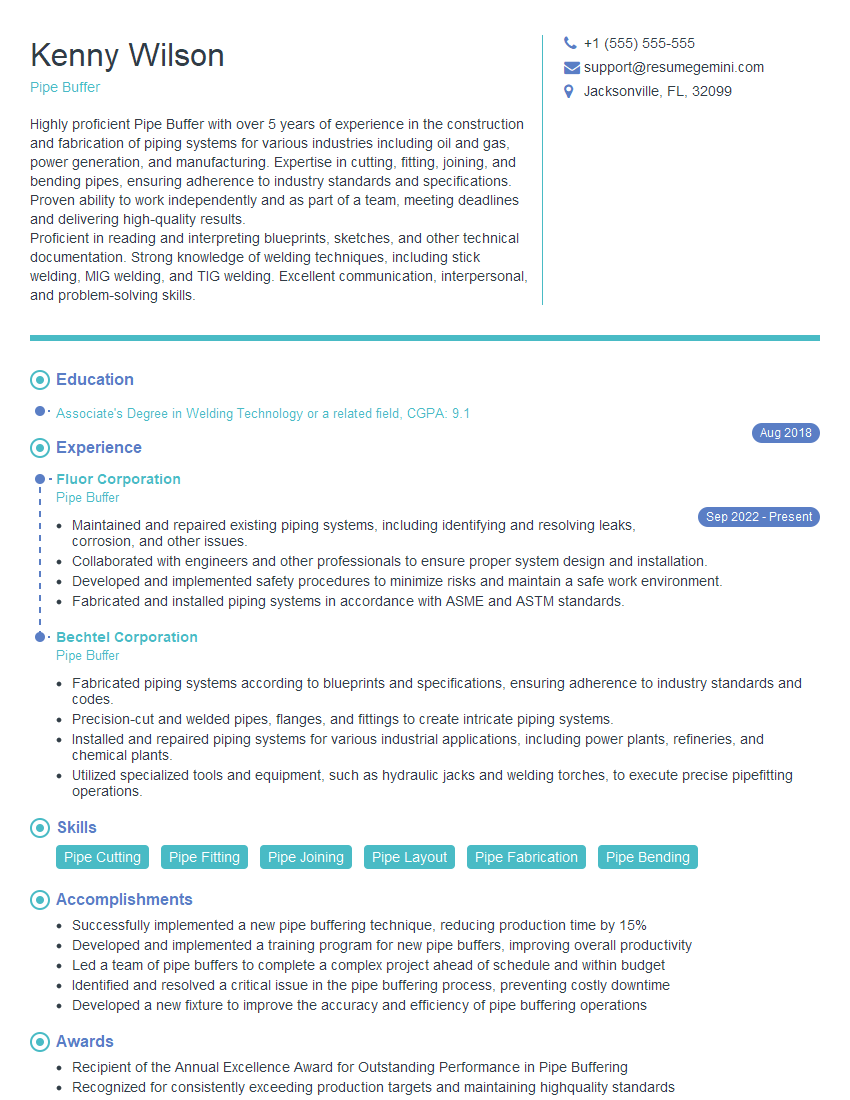
Kenny Wilson
Pipe Buffer
Summary
Highly proficient Pipe Buffer with over 5 years of experience in the construction and fabrication of piping systems for various industries including oil and gas, power generation, and manufacturing. Expertise in cutting, fitting, joining, and bending pipes, ensuring adherence to industry standards and specifications. Proven ability to work independently and as part of a team, meeting deadlines and delivering high-quality results.
Proficient in reading and interpreting blueprints, sketches, and other technical documentation. Strong knowledge of welding techniques, including stick welding, MIG welding, and TIG welding. Excellent communication, interpersonal, and problem-solving skills.
Education
Associate’s Degree in Welding Technology or a related field
August 2018
Skills
- Pipe Cutting
- Pipe Fitting
- Pipe Joining
- Pipe Layout
- Pipe Fabrication
- Pipe Bending
Work Experience
Pipe Buffer
- Maintained and repaired existing piping systems, including identifying and resolving leaks, corrosion, and other issues.
- Collaborated with engineers and other professionals to ensure proper system design and installation.
- Developed and implemented safety procedures to minimize risks and maintain a safe work environment.
- Fabricated and installed piping systems in accordance with ASME and ASTM standards.
Pipe Buffer
- Fabricated piping systems according to blueprints and specifications, ensuring adherence to industry standards and codes.
- Precision-cut and welded pipes, flanges, and fittings to create intricate piping systems.
- Installed and repaired piping systems for various industrial applications, including power plants, refineries, and chemical plants.
- Utilized specialized tools and equipment, such as hydraulic jacks and welding torches, to execute precise pipefitting operations.
Accomplishments
- Successfully implemented a new pipe buffering technique, reducing production time by 15%
- Developed and implemented a training program for new pipe buffers, improving overall productivity
- Led a team of pipe buffers to complete a complex project ahead of schedule and within budget
- Identified and resolved a critical issue in the pipe buffering process, preventing costly downtime
- Developed a new fixture to improve the accuracy and efficiency of pipe buffering operations
Awards
- Recipient of the Annual Excellence Award for Outstanding Performance in Pipe Buffering
- Recognized for consistently exceeding production targets and maintaining highquality standards
- Received a commendation for exceptional skill and dedication in pipe buffering operations
- Certified as a Master Pipe Buffer by the National Pipe Buffering Association
Certificates
- ASME B31.3 Process Piping
- ASME Boiler and Pressure Vessel Code
- AWS D1.1 Structural Welding Code Steel
- National Institute for Certification in Engineering Technologies (NICET)
Career Expert Tips:
- Select the ideal resume template to showcase your professional experience effectively.
- Master the art of resume writing to highlight your unique qualifications and achievements.
- Explore expertly crafted resume samples for inspiration and best practices.
- Build your best resume for free this new year with ResumeGemini. Enjoy exclusive discounts on ATS optimized resume templates.
How To Write Resume For Pipe Buffer
- Highlight your technical skills and experience in pipe cutting, fitting, and welding.
- Quantify your accomplishments with specific metrics and results whenever possible.
- Showcase your ability to work independently and as part of a team.
- Demonstrate your knowledge of industry standards and regulations.
Essential Experience Highlights for a Strong Pipe Buffer Resume
- Cut, fit, and join pipes using a variety of tools and equipment, including pipe cutters, saws, welding machines, and bending tools.
- Lay out and fabricate pipe systems based on blueprints and specifications, ensuring proper alignment and connections.
- Perform welding operations to join pipes, ensuring strong and leak-proof joints.
- Inspect and test piping systems to ensure they meet industry standards and specifications.
- Maintain and repair existing piping systems, including troubleshooting and resolving issues.
- Work in a safe and efficient manner, adhering to all safety regulations and procedures.
Frequently Asked Questions (FAQ’s) For Pipe Buffer
What is the primary role of a Pipe Buffer?
The primary role of a Pipe Buffer is to cut, fit, join, and bend pipes to create piping systems used in various industries such as construction, manufacturing, and power generation.
What are the essential skills required for a Pipe Buffer?
Essential skills for a Pipe Buffer include pipe cutting, fitting, welding, layout and fabrication, and adherence to industry standards and specifications.
What is the educational background required to become a Pipe Buffer?
Typically, an Associate’s Degree in Welding Technology or a related field is required to become a Pipe Buffer.
What are the career advancement opportunities for a Pipe Buffer?
With experience and additional training, a Pipe Buffer can advance to roles such as Pipe Fitter, Welder, or Supervisor in the piping industry.
What industries employ Pipe Buffers?
Pipe Buffers are employed in various industries, including construction, manufacturing, oil and gas, power generation, and shipbuilding.
What are the safety precautions that Pipe Buffers must follow?
Pipe Buffers must adhere to strict safety regulations and procedures, including wearing appropriate protective gear, following proper welding techniques, and maintaining a clean and organized work area.
What tools and equipment do Pipe Buffers commonly use?
Pipe Buffers commonly use pipe cutters, saws, welding machines, bending tools, measuring devices, and hand tools.