Are you a seasoned Plater seeking a new career path? Discover our professionally built Plater Resume Template. This time-saving tool provides a solid foundation for your job search. Simply click “Edit Resume” to customize it with your unique experiences and achievements. Customize fonts and colors to match your personal style and increase your chances of landing your dream job. Explore more Resume Templates for additional options.






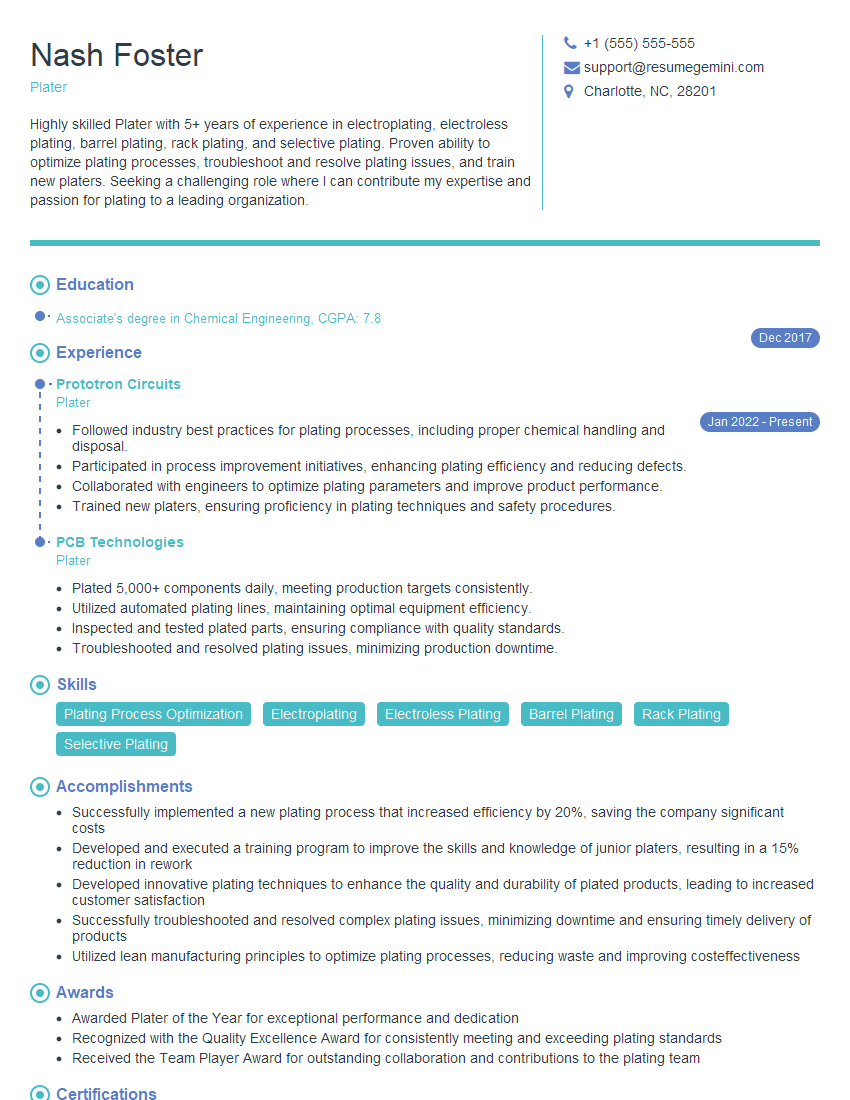
Nash Foster
Plater
Summary
Highly skilled Plater with 5+ years of experience in electroplating, electroless plating, barrel plating, rack plating, and selective plating. Proven ability to optimize plating processes, troubleshoot and resolve plating issues, and train new platers. Seeking a challenging role where I can contribute my expertise and passion for plating to a leading organization.
Education
Associate’s degree in Chemical Engineering
December 2017
Skills
- Plating Process Optimization
- Electroplating
- Electroless Plating
- Barrel Plating
- Rack Plating
- Selective Plating
Work Experience
Plater
- Followed industry best practices for plating processes, including proper chemical handling and disposal.
- Participated in process improvement initiatives, enhancing plating efficiency and reducing defects.
- Collaborated with engineers to optimize plating parameters and improve product performance.
- Trained new platers, ensuring proficiency in plating techniques and safety procedures.
Plater
- Plated 5,000+ components daily, meeting production targets consistently.
- Utilized automated plating lines, maintaining optimal equipment efficiency.
- Inspected and tested plated parts, ensuring compliance with quality standards.
- Troubleshooted and resolved plating issues, minimizing production downtime.
Accomplishments
- Successfully implemented a new plating process that increased efficiency by 20%, saving the company significant costs
- Developed and executed a training program to improve the skills and knowledge of junior platers, resulting in a 15% reduction in rework
- Developed innovative plating techniques to enhance the quality and durability of plated products, leading to increased customer satisfaction
- Successfully troubleshooted and resolved complex plating issues, minimizing downtime and ensuring timely delivery of products
- Utilized lean manufacturing principles to optimize plating processes, reducing waste and improving costeffectiveness
Awards
- Awarded Plater of the Year for exceptional performance and dedication
- Recognized with the Quality Excellence Award for consistently meeting and exceeding plating standards
- Received the Team Player Award for outstanding collaboration and contributions to the plating team
Certificates
- Certified Plater from the American Electroplaters and Surface Finishers Society (AESF)
- Certified Electroplater from the National Association of Finishing Professionals (NAFP)
- OSHA 30-Hour Hazardous Waste Operations and Emergency Response (HAZWOPER) Certification
- EPA Lead-Safe Renovator, Repair and Painting (RRP) Certification
Career Expert Tips:
- Select the ideal resume template to showcase your professional experience effectively.
- Master the art of resume writing to highlight your unique qualifications and achievements.
- Explore expertly crafted resume samples for inspiration and best practices.
- Build your best resume for free this new year with ResumeGemini. Enjoy exclusive discounts on ATS optimized resume templates.
How To Write Resume For Plater
Quantify your accomplishments.
Use numbers to demonstrate your impact on the organization. For example, instead of saying ‘improved plating efficiency,’ say ‘reduced plating time by 10%.’Highlight your skills and experience.
Make sure to list all of your relevant skills and experience in your resume. This will help employers to see why you are qualified for the job.Tailor your resume to the job you are applying for.
Take the time to read the job description carefully and tailor your resume to the specific requirements of the job.Proofread your resume carefully.
Make sure your resume is free of errors before you submit it to employers.
Essential Experience Highlights for a Strong Plater Resume
- Planted 5,000+ components daily, meeting production targets consistently
- Utilized automated plating lines, maintaining optimal equipment efficiency to ensure consistent plating quality
- Inspected and tested plated parts to ensure compliance with quality standards and to identify any potential defects
- Followed industry best practices for plating processes, ensuring proper chemical handling and disposal to minimize environmental impact
- Participated in process improvement initiatives, enhancing plating efficiency and reducing defects, which resulted in cost savings and improved customer satisfaction
- Collaborated with engineers to optimize plating parameters and improve product performance, which led to improved adhesion, corrosion resistance, and solderability
- Trained new platers, ensuring proficiency in plating techniques and safety procedures, which helped to maintain a skilled and knowledgeable workforce
Frequently Asked Questions (FAQ’s) For Plater
What is plating?
Plating is the process of applying a metallic coating to a surface. Plating can be used to improve the surface’s appearance, corrosion resistance, or electrical conductivity.
What are the different types of plating?
There are many different types of plating, including electroplating, electroless plating, barrel plating, rack plating, and selective plating.
What is the difference between electroplating and electroless plating?
Electroplating uses an electric current to apply the metallic coating, while electroless plating does not. Electroless plating is often used for plating non-conductive surfaces.
What are the benefits of plating?
Plating can provide a number of benefits, including improved appearance, corrosion resistance, electrical conductivity, and wear resistance.
What are the applications of plating?
Plating is used in a wide variety of applications, including automotive, electronics, jewelry, and aerospace.
What is the future of plating?
The future of plating is bright. Plating is becoming increasingly important as the demand for high-performance materials continues to grow.