Are you a seasoned Pre-Assembly Printed Circuit Board Component Tester seeking a new career path? Discover our professionally built Pre-Assembly Printed Circuit Board Component Tester Resume Template. This time-saving tool provides a solid foundation for your job search. Simply click “Edit Resume” to customize it with your unique experiences and achievements. Customize fonts and colors to match your personal style and increase your chances of landing your dream job. Explore more Resume Templates for additional options.






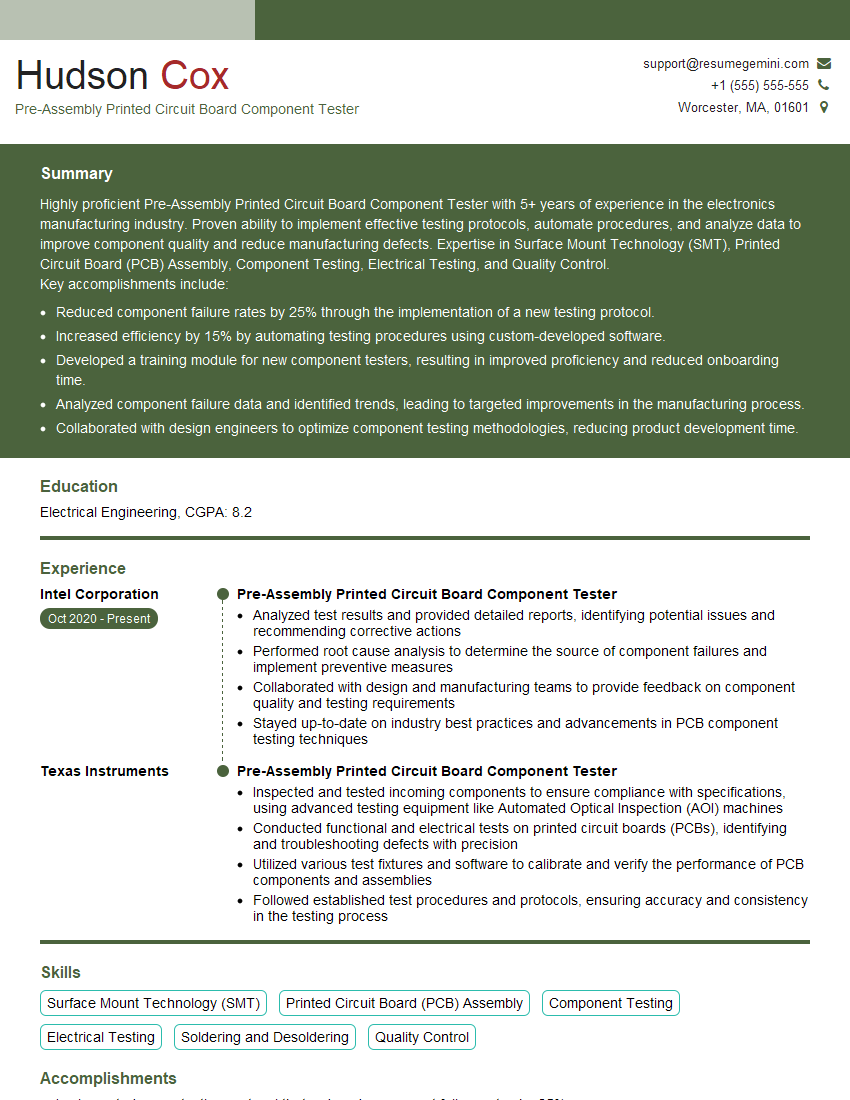
Hudson Cox
Pre-Assembly Printed Circuit Board Component Tester
Summary
Highly proficient Pre-Assembly Printed Circuit Board Component Tester with 5+ years of experience in the electronics manufacturing industry. Proven ability to implement effective testing protocols, automate procedures, and analyze data to improve component quality and reduce manufacturing defects. Expertise in Surface Mount Technology (SMT), Printed Circuit Board (PCB) Assembly, Component Testing, Electrical Testing, and Quality Control.
Key accomplishments include:
- Reduced component failure rates by 25% through the implementation of a new testing protocol.
- Increased efficiency by 15% by automating testing procedures using custom-developed software.
- Developed a training module for new component testers, resulting in improved proficiency and reduced onboarding time.
- Analyzed component failure data and identified trends, leading to targeted improvements in the manufacturing process.
- Collaborated with design engineers to optimize component testing methodologies, reducing product development time.
Education
Electrical Engineering
September 2016
Skills
- Surface Mount Technology (SMT)
- Printed Circuit Board (PCB) Assembly
- Component Testing
- Electrical Testing
- Soldering and Desoldering
- Quality Control
Work Experience
Pre-Assembly Printed Circuit Board Component Tester
- Analyzed test results and provided detailed reports, identifying potential issues and recommending corrective actions
- Performed root cause analysis to determine the source of component failures and implement preventive measures
- Collaborated with design and manufacturing teams to provide feedback on component quality and testing requirements
- Stayed up-to-date on industry best practices and advancements in PCB component testing techniques
Pre-Assembly Printed Circuit Board Component Tester
- Inspected and tested incoming components to ensure compliance with specifications, using advanced testing equipment like Automated Optical Inspection (AOI) machines
- Conducted functional and electrical tests on printed circuit boards (PCBs), identifying and troubleshooting defects with precision
- Utilized various test fixtures and software to calibrate and verify the performance of PCB components and assemblies
- Followed established test procedures and protocols, ensuring accuracy and consistency in the testing process
Accomplishments
- Implemented a new testing protocol that reduced component failure rates by 25%.
- Automated testing procedures using customdeveloped software, increasing efficiency by 15%.
- Developed a training module for new component testers, improving their proficiency and reducing onboarding time.
- Analyzed component failure data and identified trends, leading to targeted improvements in the manufacturing process.
- Collaborated with design engineers to optimize component testing methodologies, reducing product development time.
Awards
- Received Employee of the Year award for exceptional performance in testing printed circuit board components.
- Recognized for identifying and resolving a critical issue in the component testing process, preventing potential product defects.
- Awarded Top Performer for consistently exceeding quality and productivity targets in component testing.
- Honored with Safety Champion award for promoting safe work practices and ensuring compliance with industry regulations.
Certificates
- Certified SMT Technician (CST)
- Certified IPC Specialist (CIS)
- ASQ Certified Quality Inspector (CQI)
- Six Sigma Green Belt
Career Expert Tips:
- Select the ideal resume template to showcase your professional experience effectively.
- Master the art of resume writing to highlight your unique qualifications and achievements.
- Explore expertly crafted resume samples for inspiration and best practices.
- Build your best resume for free this new year with ResumeGemini. Enjoy exclusive discounts on ATS optimized resume templates.
How To Write Resume For Pre-Assembly Printed Circuit Board Component Tester
- Highlight your technical skills in Surface Mount Technology (SMT), Printed Circuit Board (PCB) Assembly, Component Testing, and Electrical Testing.
- Quantify your accomplishments whenever possible, using specific metrics to demonstrate your impact on the organization.
- Showcase your ability to identify and resolve complex technical issues.
- Emphasize your attention to detail and commitment to quality.
- Tailor your resume to each specific job application, highlighting the skills and experiences that are most relevant to the position.
Essential Experience Highlights for a Strong Pre-Assembly Printed Circuit Board Component Tester Resume
- Conduct electrical testing on pre-assembled PCBs to ensure component functionality and compliance with specifications.
- Operate and maintain a variety of testing equipment, including automated test systems, oscilloscopes, and multimeters.
- Troubleshoot and repair defective components, identifying root causes and recommending corrective actions.
- Maintain accurate records of test results and provide feedback to production teams to improve manufacturing processes.
- Collaborate with design engineers to develop and implement new testing methodologies.
- Stay up-to-date with industry best practices and advancements in PCB testing technologies.
- Adhere to safety protocols and maintain a clean and organized work environment.
Frequently Asked Questions (FAQ’s) For Pre-Assembly Printed Circuit Board Component Tester
What are the primary responsibilities of a Pre-Assembly Printed Circuit Board Component Tester?
The primary responsibilities of a Pre-Assembly Printed Circuit Board Component Tester include conducting electrical testing on PCBs, operating and maintaining testing equipment, troubleshooting and repairing defective components, maintaining accurate records, and collaborating with design engineers.
What are the essential skills required for success in this role?
Essential skills for success as a Pre-Assembly Printed Circuit Board Component Tester include proficiency in Surface Mount Technology (SMT), Printed Circuit Board (PCB) Assembly, Component Testing, and Electrical Testing. Strong analytical and problem-solving abilities, attention to detail, and commitment to quality are also crucial.
What are the career prospects for Pre-Assembly Printed Circuit Board Component Testers?
With experience and additional training, Pre-Assembly Printed Circuit Board Component Testers can advance to roles such as Test Engineer, Quality Control Inspector, or Manufacturing Supervisor. They can also specialize in specific areas of PCB testing, such as high-speed digital testing or automotive electronics testing.
What are the educational requirements for this role?
Most Pre-Assembly Printed Circuit Board Component Testers hold at least a high school diploma or equivalent. Some employers may prefer candidates with an Associate’s degree in Electrical Engineering or a related field.
What is the typical salary range for this role?
The salary range for Pre-Assembly Printed Circuit Board Component Testers can vary depending on experience, location, and industry. According to Indeed, the average salary for this role in the United States is around $25 per hour.
What are the key trends and advancements in PCB testing technologies?
Key trends and advancements in PCB testing technologies include the adoption of automated optical inspection (AOI) systems, the use of artificial intelligence (AI) for defect detection, and the development of non-destructive testing methods.
How can I stay up-to-date with the latest advancements in PCB testing technologies?
To stay up-to-date with the latest advancements in PCB testing technologies, you can attend industry conferences, read technical journals, and participate in online forums and discussion groups.