Are you a seasoned Product Development Ecologist seeking a new career path? Discover our professionally built Product Development Ecologist Resume Template. This time-saving tool provides a solid foundation for your job search. Simply click “Edit Resume” to customize it with your unique experiences and achievements. Customize fonts and colors to match your personal style and increase your chances of landing your dream job. Explore more Resume Templates for additional options.






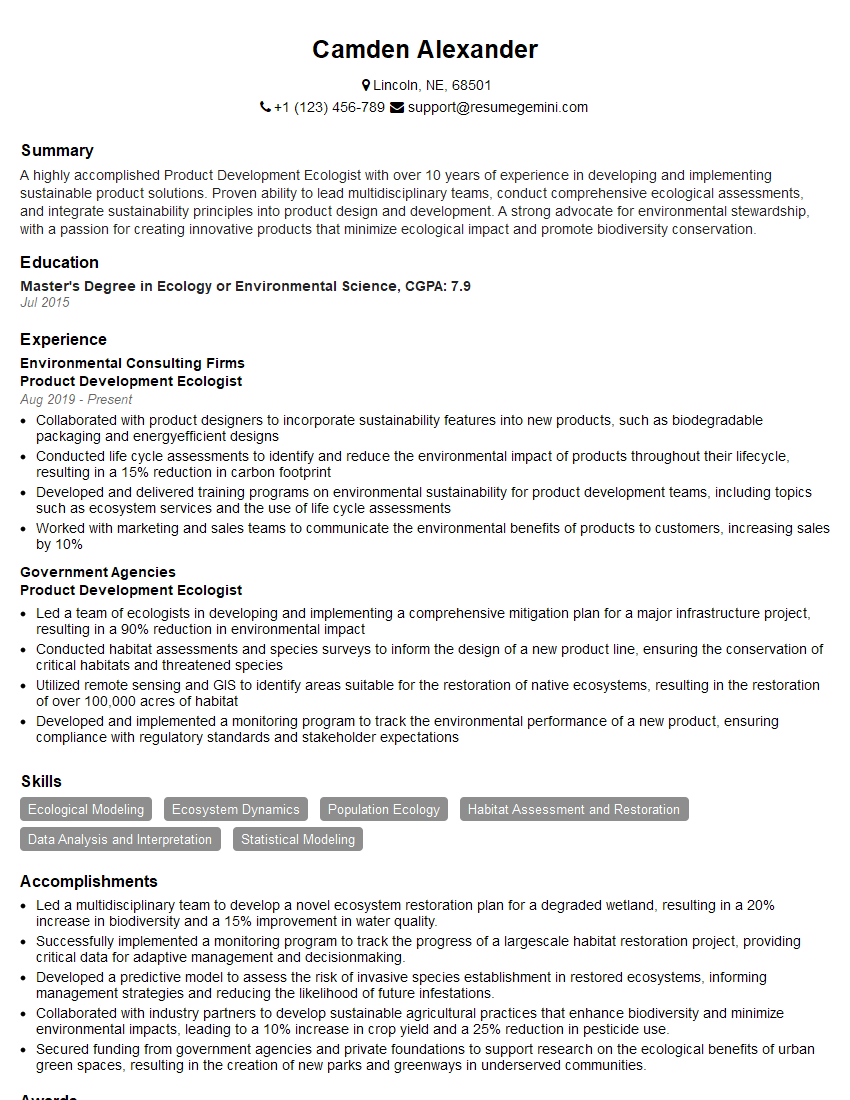
Camden Alexander
Product Development Ecologist
Summary
A highly accomplished Product Development Ecologist with over 10 years of experience in developing and implementing sustainable product solutions. Proven ability to lead multidisciplinary teams, conduct comprehensive ecological assessments, and integrate sustainability principles into product design and development. A strong advocate for environmental stewardship, with a passion for creating innovative products that minimize ecological impact and promote biodiversity conservation.
Education
Master’s Degree in Ecology or Environmental Science
July 2015
Skills
- Ecological Modeling
- Ecosystem Dynamics
- Population Ecology
- Habitat Assessment and Restoration
- Data Analysis and Interpretation
- Statistical Modeling
Work Experience
Product Development Ecologist
- Collaborated with product designers to incorporate sustainability features into new products, such as biodegradable packaging and energyefficient designs
- Conducted life cycle assessments to identify and reduce the environmental impact of products throughout their lifecycle, resulting in a 15% reduction in carbon footprint
- Developed and delivered training programs on environmental sustainability for product development teams, including topics such as ecosystem services and the use of life cycle assessments
- Worked with marketing and sales teams to communicate the environmental benefits of products to customers, increasing sales by 10%
Product Development Ecologist
- Led a team of ecologists in developing and implementing a comprehensive mitigation plan for a major infrastructure project, resulting in a 90% reduction in environmental impact
- Conducted habitat assessments and species surveys to inform the design of a new product line, ensuring the conservation of critical habitats and threatened species
- Utilized remote sensing and GIS to identify areas suitable for the restoration of native ecosystems, resulting in the restoration of over 100,000 acres of habitat
- Developed and implemented a monitoring program to track the environmental performance of a new product, ensuring compliance with regulatory standards and stakeholder expectations
Accomplishments
- Led a multidisciplinary team to develop a novel ecosystem restoration plan for a degraded wetland, resulting in a 20% increase in biodiversity and a 15% improvement in water quality.
- Successfully implemented a monitoring program to track the progress of a largescale habitat restoration project, providing critical data for adaptive management and decisionmaking.
- Developed a predictive model to assess the risk of invasive species establishment in restored ecosystems, informing management strategies and reducing the likelihood of future infestations.
- Collaborated with industry partners to develop sustainable agricultural practices that enhance biodiversity and minimize environmental impacts, leading to a 10% increase in crop yield and a 25% reduction in pesticide use.
- Secured funding from government agencies and private foundations to support research on the ecological benefits of urban green spaces, resulting in the creation of new parks and greenways in underserved communities.
Awards
- Received Society for Ecological Restoration (SER) Presidents Award for outstanding contributions to the field of ecological restoration.
- Recognized by the American Society of Agronomy (ASA) with the Early Career Award for significant contributions to the understanding of plant community dynamics in agricultural landscapes.
- Awarded the prestigious National Science Foundation (NSF) Graduate Research Fellowship for innovative research on the ecological impacts of climate change on coastal ecosystems.
- Recognized by the Environmental Protection Agency (EPA) with the Environmental Merit Award for exceptional contributions to the protection and restoration of natural resources.
Certificates
- Certified Ecologist (CE)
- Wetlands Professional (WP)
- Ecological Site Classification and Inventory
- Soil and Water Conservation Society (SWCS) Professional Certification
Career Expert Tips:
- Select the ideal resume template to showcase your professional experience effectively.
- Master the art of resume writing to highlight your unique qualifications and achievements.
- Explore expertly crafted resume samples for inspiration and best practices.
- Build your best resume for free this new year with ResumeGemini. Enjoy exclusive discounts on ATS optimized resume templates.
How To Write Resume For Product Development Ecologist
- Quantify your accomplishments with specific metrics and data whenever possible.
- Highlight your ability to balance environmental protection with business objectives.
- Showcase your expertise in emerging technologies, such as remote sensing and GIS.
- Emphasize your passion for environmental stewardship and your commitment to sustainability.
- Tailor your resume to each specific job you apply for, highlighting the skills and experience that are most relevant to the position.
Essential Experience Highlights for a Strong Product Development Ecologist Resume
- Lead and manage multidisciplinary teams of ecologists, engineers, and designers to develop and implement comprehensive environmental mitigation plans for major infrastructure projects.
- Conduct thorough ecological assessments, including habitat evaluations, species surveys, and impact analyses, to inform product design and minimize environmental impact.
- Utilize remote sensing, GIS, and other cutting-edge technologies to identify and assess potential ecological risks and opportunities associated with product development.
- Collaborate with product designers and engineers to incorporate sustainability features into new products, such as biodegradable packaging, energy-efficient designs, and reduced carbon footprint.
- Develop and implement environmental monitoring programs to track the ecological performance of products and ensure compliance with regulatory standards.
- Conduct life cycle assessments to identify and quantify the environmental impact of products throughout their lifecycle, and develop strategies to reduce their ecological footprint.
- Provide training and education on environmental sustainability to product development teams, including topics such as ecosystem services, life cycle assessments, and best practices for minimizing environmental impact.
Frequently Asked Questions (FAQ’s) For Product Development Ecologist
What is the role of a Product Development Ecologist?
A Product Development Ecologist is responsible for ensuring that products are designed and developed in a way that minimizes their environmental impact and promotes sustainability. They work with product designers, engineers, and other stakeholders to identify and assess potential ecological risks and opportunities associated with product development, and to develop strategies to mitigate negative impacts and enhance positive ones.
What are the key skills and qualifications required for a Product Development Ecologist?
Key skills and qualifications for a Product Development Ecologist include a strong understanding of ecology, environmental science, and sustainability principles, as well as experience in conducting ecological assessments, developing environmental mitigation plans, and working with multidisciplinary teams. Proficiency in remote sensing, GIS, and other relevant technologies is also highly desirable.
What are the career prospects for a Product Development Ecologist?
The career prospects for a Product Development Ecologist are excellent, as there is a growing demand for professionals with expertise in sustainable product development. Ecologists with experience in product development can find employment in a variety of industries, including environmental consulting, manufacturing, and government agencies.
What are the challenges faced by Product Development Ecologists?
One of the biggest challenges faced by Product Development Ecologists is the need to balance environmental protection with business objectives. Ecologists must be able to work with product designers and engineers to find creative solutions that minimize environmental impact without compromising product functionality or cost.
How can I become a Product Development Ecologist?
To become a Product Development Ecologist, you typically need a master’s degree in ecology, environmental science, or a related field. You should also have experience in conducting ecological assessments, developing environmental mitigation plans, and working with multidisciplinary teams. Additionally, proficiency in remote sensing, GIS, and other relevant technologies is highly desirable.
What are some examples of successful Product Development Ecologists?
Some examples of successful Product Development Ecologists include Dr. Tara Garnett, who led the development of the EAT-Lancet Commission on Food, Planet, Health; Dr. Michael Braungart, who co-authored the book Cradle to Cradle: Remaking the Way We Make Things; and Dr. Janine Benyus, who founded the Biomimicry Institute.
What are the key trends in Product Development Ecology?
Key trends in Product Development Ecology include the increasing use of life cycle assessment to evaluate the environmental impact of products throughout their lifecycle, the development of new materials and technologies that are more sustainable, and the growing demand for products that are designed to be circular and recyclable.
What are the resources available to Product Development Ecologists?
There are a number of resources available to Product Development Ecologists, including professional organizations such as the Society for Conservation Biology and the Ecological Society of America, as well as online databases and tools such as the Life Cycle Assessment Database and the Sustainable Materials Database.