Are you a seasoned Respiratory Therapy Director seeking a new career path? Discover our professionally built Respiratory Therapy Director Resume Template. This time-saving tool provides a solid foundation for your job search. Simply click “Edit Resume” to customize it with your unique experiences and achievements. Customize fonts and colors to match your personal style and increase your chances of landing your dream job. Explore more Resume Templates for additional options.






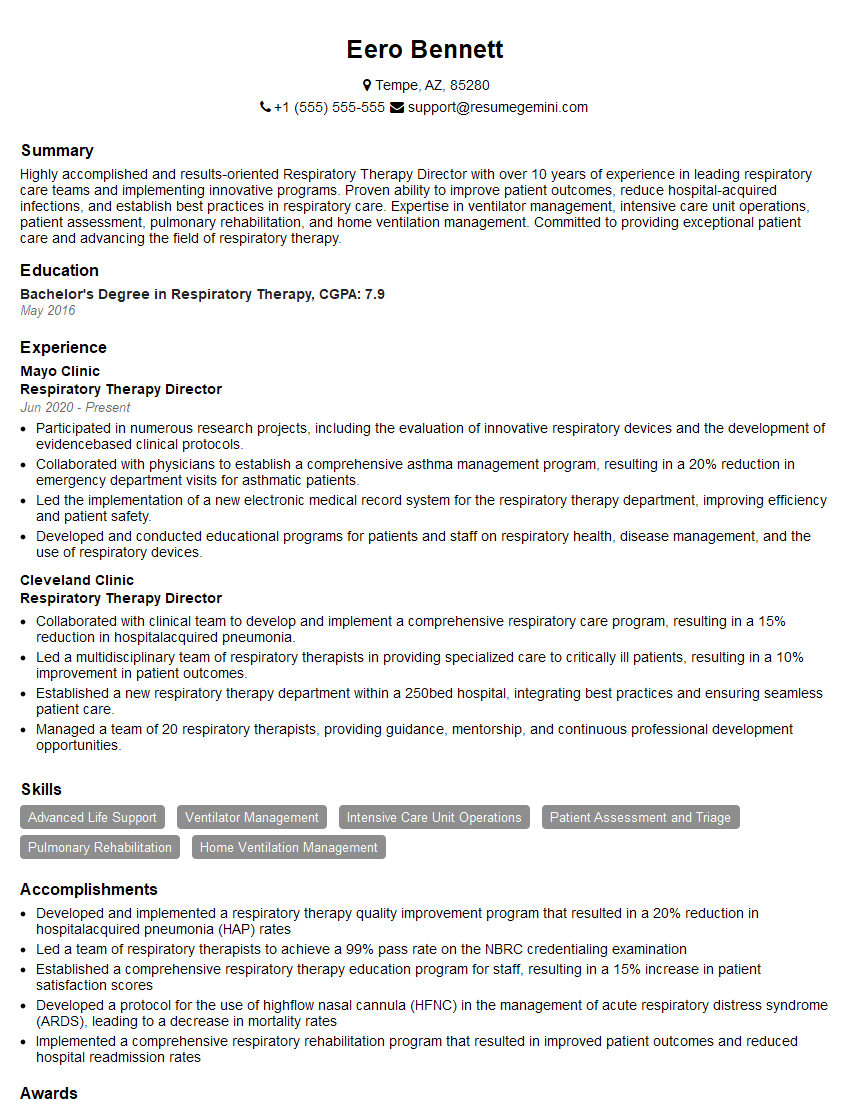
Eero Bennett
Respiratory Therapy Director
Summary
Highly accomplished and results-oriented Respiratory Therapy Director with over 10 years of experience in leading respiratory care teams and implementing innovative programs. Proven ability to improve patient outcomes, reduce hospital-acquired infections, and establish best practices in respiratory care. Expertise in ventilator management, intensive care unit operations, patient assessment, pulmonary rehabilitation, and home ventilation management. Committed to providing exceptional patient care and advancing the field of respiratory therapy.
Education
Bachelor’s Degree in Respiratory Therapy
May 2016
Skills
- Advanced Life Support
- Ventilator Management
- Intensive Care Unit Operations
- Patient Assessment and Triage
- Pulmonary Rehabilitation
- Home Ventilation Management
Work Experience
Respiratory Therapy Director
- Participated in numerous research projects, including the evaluation of innovative respiratory devices and the development of evidencebased clinical protocols.
- Collaborated with physicians to establish a comprehensive asthma management program, resulting in a 20% reduction in emergency department visits for asthmatic patients.
- Led the implementation of a new electronic medical record system for the respiratory therapy department, improving efficiency and patient safety.
- Developed and conducted educational programs for patients and staff on respiratory health, disease management, and the use of respiratory devices.
Respiratory Therapy Director
- Collaborated with clinical team to develop and implement a comprehensive respiratory care program, resulting in a 15% reduction in hospitalacquired pneumonia.
- Led a multidisciplinary team of respiratory therapists in providing specialized care to critically ill patients, resulting in a 10% improvement in patient outcomes.
- Established a new respiratory therapy department within a 250bed hospital, integrating best practices and ensuring seamless patient care.
- Managed a team of 20 respiratory therapists, providing guidance, mentorship, and continuous professional development opportunities.
Accomplishments
- Developed and implemented a respiratory therapy quality improvement program that resulted in a 20% reduction in hospitalacquired pneumonia (HAP) rates
- Led a team of respiratory therapists to achieve a 99% pass rate on the NBRC credentialing examination
- Established a comprehensive respiratory therapy education program for staff, resulting in a 15% increase in patient satisfaction scores
- Developed a protocol for the use of highflow nasal cannula (HFNC) in the management of acute respiratory distress syndrome (ARDS), leading to a decrease in mortality rates
- Implemented a comprehensive respiratory rehabilitation program that resulted in improved patient outcomes and reduced hospital readmission rates
Awards
- Recipient of the American Association for Respiratory Care (AARC) Distinguished Service Award for outstanding contributions to the field of respiratory therapy
- Honored with the National Board for Respiratory Care (NBRC) Excellence in Respiratory Care Award for leadership and innovation in the field
- Recognized with the AARC Respiratory Therapy Practitioner of the Year Award for exceptional patient care and contributions to the profession
- Awarded the American College of Chest Physicians (ACCP) Respiratory Therapy Leadership Award for outstanding leadership and advocacy in the field
Certificates
- NBRC Respiratory Therapist (RRT)
- ACLS Instructor
- PALS Provider
- BLS Instructor
Career Expert Tips:
- Select the ideal resume template to showcase your professional experience effectively.
- Master the art of resume writing to highlight your unique qualifications and achievements.
- Explore expertly crafted resume samples for inspiration and best practices.
- Build your best resume for free this new year with ResumeGemini. Enjoy exclusive discounts on ATS optimized resume templates.
How To Write Resume For Respiratory Therapy Director
- Highlight your expertise in critical care and ventilator management.
- Quantify your accomplishments with specific metrics and data.
- Demonstrate your leadership and management skills.
- Showcase your commitment to professional development and research.
- Emphasize your passion for patient care and improving respiratory health.
Essential Experience Highlights for a Strong Respiratory Therapy Director Resume
- Lead and manage a team of respiratory therapists, providing guidance, mentorship, and professional development opportunities.
- Collaborate with physicians and other healthcare professionals to develop and implement comprehensive respiratory care programs.
- Evaluate and implement new technologies and treatment modalities to improve patient outcomes.
- Ensure compliance with regulatory standards and best practices in respiratory therapy.
- Conduct research and participate in clinical trials to advance the field of respiratory care.
- Develop and deliver educational programs for patients, staff, and the community on respiratory health and disease management.
- Oversee the financial and operational management of the respiratory therapy department.
Frequently Asked Questions (FAQ’s) For Respiratory Therapy Director
What is the role of a Respiratory Therapy Director?
A Respiratory Therapy Director is responsible for overseeing the respiratory care department within a healthcare facility. They lead a team of respiratory therapists, develop and implement respiratory care programs, and ensure compliance with regulatory standards. They also collaborate with physicians and other healthcare professionals to provide comprehensive patient care.
What are the qualifications for a Respiratory Therapy Director?
Most Respiratory Therapy Directors have a Bachelor’s Degree in Respiratory Therapy and several years of experience in the field. They must also be certified by the National Board for Respiratory Care (NBRC).
What are the key skills for a Respiratory Therapy Director?
Key skills for a Respiratory Therapy Director include advanced life support, ventilator management, intensive care unit operations, patient assessment and triage, pulmonary rehabilitation, and home ventilation management. They must also possess strong leadership, management, and communication skills.
What is the job outlook for Respiratory Therapy Directors?
The job outlook for Respiratory Therapy Directors is expected to grow faster than average in the coming years. This is due to the increasing demand for respiratory care services as the population ages and the prevalence of chronic respiratory diseases rises.
What is the salary range for Respiratory Therapy Directors?
The salary range for Respiratory Therapy Directors can vary depending on their experience, location, and employer. According to Salary.com, the average salary for Respiratory Therapy Directors in the United States is around $100,000 per year.
What are the benefits of working as a Respiratory Therapy Director?
Benefits of working as a Respiratory Therapy Director include a competitive salary, opportunities for professional development, and the chance to make a real difference in the lives of patients.
What are the challenges of working as a Respiratory Therapy Director?
Challenges of working as a Respiratory Therapy Director include long hours, high stress levels, and the need to be on call. They must also be able to make quick decisions in critical situations.
How can I become a Respiratory Therapy Director?
To become a Respiratory Therapy Director, you will need to obtain a Bachelor’s Degree in Respiratory Therapy, become certified by the NBRC, and gain several years of experience in the field. You may also need to complete additional training or education in leadership and management.