Are you a seasoned Rural Sociologist seeking a new career path? Discover our professionally built Rural Sociologist Resume Template. This time-saving tool provides a solid foundation for your job search. Simply click “Edit Resume” to customize it with your unique experiences and achievements. Customize fonts and colors to match your personal style and increase your chances of landing your dream job. Explore more Resume Templates for additional options.






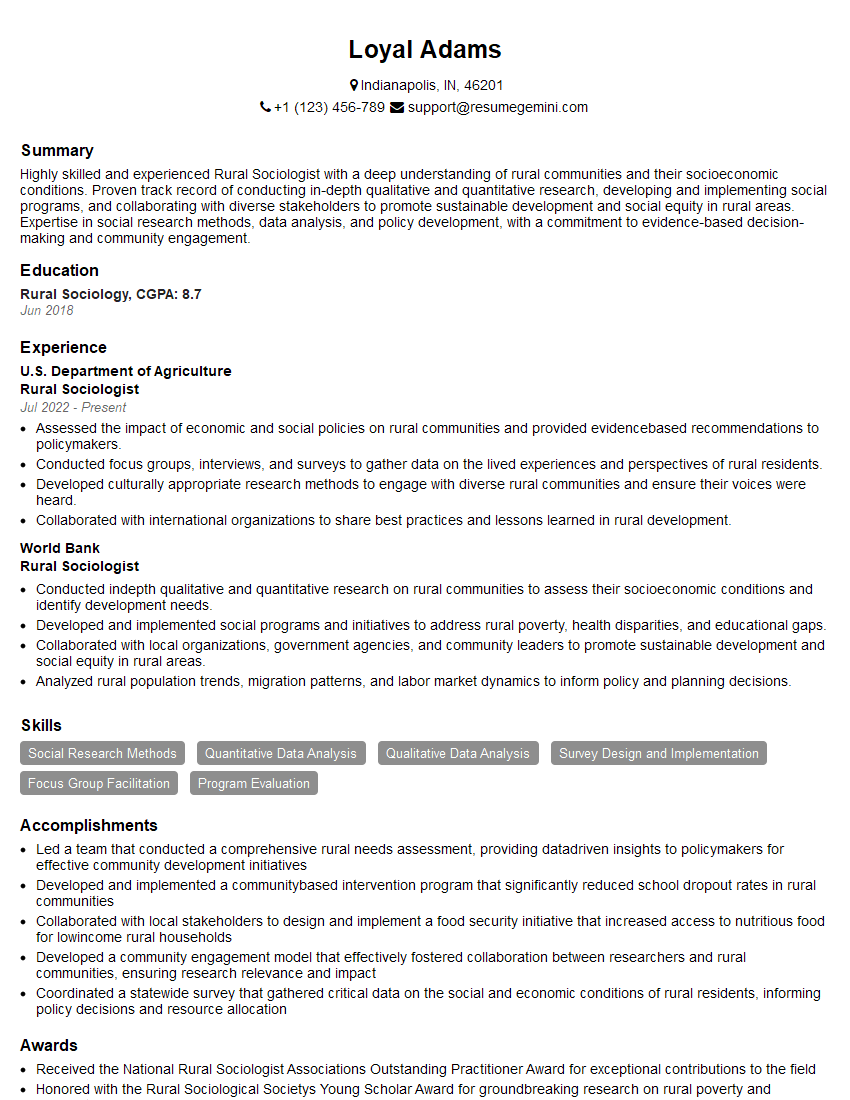
Loyal Adams
Rural Sociologist
Summary
Highly skilled and experienced Rural Sociologist with a deep understanding of rural communities and their socioeconomic conditions. Proven track record of conducting in-depth qualitative and quantitative research, developing and implementing social programs, and collaborating with diverse stakeholders to promote sustainable development and social equity in rural areas. Expertise in social research methods, data analysis, and policy development, with a commitment to evidence-based decision-making and community engagement.
Education
Rural Sociology
June 2018
Skills
- Social Research Methods
- Quantitative Data Analysis
- Qualitative Data Analysis
- Survey Design and Implementation
- Focus Group Facilitation
- Program Evaluation
Work Experience
Rural Sociologist
- Assessed the impact of economic and social policies on rural communities and provided evidencebased recommendations to policymakers.
- Conducted focus groups, interviews, and surveys to gather data on the lived experiences and perspectives of rural residents.
- Developed culturally appropriate research methods to engage with diverse rural communities and ensure their voices were heard.
- Collaborated with international organizations to share best practices and lessons learned in rural development.
Rural Sociologist
- Conducted indepth qualitative and quantitative research on rural communities to assess their socioeconomic conditions and identify development needs.
- Developed and implemented social programs and initiatives to address rural poverty, health disparities, and educational gaps.
- Collaborated with local organizations, government agencies, and community leaders to promote sustainable development and social equity in rural areas.
- Analyzed rural population trends, migration patterns, and labor market dynamics to inform policy and planning decisions.
Accomplishments
- Led a team that conducted a comprehensive rural needs assessment, providing datadriven insights to policymakers for effective community development initiatives
- Developed and implemented a communitybased intervention program that significantly reduced school dropout rates in rural communities
- Collaborated with local stakeholders to design and implement a food security initiative that increased access to nutritious food for lowincome rural households
- Developed a community engagement model that effectively fostered collaboration between researchers and rural communities, ensuring research relevance and impact
- Coordinated a statewide survey that gathered critical data on the social and economic conditions of rural residents, informing policy decisions and resource allocation
Awards
- Received the National Rural Sociologist Associations Outstanding Practitioner Award for exceptional contributions to the field
- Honored with the Rural Sociological Societys Young Scholar Award for groundbreaking research on rural poverty and inequality
- Recognized by the Rural Health Association of the United States for exceptional contributions to improving healthcare access and outcomes in rural areas
- Awarded the American Sociological Associations Section on Rural Sociologys Outstanding Service Award for dedication to advancing the field
Certificates
- Certified Professional Rural Sociologist (CPRS)
- Data Analytics Certificate
- GIS Professional Certificate
- Project Management Professional (PMP)
Career Expert Tips:
- Select the ideal resume template to showcase your professional experience effectively.
- Master the art of resume writing to highlight your unique qualifications and achievements.
- Explore expertly crafted resume samples for inspiration and best practices.
- Build your best resume for free this new year with ResumeGemini. Enjoy exclusive discounts on ATS optimized resume templates.
How To Write Resume For Rural Sociologist
- Highlight your research skills and experience in both qualitative and quantitative methodologies, showcasing your ability to collect and analyze data effectively.
- Emphasize your understanding of rural development theories and best practices, demonstrating your knowledge of the field and your commitment to evidence-based approaches.
- Showcase your ability to work collaboratively with diverse stakeholders, including community members, government agencies, and non-profit organizations, highlighting your interpersonal and communication skills.
- Quantify your accomplishments whenever possible, using specific metrics to demonstrate the impact of your work and the positive outcomes achieved for rural communities.
Essential Experience Highlights for a Strong Rural Sociologist Resume
- Conducted comprehensive research to assess the socioeconomic conditions of rural communities, identifying key development needs and challenges.
- Developed and implemented social programs targeted at addressing rural poverty, health disparities, and educational gaps, ensuring equitable access to essential services and resources.
- Collaborated with local organizations, government agencies, and community leaders to foster partnerships and promote sustainable development initiatives, empowering rural communities to take ownership of their well-being.
- Analyzed rural population trends, migration patterns, and labor market dynamics to inform policy and planning decisions at the local, regional, and national levels.
- Assessed the impact of economic and social policies on rural communities, providing evidence-based recommendations to policymakers to ensure inclusive and equitable development.
- Facilitated focus groups, conducted interviews, and administered surveys to gather data on the lived experiences and perspectives of rural residents, ensuring their voices were heard and incorporated into decision-making processes.
- Developed culturally appropriate research methods to effectively engage with diverse rural communities, respecting their unique values, traditions, and perspectives.
Frequently Asked Questions (FAQ’s) For Rural Sociologist
What is the role of a Rural Sociologist?
Rural Sociologists study the social, economic, and environmental factors that affect the lives of people living in rural communities. They conduct research, develop and implement programs, and advocate for policies that promote the well-being of rural residents.
What are the key skills required for a Rural Sociologist?
Key skills for Rural Sociologists include research methods, data analysis, program evaluation, community engagement, and policy analysis. They should also have a strong understanding of rural development theories and best practices.
What are the career prospects for Rural Sociologists?
Rural Sociologists can work in academia, government agencies, non-profit organizations, and international development agencies. They can also work as independent consultants or researchers.
What is the job outlook for Rural Sociologists?
The job outlook for Rural Sociologists is expected to be good over the next decade, as there is a growing demand for professionals with expertise in rural development.
How can I become a Rural Sociologist?
To become a Rural Sociologist, you typically need a master’s or doctoral degree in Rural Sociology or a related field. You should also have experience in research and community engagement.
What are some of the challenges facing Rural Sociologists?
Some of the challenges facing Rural Sociologists include the lack of funding for rural research and programs, the difficulty of working in remote areas, and the need to address the complex social and economic issues that affect rural communities.