Are you a seasoned Silviculturist seeking a new career path? Discover our professionally built Silviculturist Resume Template. This time-saving tool provides a solid foundation for your job search. Simply click “Edit Resume” to customize it with your unique experiences and achievements. Customize fonts and colors to match your personal style and increase your chances of landing your dream job. Explore more Resume Templates for additional options.






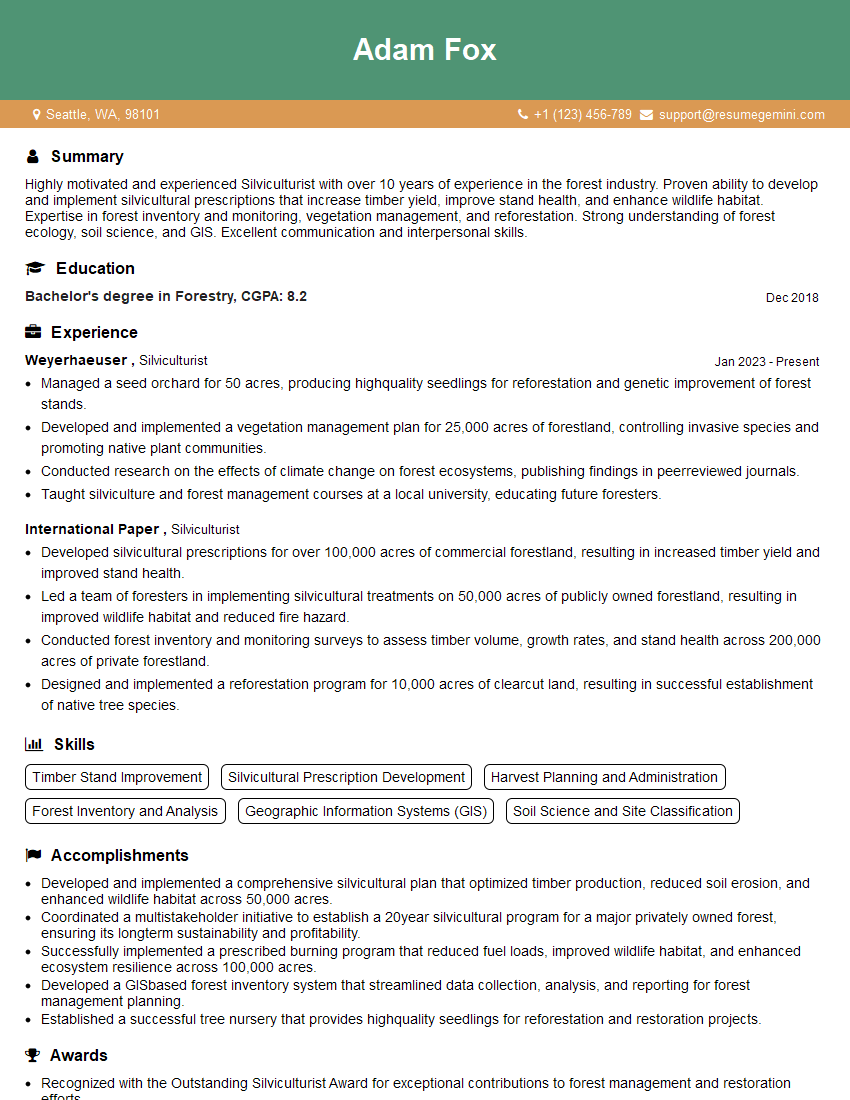
Adam Fox
Silviculturist
Summary
Highly motivated and experienced Silviculturist with over 10 years of experience in the forest industry. Proven ability to develop and implement silvicultural prescriptions that increase timber yield, improve stand health, and enhance wildlife habitat. Expertise in forest inventory and monitoring, vegetation management, and reforestation. Strong understanding of forest ecology, soil science, and GIS. Excellent communication and interpersonal skills.
Education
Bachelor’s degree in Forestry
December 2018
Skills
- Timber Stand Improvement
- Silvicultural Prescription Development
- Harvest Planning and Administration
- Forest Inventory and Analysis
- Geographic Information Systems (GIS)
- Soil Science and Site Classification
Work Experience
Silviculturist
- Managed a seed orchard for 50 acres, producing highquality seedlings for reforestation and genetic improvement of forest stands.
- Developed and implemented a vegetation management plan for 25,000 acres of forestland, controlling invasive species and promoting native plant communities.
- Conducted research on the effects of climate change on forest ecosystems, publishing findings in peerreviewed journals.
- Taught silviculture and forest management courses at a local university, educating future foresters.
Silviculturist
- Developed silvicultural prescriptions for over 100,000 acres of commercial forestland, resulting in increased timber yield and improved stand health.
- Led a team of foresters in implementing silvicultural treatments on 50,000 acres of publicly owned forestland, resulting in improved wildlife habitat and reduced fire hazard.
- Conducted forest inventory and monitoring surveys to assess timber volume, growth rates, and stand health across 200,000 acres of private forestland.
- Designed and implemented a reforestation program for 10,000 acres of clearcut land, resulting in successful establishment of native tree species.
Accomplishments
- Developed and implemented a comprehensive silvicultural plan that optimized timber production, reduced soil erosion, and enhanced wildlife habitat across 50,000 acres.
- Coordinated a multistakeholder initiative to establish a 20year silvicultural program for a major privately owned forest, ensuring its longterm sustainability and profitability.
- Successfully implemented a prescribed burning program that reduced fuel loads, improved wildlife habitat, and enhanced ecosystem resilience across 100,000 acres.
- Developed a GISbased forest inventory system that streamlined data collection, analysis, and reporting for forest management planning.
- Established a successful tree nursery that provides highquality seedlings for reforestation and restoration projects.
Awards
- Recognized with the Outstanding Silviculturist Award for exceptional contributions to forest management and restoration efforts.
- Recipient of the Forest Stewardship Councils Excellence in Silviculture Award for promoting sustainable forest management practices.
- Honored with the Society of American Foresters Young Silviculturist of the Year Award for innovative approaches to forest regeneration and stand improvement.
- Recognized by the National Wild Turkey Federation for exceptional contributions to forest management that benefit wildlife populations.
Certificates
- Registered Professional Forester
- Certified Silviculturist
- Certified Soil Scientist
- Certified Forest Fire Manager
Career Expert Tips:
- Select the ideal resume template to showcase your professional experience effectively.
- Master the art of resume writing to highlight your unique qualifications and achievements.
- Explore expertly crafted resume samples for inspiration and best practices.
- Build your best resume for free this new year with ResumeGemini. Enjoy exclusive discounts on ATS optimized resume templates.
How To Write Resume For Silviculturist
- Highlight your experience in developing and implementing silvicultural prescriptions that have resulted in measurable improvements in timber yield, stand health, or wildlife habitat.
- Showcase your knowledge of forest ecology, soil science, and GIS by describing projects where you have used these skills to solve forest management challenges.
- Quantify your accomplishments whenever possible. For example, instead of saying “Developed silvicultural prescriptions for over 100,000 acres of commercial forestland,” say “Developed silvicultural prescriptions for over 100,000 acres of commercial forestland, resulting in a 15% increase in timber yield.”
- Tailor your resume and cover letter to the specific job you are applying for. Highlight the skills and experience that are most relevant to the position.
Essential Experience Highlights for a Strong Silviculturist Resume
- Develop and implement silvicultural prescriptions to optimize timber production, stand health, and wildlife habitat.
- Conduct forest inventory and monitoring to assess timber volume, growth rates, and stand health.
- Design and implement reforestation programs to establish and maintain healthy forest stands.
- Manage vegetation to control invasive species and promote native plant communities.
- Collaborate with other professionals, such as foresters, wildlife biologists, and ecologists, to develop and implement forest management plans.
- Stay abreast of the latest silvicultural research and best practices to ensure the sustainability of forest ecosystems.
Frequently Asked Questions (FAQ’s) For Silviculturist
What is the role of a silviculturist?
Silviculturists are responsible for managing and improving the health and productivity of forests. They develop and implement silvicultural treatments, such as thinning, pruning, and prescribed burning, to achieve specific management objectives. Silviculturists also conduct research on forest ecology and tree physiology to develop new and improved silvicultural practices.
What are the educational requirements for a silviculturist?
Most silviculturists have a bachelor’s degree in forestry or a related field. Some silviculturists also have a master’s degree or doctorate in forestry or a related field.
What are the job prospects for silviculturists?
The job outlook for silviculturists is expected to be good over the next few years. As the demand for wood products continues to grow, silviculturists will be needed to manage and improve the health and productivity of forests.
What are the key skills that silviculturists need?
Silviculturists need a strong understanding of forest ecology, soil science, and tree physiology. They also need to be able to develop and implement silvicultural treatments, conduct forest inventory and monitoring, and communicate effectively with landowners and other stakeholders.
What are the different types of silvicultural treatments?
There are many different types of silvicultural treatments, each with its own specific objectives. Some of the most common silvicultural treatments include thinning, pruning, prescribed burning, and fertilization.
How can I become a silviculturist?
To become a silviculturist, you will need to earn a bachelor’s degree in forestry or a related field. You may also need to earn a master’s degree or doctorate in forestry or a related field. After completing your education, you will need to gain experience working in the field of forestry. You can gain experience by working for a government agency, a private forestry company, or a non-profit organization.
What are the professional organizations for silviculturists?
The Society of American Foresters (SAF) is the largest professional organization for silviculturists in the United States. The SAF provides a variety of resources for silviculturists, including continuing education opportunities, networking opportunities, and professional development programs.
What are the continuing education opportunities for silviculturists?
There are a variety of continuing education opportunities available for silviculturists. These opportunities include workshops, conferences, and online courses. Silviculturists can also earn continuing education credits by reading professional journals and books.