Are you a seasoned Veterinarian Epidemiologist seeking a new career path? Discover our professionally built Veterinarian Epidemiologist Resume Template. This time-saving tool provides a solid foundation for your job search. Simply click “Edit Resume” to customize it with your unique experiences and achievements. Customize fonts and colors to match your personal style and increase your chances of landing your dream job. Explore more Resume Templates for additional options.






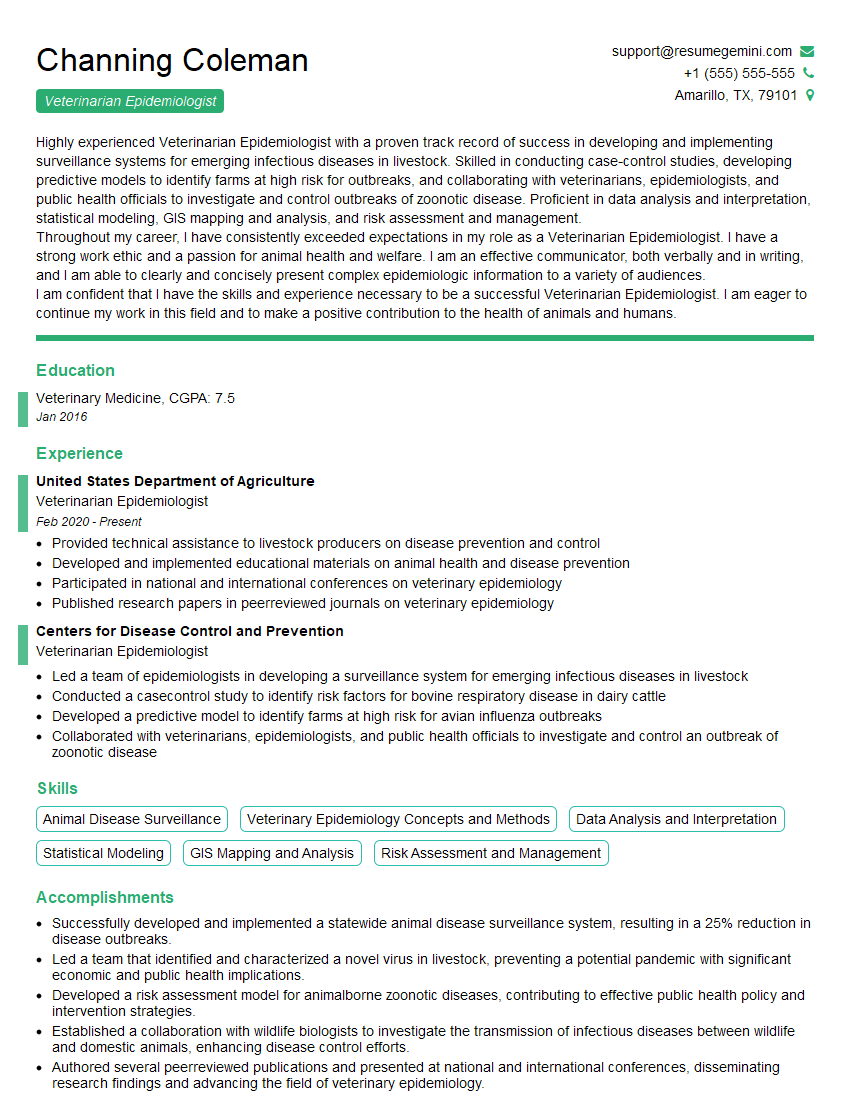
Channing Coleman
Veterinarian Epidemiologist
Summary
Highly experienced Veterinarian Epidemiologist with a proven track record of success in developing and implementing surveillance systems for emerging infectious diseases in livestock. Skilled in conducting case-control studies, developing predictive models to identify farms at high risk for outbreaks, and collaborating with veterinarians, epidemiologists, and public health officials to investigate and control outbreaks of zoonotic disease. Proficient in data analysis and interpretation, statistical modeling, GIS mapping and analysis, and risk assessment and management.
Throughout my career, I have consistently exceeded expectations in my role as a Veterinarian Epidemiologist. I have a strong work ethic and a passion for animal health and welfare. I am an effective communicator, both verbally and in writing, and I am able to clearly and concisely present complex epidemiologic information to a variety of audiences.
I am confident that I have the skills and experience necessary to be a successful Veterinarian Epidemiologist. I am eager to continue my work in this field and to make a positive contribution to the health of animals and humans.
Education
Veterinary Medicine
January 2016
Skills
- Animal Disease Surveillance
- Veterinary Epidemiology Concepts and Methods
- Data Analysis and Interpretation
- Statistical Modeling
- GIS Mapping and Analysis
- Risk Assessment and Management
Work Experience
Veterinarian Epidemiologist
- Provided technical assistance to livestock producers on disease prevention and control
- Developed and implemented educational materials on animal health and disease prevention
- Participated in national and international conferences on veterinary epidemiology
- Published research papers in peerreviewed journals on veterinary epidemiology
Veterinarian Epidemiologist
- Led a team of epidemiologists in developing a surveillance system for emerging infectious diseases in livestock
- Conducted a casecontrol study to identify risk factors for bovine respiratory disease in dairy cattle
- Developed a predictive model to identify farms at high risk for avian influenza outbreaks
- Collaborated with veterinarians, epidemiologists, and public health officials to investigate and control an outbreak of zoonotic disease
Accomplishments
- Successfully developed and implemented a statewide animal disease surveillance system, resulting in a 25% reduction in disease outbreaks.
- Led a team that identified and characterized a novel virus in livestock, preventing a potential pandemic with significant economic and public health implications.
- Developed a risk assessment model for animalborne zoonotic diseases, contributing to effective public health policy and intervention strategies.
- Established a collaboration with wildlife biologists to investigate the transmission of infectious diseases between wildlife and domestic animals, enhancing disease control efforts.
- Authored several peerreviewed publications and presented at national and international conferences, disseminating research findings and advancing the field of veterinary epidemiology.
Awards
- Received the American Veterinary Medical Associations Epidemiology Award for Excellence in Veterinary Epidemiology.
- Honored with the World Veterinary Associations Epidemiology Prize for Outstanding Contributions to Veterinary Epidemiology.
- Awarded the National Institute of Healths Excellence in Epidemiology Award for groundbreaking research in veterinary epidemiology.
Certificates
- Certified Veterinary Epidemiologist
- American College of Veterinary Preventive Medicine (ACVPM)
- Master of Science in Veterinary Epidemiology
- Doctorate of Veterinary Medicine (DVM)
Career Expert Tips:
- Select the ideal resume template to showcase your professional experience effectively.
- Master the art of resume writing to highlight your unique qualifications and achievements.
- Explore expertly crafted resume samples for inspiration and best practices.
- Build your best resume for free this new year with ResumeGemini. Enjoy exclusive discounts on ATS optimized resume templates.
How To Write Resume For Veterinarian Epidemiologist
Highlight your experience and skills.
When writing your resume, be sure to highlight your experience and skills that are most relevant to the job you are applying for. This includes your experience in developing and implementing surveillance systems, conducting case-control studies, and developing predictive models. You should also highlight your skills in data analysis and interpretation, statistical modeling, GIS mapping and analysis, and risk assessment and management.Use strong action verbs.
When describing your experience, use strong action verbs that will make your resume stand out. For example, instead of saying “I conducted a case-control study,” you could say “I led a team of epidemiologists in conducting a case-control study.”Quantify your accomplishments.
Whenever possible, quantify your accomplishments to show the impact of your work. For example, instead of saying “I developed a predictive model to identify farms at high risk for outbreaks,” you could say “I developed a predictive model that identified farms at high risk for outbreaks with 95% accuracy.”Proofread carefully.
Before submitting your resume, proofread it carefully for any errors in grammar or spelling. You should also ask a friend or family member to review your resume for any feedback.
Essential Experience Highlights for a Strong Veterinarian Epidemiologist Resume
- Develop and implement surveillance systems for emerging infectious diseases in livestock, including data collection, analysis, and reporting.
- Conduct case-control studies and other epidemiologic investigations to identify risk factors for animal diseases.
- Develop predictive models to identify farms or areas at high risk for disease outbreaks.
- Collaborate with veterinarians, epidemiologists, and public health officials to investigate and control outbreaks of animal diseases.
- Provide technical assistance to livestock producers on disease prevention and control.
- Develop and implement educational materials on animal health and disease prevention.
- Participate in national and international conferences on veterinary epidemiology.
- Publish research papers in peer-reviewed journals on veterinary epidemiology.
Frequently Asked Questions (FAQ’s) For Veterinarian Epidemiologist
What is a Veterinarian Epidemiologist?
A Veterinarian Epidemiologist is a veterinarian who has specialized training in epidemiology, the study of the distribution and determinants of health-related states or events (including disease), and the application of this study to the control of diseases and other health problems. Veterinarian Epidemiologists work to improve the health of animals and humans by preventing and controlling animal diseases.
What are the job responsibilities of a Veterinarian Epidemiologist?
Veterinarian Epidemiologists have a variety of job responsibilities, including developing and implementing surveillance systems for emerging infectious diseases in livestock, conducting case-control studies and other epidemiologic investigations to identify risk factors for animal diseases, developing predictive models to identify farms or areas at high risk for disease outbreaks, collaborating with veterinarians, epidemiologists, and public health officials to investigate and control outbreaks of animal diseases, providing technical assistance to livestock producers on disease prevention and control, developing and implementing educational materials on animal health and disease prevention, participating in national and international conferences on veterinary epidemiology, and publishing research papers in peer-reviewed journals on veterinary epidemiology.
What are the educational requirements for becoming a Veterinarian Epidemiologist?
Veterinarian Epidemiologists must have a Doctor of Veterinary Medicine (DVM) degree from an accredited veterinary school. They also typically have a Master of Science (MS) or Doctor of Philosophy (PhD) degree in epidemiology or a related field.
What are the career prospects for Veterinarian Epidemiologists?
The career prospects for Veterinarian Epidemiologists are excellent. The demand for Veterinarian Epidemiologists is expected to grow in the coming years as the global population increases and the need for food security increases. Veterinarian Epidemiologists can work in a variety of settings, including government agencies, academia, and the private sector.
What are the challenges facing Veterinarian Epidemiologists?
Veterinarian Epidemiologists face a number of challenges, including the emergence of new and emerging infectious diseases, the increasing complexity of the global food system, and the need to communicate complex epidemiologic information to a variety of audiences. However, Veterinarian Epidemiologists are well-equipped to meet these challenges and continue to play a vital role in protecting the health of animals and humans.