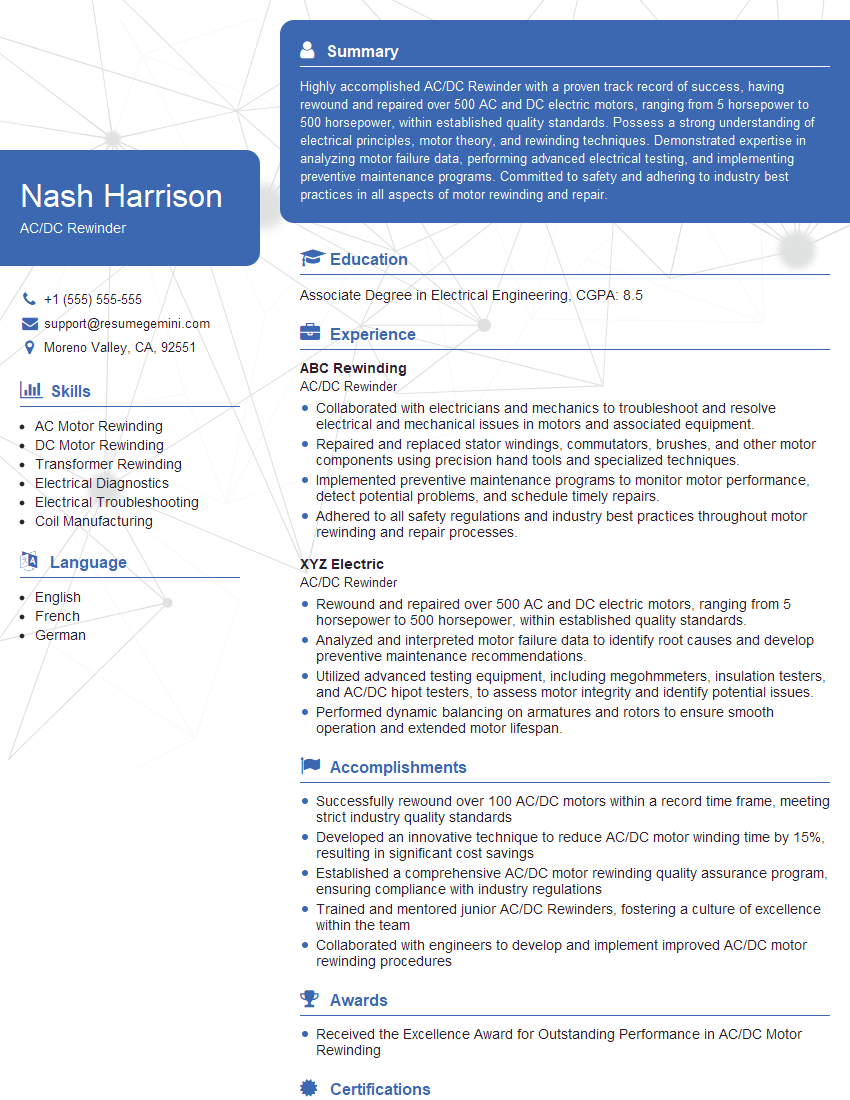
Are you gearing up for an interview for a AC/DC Rewinder position? Whether you’re a seasoned professional or just stepping into the role, understanding what’s expected can make all the difference. In this blog, we dive deep into the essential interview questions for AC/DC Rewinder and break down the key responsibilities of the role. By exploring these insights, you’ll gain a clearer picture of what employers are looking for and how you can stand out. Read on to equip yourself with the knowledge and confidence needed to ace your next interview and land your dream job!
Acing the interview is crucial, but landing one requires a compelling resume that gets you noticed. Crafting a professional document that highlights your skills and experience is the first step toward interview success. ResumeGemini can help you build a standout resume that gets you called in for that dream job.






Essential Interview Questions For AC/DC Rewinder
1. Can you explain the process of rewinding an AC/DC motor?
The process of rewinding an AC/DC motor involves several steps:
- Disassembly: The motor is disassembled to access the stator and rotor.
- Removing the old windings: The old windings are carefully removed from the stator and rotor.
- Cleaning: The stator and rotor are cleaned to remove any debris or contaminants.
- Winding the new coils: New coils are wound onto the stator and rotor using the correct wire gauge and number of turns.
- Connecting the windings: The windings are connected to the appropriate terminals.
- Insulating the windings: The windings are insulated to prevent electrical shorts.
- Reassembly: The motor is reassembled and tested to ensure proper operation.
2. What types of insulation materials are commonly used in AC/DC motor windings?
Types of Insulation Materials:
- Varnish: A liquid or film applied to the windings to provide electrical insulation and moisture resistance.
- Enamel: A thin, heat-resistant coating applied to individual wires to provide electrical insulation.
- Nomex paper: A high-temperature-resistant material used to insulate between layers of windings.
- Mylar: A polyester film used for slot insulation and phase insulation.
- Fiberglass: A synthetic material used for slot insulation and phase insulation.
3. How do you determine the correct wire gauge for AC/DC motor windings?
Determining the correct wire gauge involves considering several factors:
- Current rating: The wire gauge must be able to carry the expected current without overheating.
- Temperature: The wire must be able to withstand the operating temperature of the motor.
- Space constraints: The wire gauge must fit within the available space in the motor.
- Cost: Thicker wire gauges are generally more expensive.
4. What is the purpose of slot wedges in AC/DC motors?
Slot wedges serve several purposes:
- Coil support: They support and hold the coils in place within the stator slots.
- Vibration reduction: They reduce vibration and noise caused by coil movement.
- Insulation: They provide additional insulation between the coils and the stator core.
5. How do you test the continuity of AC/DC motor windings?
Continuity testing involves:
- Using a multimeter: Set the multimeter to the continuity mode and connect the probes to the terminals of the winding.
- Checking for a reading: A zero or low-resistance reading indicates continuity, while an infinite resistance reading indicates a break in the winding.
6. What is the difference between a lap winding and a wave winding in AC/DC motors?
Lap Winding:
- The coils overlap each other in the slots.
- Produces higher starting torque but lower efficiency.
Wave Winding:
- The coils are connected in a continuous loop without overlapping.
- Produces lower starting torque but higher efficiency.
7. What is the importance of balancing the windings in an AC/DC motor?
Balancing the windings is crucial because it ensures:
- Reduced vibration: Unbalanced windings can cause excessive vibration and noise.
- Increased efficiency: Balanced windings maximize motor efficiency by minimizing losses.
- Extended lifespan: Balanced windings reduce stress on the motor components, leading to a longer lifespan.
8. How do you diagnose and troubleshoot common AC/DC motor problems?
Common AC/DC motor problems and troubleshooting methods include:
- Overheating: Check for excessive load, blocked ventilation, or winding shorts.
- Low starting torque: Inspect the windings for open circuits or shorts, check the capacitor (if applicable).
- Excessive vibration: Balance the windings, check for loose components or misalignment.
- Noisy operation: Check for bearing wear, rotor or stator damage, or unbalanced windings.
9. What safety precautions should be followed when working on AC/DC motors?
Safety precautions include:
- Power isolation: Disconnect the motor from all power sources before working on it.
- Proper grounding: Ensure that the motor and equipment are properly grounded.
- Protective clothing: Wear appropriate safety glasses, gloves, and flame-resistant clothing.
- Hazard awareness: Be aware of potential hazards such as high voltage, rotating parts, and fire.
10. How do you stay up-to-date on the latest advancements in AC/DC motor rewinding techniques?
To stay updated, I engage in the following activities:
- Industry publications: Subscribe to trade magazines and technical journals.
- Conferences and workshops: Attend industry events to learn about new technologies and best practices.
- Online resources: Utilize manufacturer websites, forums, and technical articles for information sharing.
Interviewers often ask about specific skills and experiences. With ResumeGemini‘s customizable templates, you can tailor your resume to showcase the skills most relevant to the position, making a powerful first impression. Also check out Resume Template specially tailored for AC/DC Rewinder.
Career Expert Tips:
- Ace those interviews! Prepare effectively by reviewing the Top 50 Most Common Interview Questions on ResumeGemini.
- Navigate your job search with confidence! Explore a wide range of Career Tips on ResumeGemini. Learn about common challenges and recommendations to overcome them.
- Craft the perfect resume! Master the Art of Resume Writing with ResumeGemini’s guide. Showcase your unique qualifications and achievements effectively.
- Great Savings With New Year Deals and Discounts! In 2025, boost your job search and build your dream resume with ResumeGemini’s ATS optimized templates.
Researching the company and tailoring your answers is essential. Once you have a clear understanding of the AC/DC Rewinder‘s requirements, you can use ResumeGemini to adjust your resume to perfectly match the job description.
Key Job Responsibilities
An AC/DC Rewinder is responsible for repairing and maintaining AC and DC motors, generators, and transformers. They work in a variety of settings, including manufacturing plants, power plants, and repair shops.
1. Repair and Rewind Motors and Generators
AC/DC Rewinders repair and rewind motors and generators of various sizes and types. They inspect the equipment to identify the problem, and then disassemble it to access the damaged components. They rewind the coils, replace damaged parts, and reassemble the equipment. They also test the equipment to ensure that it is working properly.
- Inspect motors and generators to identify problems
- Disassemble equipment to access damaged components
- Rewind coils and replace damaged parts
- Reassemble equipment and test it to ensure proper operation
2. Repair and Rewind Transformers
AC/DC Rewinders repair and rewind transformers of various sizes and types. They inspect the equipment to identify the problem, and then disassemble it to access the damaged components. They rewind the coils, replace damaged parts, and reassemble the equipment. They also test the equipment to ensure that it is working properly.
- Inspect transformers to identify problems
- Disassemble equipment to access damaged components
- Rewind coils and replace damaged parts
- Reassemble equipment and test it to ensure proper operation
3. Maintain Electrical Equipment
AC/DC Rewinders perform preventive maintenance on electrical equipment to prevent breakdowns and extend its lifespan. They clean and lubricate equipment, inspect it for damage, and make minor repairs. They also keep records of maintenance activities.
- Clean and lubricate electrical equipment
- Inspect equipment for damage
- Make minor repairs
- Keep records of maintenance activities
4. Troubleshoot Electrical Problems
AC/DC Rewinders troubleshoot electrical problems in motors, generators, transformers, and other electrical equipment. They use their knowledge of electrical systems to identify the source of the problem and make repairs.
- Use electrical testing equipment to identify problems
- Repair electrical components
- Troubleshoot electrical systems
Interview Tips
Preparing for an AC/DC Rewinder interview can be daunting, but with the right strategies, you can increase your chances of success. Here are some tips to help you ace your interview:
1. Research the Company and the Position
Before the interview, take the time to research the company and the specific position you are applying for. This will help you understand the company’s culture, values, and goals. You can also use this information to tailor your answers to the interviewer’s questions.
- Visit the company’s website
- Read industry news and articles
- Talk to people who work or have worked for the company
2. Practice Answering Common Interview Questions
There are a number of common interview questions that you are likely to be asked. Practice answering these questions in advance so that you can deliver confident and articulate responses. Some common interview questions include:
- Tell me about yourself.
- Why are you interested in this position?
- What are your strengths and weaknesses?
- What are your salary expectations?
3. Highlight Your Skills and Experience
During the interview, be sure to highlight your skills and experience that are relevant to the position you are applying for. Use specific examples to demonstrate your abilities. For example, you could talk about a time when you repaired a complex motor or troubleshot an electrical problem.
- Use the STAR method to answer interview questions
- Provide specific examples of your skills and experience
- Quantify your accomplishments whenever possible
4. Ask Questions
Asking questions at the end of the interview shows that you are interested in the position and the company. It also gives you an opportunity to learn more about the company and the role. Some good questions to ask include:
- What are the biggest challenges facing the company right now?
- What are the opportunities for advancement within the company?
- What is the company culture like?
Next Step:
Armed with this knowledge, you’re now well-equipped to tackle the AC/DC Rewinder interview with confidence. Remember, preparation is key. So, start crafting your resume, highlighting your relevant skills and experiences. Don’t be afraid to tailor your application to each specific job posting. With the right approach and a bit of practice, you’ll be well on your way to landing your dream job. Build your resume now from scratch or optimize your existing resume with ResumeGemini. Wish you luck in your career journey!