Are you gearing up for a career shift or aiming to ace your next interview? Look no further! We’ve curated a comprehensive guide to help you crack the interview for the coveted Assembler, Generator, Repair position. From understanding the key responsibilities to mastering the most commonly asked questions, this blog has you covered. So, buckle up and let’s embark on this journey together.
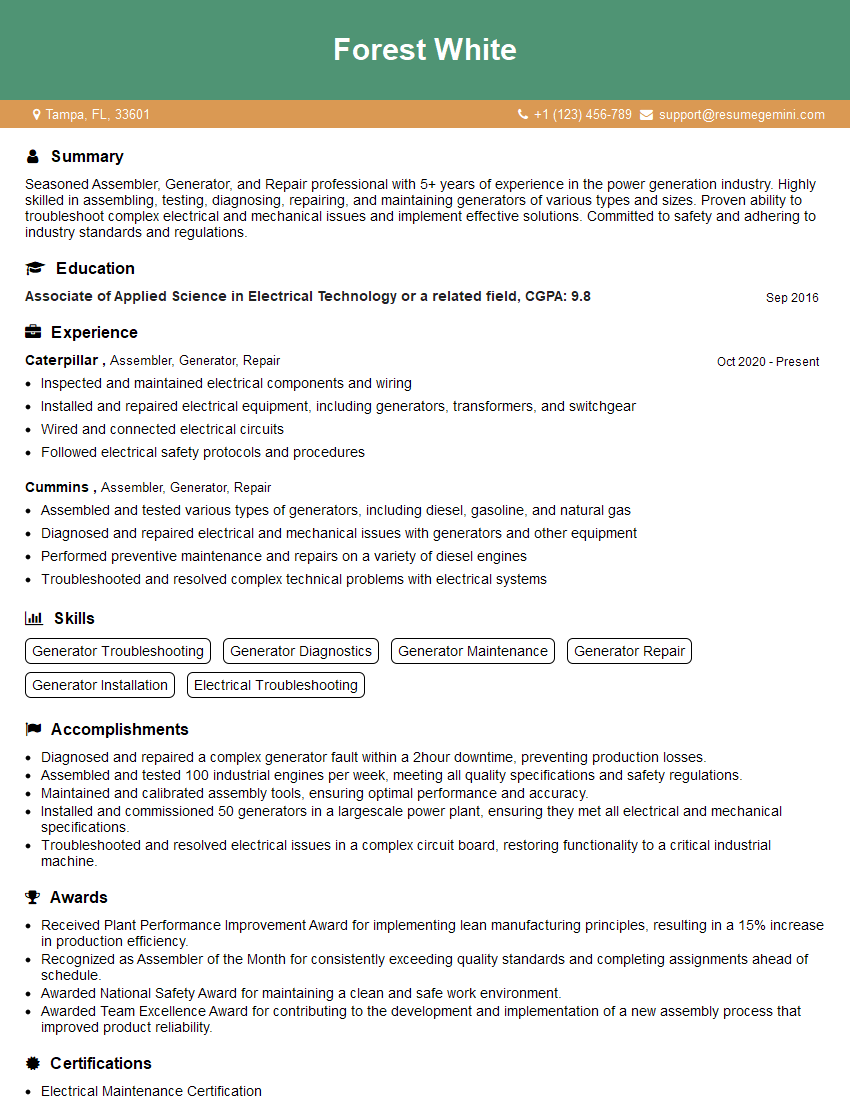
Acing the interview is crucial, but landing one requires a compelling resume that gets you noticed. Crafting a professional document that highlights your skills and experience is the first step toward interview success. ResumeGemini can help you build a standout resume that gets you called in for that dream job.






Essential Interview Questions For Assembler, Generator, Repair
1. Describe the process of assembling a generator.
The process of assembling a generator requires several steps:
- Inspect the parts: Ensure that all necessary components are present and in good condition.
- Prepare the frame: Set up the frame and secure it properly.
- Install the stator: Place the stator into the frame and align it correctly.
- Install the rotor: Insert the rotor into the stator and attach it to the shaft.
- Connect the windings: Wire the stator and rotor windings according to the schematic.
- Install the bearings: Fit the bearings onto the shaft to support the rotor.
- Assemble the end bells: Place the end bells on either side of the stator and secure them.
- Test the generator: Perform electrical tests to verify proper operation and output.
2. How do you troubleshoot a generator that is not producing power?
Check the fuel system
- Inspect the fuel tank for adequate fuel.
- Check the fuel lines for leaks or blockages.
- Test the fuel pump and fuel filter.
Check the electrical system
- Test the battery voltage and terminals.
- Inspect the wiring harness for damage or loose connections.
- Check the voltage regulator and alternator output.
Check the mechanical system
- Examine the engine compression and spark plugs.
- Inspect the air filter and exhaust system for restrictions.
- Check the oil level and condition.
3. What is the difference between a three-phase generator and a single-phase generator?
- Number of phases: Three-phase generators produce three alternating currents (AC) with a 120-degree phase shift, while single-phase generators produce a single AC.
- Power output: Three-phase generators can deliver higher power than single-phase generators due to the balanced load distribution.
- Efficiency: Three-phase generators are more efficient than single-phase generators because they reduce power losses caused by unbalanced currents.
- Applications: Three-phase generators are commonly used in industrial and commercial applications with high power demands, such as motors, pumps, and large appliances. Single-phase generators are suitable for residential and small-scale applications.
4. Explain the importance of regular maintenance for generators.
- Prevent breakdowns: Regular maintenance helps identify potential issues and address them before they lead to costly repairs or generator failure.
- Extend lifespan: Proper maintenance practices can significantly extend the generator’s lifespan by reducing wear and tear and keeping the components in optimal condition.
- Improve performance: Regular maintenance ensures that the generator operates efficiently and delivers the expected power output.
- Safety: Neglecting maintenance can lead to safety hazards, such as electrical fires or carbon monoxide poisoning.
5. What are the safety precautions to observe when working with generators?
- Use proper grounding: Ground the generator frame to prevent electrical shock.
- Keep away from flammable materials: Generators produce heat and exhaust that can ignite nearby flammable substances.
- Never overload the generator: Operating the generator beyond its rated capacity can damage the unit and create electrical hazards.
- Avoid operating in enclosed spaces: Generators emit carbon monoxide, which can accumulate in enclosed areas and lead to poisoning.
- Wear protective gear: Use gloves, safety glasses, and hearing protection when working with generators.
6. What are the common types of generator repairs you have performed?
- Starter repairs: Replacing or repairing faulty starter motors and solenoids.
- Fuel system repairs: Cleaning or replacing fuel filters, fuel pumps, and carburetors.
- Electrical repairs: Troubleshooting and fixing electrical faults, including wiring harness issues, voltage regulator problems, and alternator malfunctions.
- Engine repairs: Performing compression tests, replacing spark plugs and ignition coils, and overhauling engines.
- Cooling system repairs: Servicing radiators, water pumps, and thermostats.
7. Describe a challenging generator repair you encountered and how you resolved it.
I faced a challenging generator repair involving a persistent electrical fault. The generator would intermittently lose power during operation. After thorough troubleshooting, I discovered a loose connection in the stator windings. I carefully dissembled the generator, inspected the stator, and reconnected the loose wires. This resolved the fault and restored the generator to full functionality.
8. What are some preventive maintenance measures to prolong the life of a generator?
- Regular oil changes: Change the generator oil and filter according to the manufacturer’s recommendations.
- Air filter cleaning: Regularly clean or replace the air filter to ensure proper airflow and prevent engine damage.
- Fuel system maintenance: Service the fuel system, including cleaning or replacing fuel filters and checking fuel lines.
- Cooling system maintenance: Keep the cooling system clean and in good condition by flushing the radiator and replacing coolant regularly.
- Battery maintenance: Test the battery regularly and replace it if necessary to ensure reliable starting.
9. How do you ensure the quality of your generator repairs?
- Thorough inspection: Before starting repairs, I thoroughly inspect the generator to identify any potential issues.
- Use of genuine parts: I always use genuine or high-quality replacement parts to ensure durability and reliability.
- Precision testing: After repairs, I perform rigorous electrical and mechanical tests to ensure the generator meets specifications.
- Customer satisfaction: I prioritize customer satisfaction by providing detailed explanations of the repairs and ensuring the generator is operating optimally.
10. How do you stay updated on the latest generator technologies and repair techniques?
- Industry conferences: I attend industry conferences and seminars to stay abreast of the latest advancements.
- Technical publications: I subscribe to technical journals and magazines to keep up with industry trends and best practices.
- Online resources: I utilize online forums and databases to research specific generator models and repair techniques.
- Manufacturer training: I participate in manufacturer-sponsored training programs to gain specialized knowledge on specific generator brands.
Interviewers often ask about specific skills and experiences. With ResumeGemini‘s customizable templates, you can tailor your resume to showcase the skills most relevant to the position, making a powerful first impression. Also check out Resume Template specially tailored for Assembler, Generator, Repair.
Career Expert Tips:
- Ace those interviews! Prepare effectively by reviewing the Top 50 Most Common Interview Questions on ResumeGemini.
- Navigate your job search with confidence! Explore a wide range of Career Tips on ResumeGemini. Learn about common challenges and recommendations to overcome them.
- Craft the perfect resume! Master the Art of Resume Writing with ResumeGemini’s guide. Showcase your unique qualifications and achievements effectively.
- Great Savings With New Year Deals and Discounts! In 2025, boost your job search and build your dream resume with ResumeGemini’s ATS optimized templates.
Researching the company and tailoring your answers is essential. Once you have a clear understanding of the Assembler, Generator, Repair‘s requirements, you can use ResumeGemini to adjust your resume to perfectly match the job description.
Key Job Responsibilities
Assemblers, Generators, and Repairers are responsible for putting together, maintaining, and fixing a variety of machines, equipment, and structures. Their duties may vary depending on the industry in which they are employed, but some of their most common responsibilities include:
1. Assembling Products
Assemblers, Generators, and Repairers put together products using parts and materials provided by manufacturers. They may use hand tools, power tools, or automated machinery to assemble products such as cars, appliances, furniture, and electronics.
2. Maintaining Equipment
Assemblers, Generators, and Repairers maintain equipment to ensure that it is working properly and efficiently. They may perform routine maintenance tasks such as cleaning, lubricating, and inspecting equipment, as well as more complex repairs such as replacing parts and troubleshooting problems.
3. Repairing Structures
Assemblers, Generators, and Repairers repair structures such as buildings, bridges, and roads. They may use a variety of tools and materials to repair cracks, leaks, and other damage to structures.
4. Installing Equipment
Assemblers, Generators, and Repairers install equipment in a variety of settings, such as homes, businesses, and factories. They may install equipment such as HVAC systems, electrical systems, and plumbing systems.
Interview Tips
There are several things you can do to prepare for your interview as an Assembler, Generator, or Repairer. Here are a few tips to help you ace the interview:
1. Research the Company
Before your interview, take some time to research the company you are interviewing with. Learn about their products, services, and company culture. This will help you to understand the company’s needs and how you can contribute to their success.
2. Practice Your Answers
Take some time to practice answering common interview questions. This will help you to feel more confident during your interview and to articulate your answers clearly and concisely.
3. Dress Professionally
Dress professionally for your interview. This shows the interviewer that you are serious about the job and that you respect the company.
4. Be On Time
Arrive for your interview on time. Punctuality shows the interviewer that you are organized and respectful of their time.
5. Be Prepared to Answer Questions About Your Experience
The interviewer will likely ask you about your experience as an Assembler, Generator, or Repairer. Be prepared to discuss your skills, experience, and accomplishments.
6. Ask Questions
At the end of the interview, be sure to ask the interviewer questions about the job and the company. This shows the interviewer that you are interested in the job and that you are eager to learn more about the company.
Next Step:
Now that you’re armed with the knowledge of Assembler, Generator, Repair interview questions and responsibilities, it’s time to take the next step. Build or refine your resume to highlight your skills and experiences that align with this role. Don’t be afraid to tailor your resume to each specific job application. Finally, start applying for Assembler, Generator, Repair positions with confidence. Remember, preparation is key, and with the right approach, you’ll be well on your way to landing your dream job. Build an amazing resume with ResumeGemini