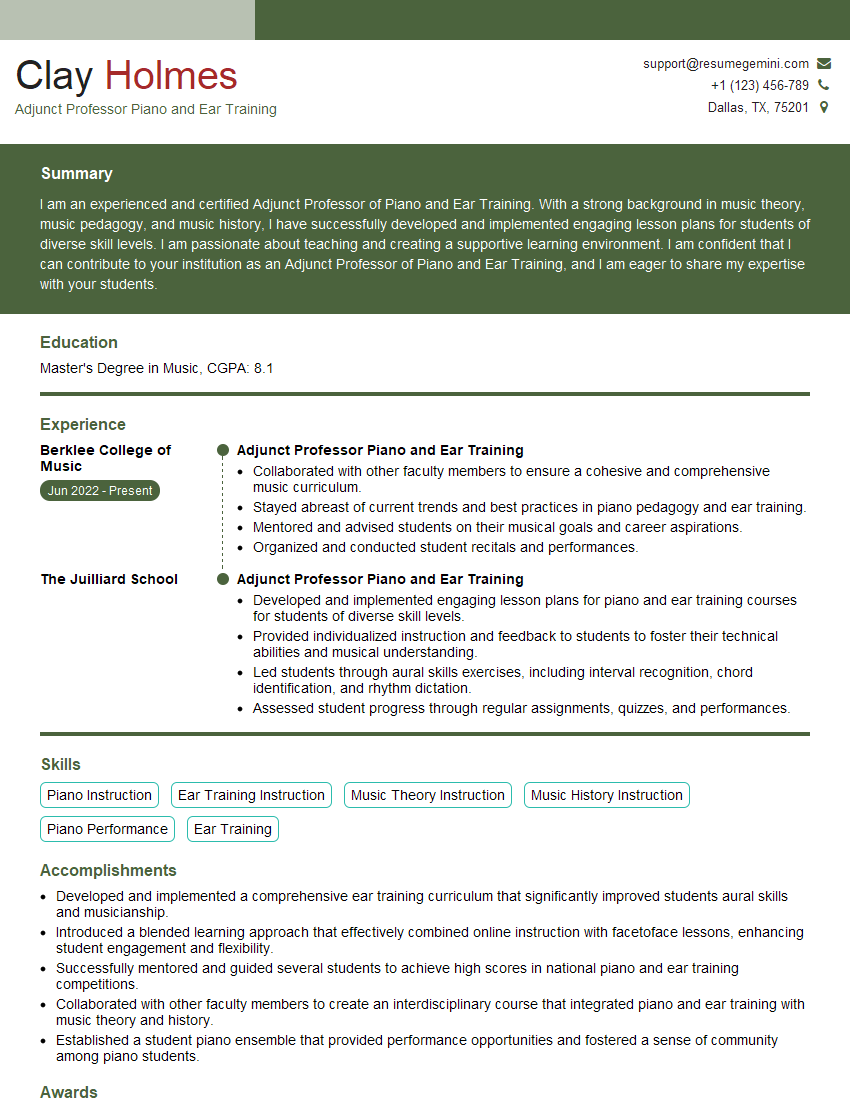
Are you gearing up for a career in Adjunct Professor Piano and Ear Training? Feeling nervous about the interview questions that might come your way? Don’t worry, you’re in the right place. In this blog post, we’ll dive deep into the most common interview questions for Adjunct Professor Piano and Ear Training and provide you with expert-backed answers. We’ll also explore the key responsibilities of this role so you can tailor your responses to showcase your perfect fit.
Acing the interview is crucial, but landing one requires a compelling resume that gets you noticed. Crafting a professional document that highlights your skills and experience is the first step toward interview success. ResumeGemini can help you build a standout resume that gets you called in for that dream job.






Essential Interview Questions For Adjunct Professor Piano and Ear Training
1. What teaching methods do you employ to develop students’ piano technique and musicianship?
In my piano lessons, I utilize a holistic approach that emphasizes technical proficiency, musical expression, and a deep understanding of the instrument. I begin by assessing each student’s current skills and learning style, then tailor my teaching methods accordingly.
- For technical development, I incorporate exercises that focus on finger dexterity, scales, arpeggios, and rhythmic precision. I emphasize proper hand position, posture, and finger independence.
- To foster musicality, I introduce repertoire that challenges students both technically and musically. I encourage them to analyze pieces, explore different interpretations, and develop their own expressive style.
- I also incorporate ear training exercises into my lessons. This helps students develop their aural skills, allowing them to play by ear, recognize intervals, and transcribe melodies.
2. How do you assess student progress and provide constructive feedback?
Regular Assessments
- I conduct regular performance assessments to evaluate students’ technical skills, musicality, and overall progress.
- I also administer written assignments, such as music theory quizzes, to assess their understanding of musical concepts.
Constructive Feedback
- I provide detailed and tailored feedback on students’ performances and assignments, highlighting both strengths and areas for improvement.
- I use specific examples and demonstrations to illustrate my feedback, making it actionable and easy for students to understand.
- I encourage students to ask questions and engage in open dialogue, fostering a collaborative learning environment.
3. What is your experience with preparing students for piano performance exams?
I have extensive experience preparing students for piano performance exams, including ABRSM, RCM, and Trinity College London exams. I am familiar with the exam requirements, marking criteria, and musical repertoire for each grade level.
- I work closely with students to develop a structured practice plan that ensures they cover all aspects of the exam, including scales, arpeggios, sight-reading, and selected pieces.
- I provide regular mock exams to simulate the exam conditions and give students an opportunity to identify areas for improvement.
- I also assist students in choosing appropriate repertoire that showcases their abilities and aligns with the exam requirements.
4. How do you incorporate technology into your piano instruction?
I embrace technology as a valuable tool to enhance piano instruction. Here are some ways I incorporate it:
- I use digital pianos with built-in metronomes, recording capabilities, and various sound effects to enhance practice and performance.
- I utilize music education apps and software to supplement lessons, providing students with additional practice material, interactive exercises, and real-time feedback.
- I also incorporate online resources, such as video tutorials, music theory databases, and online practice communities, to extend students’ learning beyond the classroom.
5. How do you engage with students from diverse backgrounds and learning styles?
Creating an inclusive and equitable learning environment is paramount to me. I approach diversity by:
- Recognizing and valuing the unique perspectives and experiences of students from different backgrounds.
- Tailoring my teaching methods to cater to different learning styles, such as visual, auditory, and kinesthetic.
- Providing opportunities for students to collaborate and learn from each other, fostering a sense of community.
- Encouraging open communication and creating a safe space where students feel comfortable asking questions and expressing their ideas.
6. How do you stay up-to-date with the latest developments in piano pedagogy?
Continuous professional development is essential in my role as an educator. I engage in various activities to stay abreast of the latest advancements in piano pedagogy:
- Attending workshops, conferences, and masterclasses conducted by renowned pianists and educators.
- Reading research articles, books, and online resources on piano teaching methods and techniques.
- Collaborating with other piano instructors and music educators to exchange ideas and best practices.
- Seeking opportunities to observe experienced piano teachers and incorporate effective strategies into my own teaching.
7. How do you encourage students to develop their own musical voice and creativity?
Fostering creativity and self-expression is a central aspect of my teaching philosophy. I employ these strategies:
- Encouraging students to explore different musical styles and genres, expanding their musical horizons.
- Providing opportunities for improvisation and composition, allowing students to experiment with sound and create their own unique musical ideas.
- Introducing students to contemporary pianists and composers who challenge musical conventions and inspire creative thinking.
- Creating a supportive and non-judgmental environment where students feel comfortable taking risks and expressing themselves.
8. How do you handle students who struggle with certain aspects of piano playing?
Supporting students who encounter challenges is an important part of my approach. I address this by:
- Identifying the specific areas where students struggle through observation and assessment.
- Breaking down complex concepts into smaller, manageable steps to make them more accessible.
- Providing targeted exercises and practice strategies to reinforce specific skills and techniques.
- Offering encouragement, positive reinforcement, and a growth mindset to foster resilience and perseverance.
9. How do you collaborate with parents/guardians to support students’ progress?
Open communication and collaboration with parents/guardians are crucial for student success. I maintain regular contact through:
- Scheduled parent-teacher meetings to discuss student progress, set goals, and address any concerns.
- Progress reports and informal updates to provide timely feedback on students’ achievements and areas for improvement.
- Encouraging parents/guardians to attend student performances and recitals, fostering a sense of support and involvement.
- Welcoming parental input and suggestions to create a collaborative and supportive learning environment.
10. How do you manage a diverse classroom with students of different levels and abilities?
Creating an inclusive learning environment that accommodates diverse student needs is essential. I approach this challenge by:
- Assessing students’ prior knowledge and skills to tailor instruction to their individual levels.
- Differentiation of instruction through the use of tiered assignments, small group instruction, and personalized learning plans.
- Providing opportunities for peer learning and collaboration, fostering a supportive and motivating classroom atmosphere.
- Setting clear expectations and providing consistent feedback to ensure all students make progress and feel valued.
Interviewers often ask about specific skills and experiences. With ResumeGemini‘s customizable templates, you can tailor your resume to showcase the skills most relevant to the position, making a powerful first impression. Also check out Resume Template specially tailored for Adjunct Professor Piano and Ear Training.
Career Expert Tips:
- Ace those interviews! Prepare effectively by reviewing the Top 50 Most Common Interview Questions on ResumeGemini.
- Navigate your job search with confidence! Explore a wide range of Career Tips on ResumeGemini. Learn about common challenges and recommendations to overcome them.
- Craft the perfect resume! Master the Art of Resume Writing with ResumeGemini’s guide. Showcase your unique qualifications and achievements effectively.
- Great Savings With New Year Deals and Discounts! In 2025, boost your job search and build your dream resume with ResumeGemini’s ATS optimized templates.
Researching the company and tailoring your answers is essential. Once you have a clear understanding of the Adjunct Professor Piano and Ear Training‘s requirements, you can use ResumeGemini to adjust your resume to perfectly match the job description.
Key Job Responsibilities
The Adjunct Professor of Piano and Ear Training plays a crucial role in fostering musical excellence within the academic community. Their primary responsibilities encompass:
1. Teaching and Instruction
Imparting knowledge and skills in both piano performance and ear training to a diverse student body.
- Providing individualized instruction tailored to each student’s needs and abilities.
- Developing and implementing engaging and effective lesson plans for both disciplines.
2. Curriculum Development and Assessment
Contributing to the design and evaluation of the piano and ear training curriculum.
- Collaborating with colleagues to ensure alignment with program goals and industry standards.
- Evaluating student progress through regular assessments and providing constructive feedback.
3. Student Advising and Mentoring
Guiding and supporting students in their musical and academic pursuits.
- Assisting students in developing realistic practice schedules and performance goals.
- Providing emotional support and encouragement to foster students’ confidence and motivation.
4. Performance and Collaboration
Participating in musical performances and collaborating with other faculty and students.
- Performing as a soloist, accompanist, or ensemble member in recitals and concerts.
- Participating in research and outreach activities related to piano and ear training.
Interview Tips
Preparation is key to acing an interview for the Adjunct Professor of Piano and Ear Training position. Here are some valuable tips to help you stand out:
1. Research the Institution and Program
Thoroughly research the institution and the specific piano and ear training program you are applying for.
- Visit the college or university website for information on the mission, faculty, and curriculum.
- Attend any open houses or information sessions to connect with current students and faculty.
2. Showcase Your Teaching Philosophy and Experience
Articulate your teaching philosophy and highlight your experience in piano instruction and ear training.
- Explain your approach to teaching piano technique, musical interpretation, and performance.
- Discuss your strategies for developing students’ listening skills, pitch recognition, and rhythm accuracy.
3. Prepare a Musical Performance
Demonstrate your musical prowess by preparing a piano performance for the interview.
- Select a piece that showcases your technical abilities and musical sensitivity.
- Practice thoroughly to ensure a polished and error-free performance.
4. Ask Thoughtful Questions
Preparing thoughtful questions to ask the interviewer demonstrates your interest and engagement.
- Inquire about the specific responsibilities and expectations of the position.
- Ask about the institution’s commitment to supporting adjunct faculty.
Next Step:
Armed with this knowledge, you’re now well-equipped to tackle the Adjunct Professor Piano and Ear Training interview with confidence. Remember, a well-crafted resume is your first impression. Take the time to tailor your resume to highlight your relevant skills and experiences. And don’t forget to practice your answers to common interview questions. With a little preparation, you’ll be on your way to landing your dream job. So what are you waiting for? Start building your resume and start applying! Build an amazing resume with ResumeGemini.