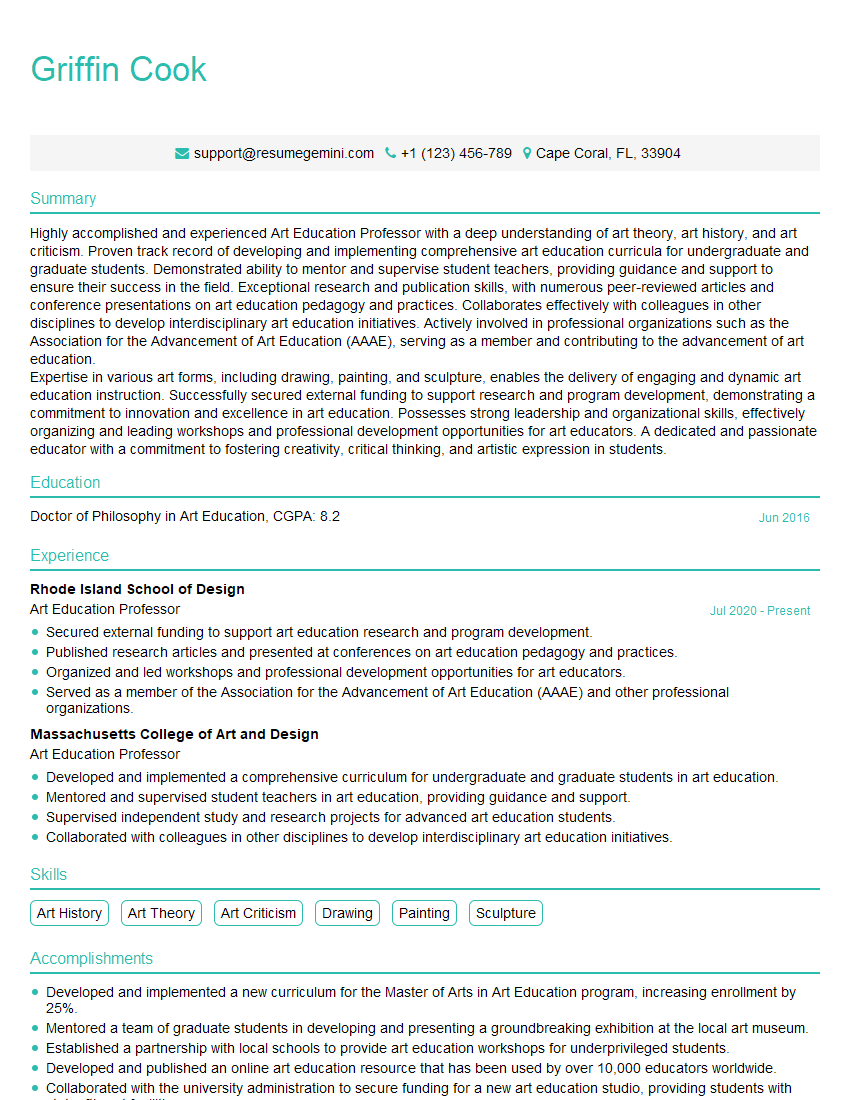
Are you gearing up for an interview for a Art Education Professor position? Whether you’re a seasoned professional or just stepping into the role, understanding what’s expected can make all the difference. In this blog, we dive deep into the essential interview questions for Art Education Professor and break down the key responsibilities of the role. By exploring these insights, you’ll gain a clearer picture of what employers are looking for and how you can stand out. Read on to equip yourself with the knowledge and confidence needed to ace your next interview and land your dream job!
Acing the interview is crucial, but landing one requires a compelling resume that gets you noticed. Crafting a professional document that highlights your skills and experience is the first step toward interview success. ResumeGemini can help you build a standout resume that gets you called in for that dream job.






Essential Interview Questions For Art Education Professor
1. How do you promote critical thinking in your art education classes?
• Engage students in discussions and debates about art and its history.
• Encourage students to analyze and interpret works of art independently.
• Provide students with opportunities to create their own art and reflect on their creative process.
• Incorporate art criticism and analysis into the curriculum.
2. How do you differentiate instruction to meet the needs of diverse learners?
Addressing Learning Styles
• Provide a variety of learning activities that cater to different learning styles (e.g., visual, auditory, kinesthetic).
• Offer flexible learning options such as online resources and individualized pacing.
Accommodating Diverse Backgrounds
• Create a welcoming and inclusive classroom environment that respects and values cultural diversity.
• Incorporate art from various cultures and perspectives into the curriculum.
• Provide opportunities for students to share their own cultural experiences through art.
Addressing Special Needs
• Collaborate with special education teachers and support staff to develop appropriate accommodations.
• Modify assignments and provide assistive technology to support students with disabilities.
3. How do you assess student learning in art education?
• Use a variety of assessment methods to capture student progress, such as:
- Portfolios
- Presentations
- Journals
- Observations
- Written assignments
• Provide students with clear and specific grading rubrics.
• Offer feedback and guidance to help students improve their work.
4. How do you stay up-to-date with current trends and research in art education?
• Attend conferences and workshops
• Read professional journals and books
• Engage in online professional development courses
• Network with other art educators
5. How do you foster creativity and innovation in the classroom?
• Create a safe and supportive environment where students feel comfortable taking risks and expressing themselves.
• Provide open-ended assignments that allow students to explore their own ideas.
• Encourage students to experiment with different materials and techniques.
• Celebrate and showcase student work.
6. How do you engage parents and the community in your art education program?
• Host art exhibitions and events
• Invite parents and community members to participate in art workshops
• Create opportunities for students to share their artwork with the community
• Collaborate with local arts organizations
7. What are your strengths and weaknesses as an art education professor?
• Strengths:
- Strong understanding of art history and theory
- Excellent communication and interpersonal skills
- Passion for teaching and helping students learn
- Experience in developing and implementing innovative art education programs
• Weaknesses:
- Limited experience with online teaching
- Need to improve time management skills
8. Why are you interested in this position?
• I am passionate about art education and believe that it plays a vital role in the development of well-rounded individuals.
• I am excited about the opportunity to join your esteemed institution and contribute to the success of your art education program.
• I am confident that my skills and experience would make me a valuable asset to your team.
9. How do you incorporate technology into your teaching?
• Use digital tools for creating and presenting art
• Incorporate online resources and platforms into the curriculum
• Use social media to connect with students and showcase their work
10. What is your teaching philosophy?
• I believe that art education should be accessible and inclusive to all students.
• I strive to create a supportive and collaborative learning environment where students feel comfortable taking risks and expressing themselves.
• I believe that art education should be relevant to students’ lives and help them develop critical thinking skills, creativity, and problem-solving abilities.
Interviewers often ask about specific skills and experiences. With ResumeGemini‘s customizable templates, you can tailor your resume to showcase the skills most relevant to the position, making a powerful first impression. Also check out Resume Template specially tailored for Art Education Professor.
Career Expert Tips:
- Ace those interviews! Prepare effectively by reviewing the Top 50 Most Common Interview Questions on ResumeGemini.
- Navigate your job search with confidence! Explore a wide range of Career Tips on ResumeGemini. Learn about common challenges and recommendations to overcome them.
- Craft the perfect resume! Master the Art of Resume Writing with ResumeGemini’s guide. Showcase your unique qualifications and achievements effectively.
- Great Savings With New Year Deals and Discounts! In 2025, boost your job search and build your dream resume with ResumeGemini’s ATS optimized templates.
Researching the company and tailoring your answers is essential. Once you have a clear understanding of the Art Education Professor‘s requirements, you can use ResumeGemini to adjust your resume to perfectly match the job description.
Key Job Responsibilities
Art Education Professors are responsible for teaching, research, and service in the field of art education. They work with students to develop their understanding of art and its role in society, and to prepare them for careers in art education.
1. Teaching
Art Education Professors typically teach a variety of courses, including art theory, art history, and art education methods. They also supervise student teachers and mentor graduate students.
- Develop and deliver course lectures and materials.
- Lead discussions and facilitate student learning.
- Supervise student teachers and mentor graduate students.
2. Research
Art Education Professors are expected to conduct research in their field. This research may focus on topics such as the effectiveness of different teaching methods, the development of new curricula, or the role of art in society.
- Conduct research on various aspects of art education.
- Publish research findings in academic journals and present at conferences.
- Collaborate with other researchers in the field.
3. Service
Art Education Professors are often involved in service activities, such as serving on committees, organizing conferences, and providing professional development workshops. They may also work with community organizations to promote art education.
- Serve on committees and participate in professional organizations.
- Organize conferences and workshops.
- Provide professional development to teachers and administrators.
4. Other Responsibilities
In addition to teaching, research, and service, Art Education Professors may also be responsible for advising students, fundraising, and developing new programs.
- Advise students on their academic and career goals.
- Fundraise to support programs and initiatives.
- Develop new programs and curricula.
Interview Tips
Preparing for an interview for an Art Education Professor position can be daunting, but following these tips can help you put your best foot forward and increase your chances of success:
1. Research the job and the institution
Before you go to your interview, take some time to research the job and the institution. This will help you understand the specific requirements of the position and the culture of the school. You can find most of this information on the school’s website.
- Review the job description carefully.
- Visit the school’s website.
- Talk to people who know about the school and the position.
2. Prepare your answers to common interview questions
There are a few common interview questions that you can expect to be asked, such as “Tell me about yourself” and “Why are you interested in this position?” It is important to practice your answers to these questions so that you come across as confident and prepared.
- Prepare your answers to common interview questions.
- Practice your answers with a friend or family member.
- Be prepared to talk about your teaching experience, research, and service.
3. Bring your portfolio and teaching materials
If you are asked to bring a portfolio or teaching materials to your interview, be sure to do so. This will give the interviewer a chance to see your work and get a better sense of your teaching style.
- Bring a portfolio of your work.
- Bring examples of your teaching materials.
- Be prepared to discuss your teaching philosophy.
4. Dress professionally and arrive on time
First impressions matter, so be sure to dress professionally and arrive on time for your interview. This will show the interviewer that you are serious about the position and that you respect their time.
- Dress professionally.
- Arrive on time for your interview.
- Be respectful of the interviewer’s time.
5. Be yourself and be confident
The most important thing is to be yourself and be confident. The interviewer wants to get to know the real you, so don’t try to be someone you’re not. Just relax, be yourself, and let your passion for art education shine through.
- Be yourself.
- Be confident.
- Let your passion for art education shine through.
Next Step:
Now that you’re armed with interview-winning answers and a deeper understanding of the Art Education Professor role, it’s time to take action! Does your resume accurately reflect your skills and experience for this position? If not, head over to ResumeGemini. Here, you’ll find all the tools and tips to craft a resume that gets noticed. Don’t let a weak resume hold you back from landing your dream job. Polish your resume, hit the “Build Your Resume” button, and watch your career take off! Remember, preparation is key, and ResumeGemini is your partner in interview success.